. 2017 Apr 14;17(1):53.
doi: 10.1186/s12876-017-0605-x.

Lactobacillus casei DG and its postbiotic reduce the inflammatory mucosal response: an ex-vivo organ culture model of post-infectious irritable bowel syndrome

Affiliations

Lactobacillus casei DG and its postbiotic reduce the inflammatory mucosal response: an ex-vivo organ culture model of post-infectious irritable bowel syndrome

Debora Compare et al. BMC Gastroenterol. .

Abstract

Background: The evidence on the role of gut microbiota in post-infectious irritable bowel syndrome (PI-IBS) is convincing. Lactobacillus spp. positively affect IBS symptoms, although the mechanisms through which probiotics exert their beneficial effects are largely unknown. The aim of the study is to evaluate the role of Lactobacillus casei DG (LC-DG) and its postbiotic (PB) in modulating the inflammatory/immune-response in PI-IBS in an ex-vivo organ culture model.

Methods: Ex vivo cultures of ileal and colonic mucosa from 10 PI-IBS, diarrhea predominant subtype (D) patients, and 10 healthy controls (HC) were treated with LPS, LC-DG and PB. Interleukin (IL)-1α, IL-6, IL-8 and IL-10 mRNA levels were assessed by real-time PCR and Toll like receptor 4 (TLR-4) protein expression by Western blotting.

Results: At baseline, IL-1α, IL-6 and IL-8 mRNA levels as well as TLR-4 protein expression were significantly higher while IL-10 mRNA levels were lower in PI-IBS D than in HC in both ileum and colon. LC-DG and PB significantly reduced the mRNA levels of pro-inflammatory cytokines and TLR-4 while increased that of IL-10 after LPS stimulation. The protective effect was more pronounced for PB than LC-DG treatment.

Conclusion: LC-DG and its PB attenuate the inflammatory mucosal response in an ex-vivo organ culture model of PI-IBS D.

Keywords: Post-infectious irritable bowel syndrome; Postbiotic; Probiotics.


Figures
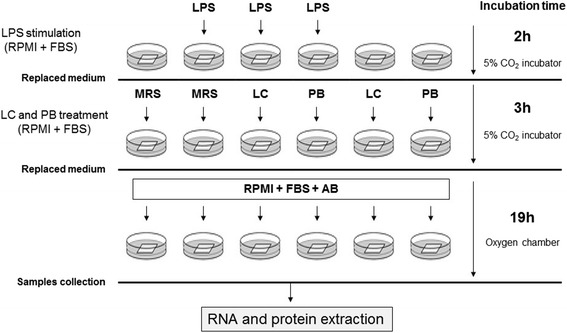
Fig. 1
Fig. 1
Schematic diagram of the experimental procedures
Fig. 2
Fig. 2
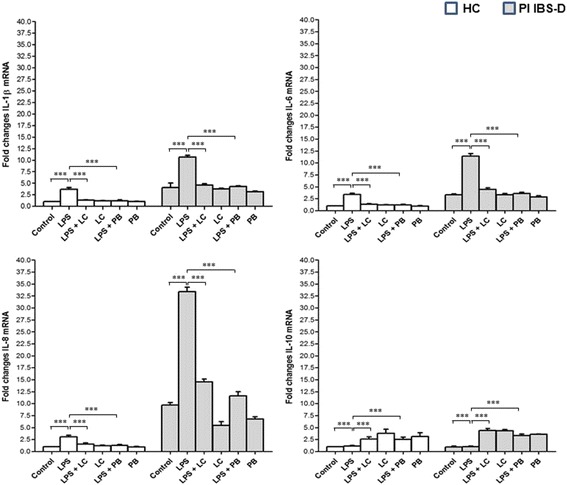
Fold changes in mRNA levels of IL-1α, IL-6, IL-8 and IL-10 in the ileal mucosa of HC and IBS-D patients. IL-1α, IL-6 and IL-8 mRNA baseline levels were higher and IL-10 mRNA levels were lower in post-infectious IBS-D than HC. The stimulation of intestinal mucosa with 100 μg/ml LPS significantly increased mRNA levels of all cytokines in respect to baseline in both HC and PI-IBS D patients. In contrast, LPS treatment did not affect IL-10 mRNA levels in both HC and IBS-D. LC-DG treatment was effective in reducing IL-1α and IL-8 mRNA levels and increasing IL-10 m-RNA levels. PB treatment was effective in reducing IL-1α, IL-6 and IL-8 mRNA levels and increasing IL-10 m-RNA levels. ***p < 0.0001. HC: healthy controls; PI IBS-D: post-infectious irritable bowel disease diarrhea subtype; LPS: lipopolysaccharide; LC: Lactobacillus Casei DG; PB: postbiotic
Fig. 3
Fig. 3
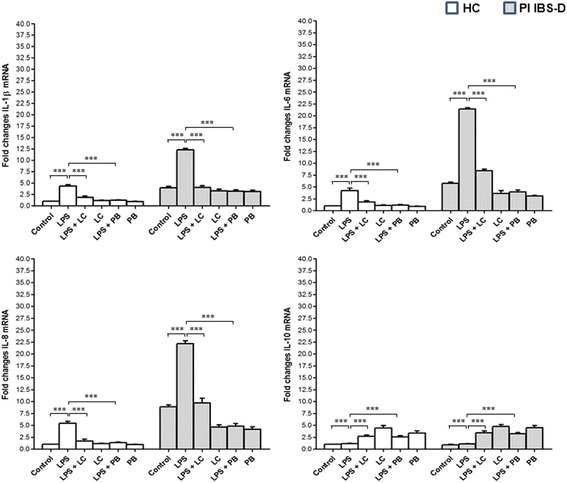
Fold changes in mRNA levels of IL-1α, IL-6, IL-8 and IL-10 in the left colon mucosa of HC and IBS-D patients. IL-1α, IL-6 and IL-8 mRNA baseline levels were higher and IL-10 mRNA levels were lower in PI-IBS D than HC. The stimulation of intestinal mucosa with 100 μg/ml LPS significantly increased mRNA levels of all cytokines in respect to baseline in both HC and PI-IBS D patients. In contrast, LPS treatment did not affect IL-10 mRNA levels in both HC and IBS-D. LC-DG and PB treatment were effective in reducing IL-1α, IL-6 and IL-8 mRNA levels and increasing IL-10 m-RNA levels. ***p < 0.0001. HC: healthy controls; PI IBS-D: post-infectious irritable bowel disease diarrhea subtype; LPS: lipopolysaccharide; LC: Lactobacillus Casei DG; PB: postbiotic
Fig. 4
Fig. 4
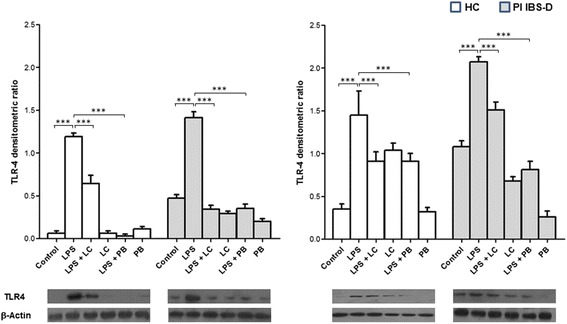
TLR-4 protein expression in ileal and left colon mucosa of HC and IBS-D patients. TLR-4 protein baseline levels were higher in PI-IBS D patients in respect to HC in both ileal and colonic mucosa. The stimulation of intestinal mucosa with 100 μg/ml LPS increased TLR-4 protein expression in both HC and IBS-D patients with a more pronounced effect in colonic mucosa. LC-DG and PB treatment reduced TLR-4 protein expression in both HC and IBS-D patients particularly in ileal mucosa. ***p < 0.0001. HC: healthy controls; PI IBS-D: post-infectious irritable bowel disease diarrhea subtype; LPS: lipopolysaccharide; LC: Lactobacillus Casei DG; PB: postbiotic

References

    1. Lovell RM, Ford AC. Global prevalence of and risk factors for irritable bowel syndrome: a meta-analysis. Clin Gastroenterol Hepatol. 2012;10:712–721.e4. doi: 10.1016/j.cgh.2012.02.029. - DOI - PubMed
    1. Canavan C, West J, Card T. Review article: the economic impact of the irritable bowel syndrome. Aliment Pharmacol Ther. 2014;40:1023–34. doi: 10.1111/apt.12938. - DOI - PubMed
    1. Shih DQ, Kwan LY. All roads lead to Rome: update on Rome III criteria and new treatment options. Gastroenterol Rep. 2007;1:56–65. - PMC - PubMed
    1. Chey WD, Kurlander J, Eswaran S. Irritable bowel syndrome: a clinical review. JAMA. 2015;313:949–58. doi: 10.1001/jama.2015.0954. - DOI - PubMed
    1. Dupont HL. Review article: evidence for the role of gut microbiota in irritable bowel syndrome and its potential influence on therapeutic targets. Aliment Pharmacol Ther. 2014;39:1033–42. doi: 10.1111/apt.12728. - DOI - PubMed

MeSH terms