. 2017 May:119:479-489.
doi: 10.1016/j.phrs.2016.11.036.

Single molecule force spectroscopy for in-situ probing oridonin inhibited ROS-mediated EGF-EGFR interactions in living KYSE-150 cells

Affiliations

Single molecule force spectroscopy for in-situ probing oridonin inhibited ROS-mediated EGF-EGFR interactions in living KYSE-150 cells

Jiang Pi et al. Pharmacol Res. 2017 May.

Abstract

As the active anticancer component of Rabdosia Rubescens, oridonin has been proved to show strong anticancer activity in cancer cells, which is also found to be closely related to its specific inhibition effects on the EGFR tyrosine kinase activity. In this study, atomic force microscopy based single molecule force spectroscopy (AFM-SMFS) was used for real-time and in-situ detection of EGF-EGFR interactions in living esophageal cancer KYSE-150 cells to evaluate the anticancer activity of oridonin for the first time. Oridonin was found to induce apoptosis and also reduce EGFR expression in KYSE-150 cells. AFM-SMFS results demonstrated that oridonin could inhibit the binding between EGF and EGFR in KYSE-150 cells by decreasing the unbinding force and binding probability for EGF-EGFR complexes, which was further proved to be closely associated with the intracellular ROS level. More precise mechanism studies based on AFM-SMFS demonstrated that oridonin treatment could decrease the energy barrier width, increase the dissociation off rate constant and decrease the activation energy of EGF-EGFR complexes in ROS dependent way, suggesting oridonin as a strong anticancer agent targeting EGF-EGFR interactions in cancer cells through ROS dependent mechanism. Our results not only suggested oridonin as a strong anticancer agent targeting EGF-EGFR interactions in ROS dependent mechanism, but also highlighted AFM-SMFS as a powerful technique for pharmacodynamic studies by detecting ligand-receptor interactions, which was also expected to be developed into a promising tool for the screening and mechanism studies of drugs.

Keywords: Atomic force microscopy; EGFR; Esophageal cancer; Oridonin; Single molecule force spectroscopy.


Conflict of interest statement

Conflict of interests

The authors declare that they have no conflict of interests.

Figures
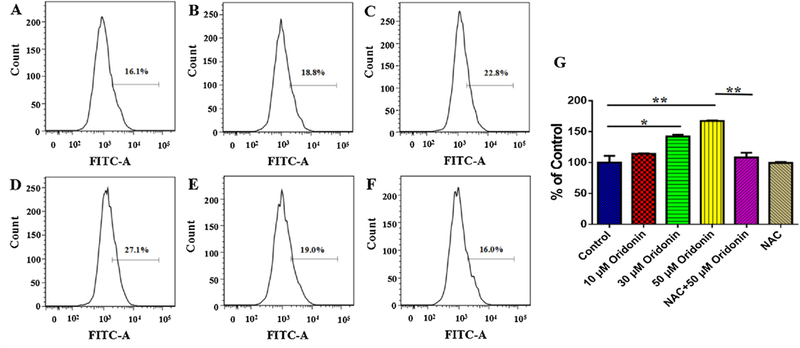
Fig. 1.
Fig. 1.
Effects of oridonin on intracellular ROS level of KYSE-150 cells. (A) Control KYSE-150 cells, (B) 10 μM oridonin treated KYSE-150 cells, (C) 30 μM oridonin treated KYSE-150 cells, (D) 50 μM oridonin treated KYSE-150 cells, (E) 2.5 μM MNAC and 50 μM oridonin treated KYSE-150 cells, (F) 2.5Μm MNAC treated KYSE-150 cells. (G) Statistical results of oridonin induced ROS production in KYSE-150 cells, data was expressed as mean ± S.E.M. from three independent experiments, *p < 0.05, **p < 0.01.
Fig. 2.
Fig. 2.
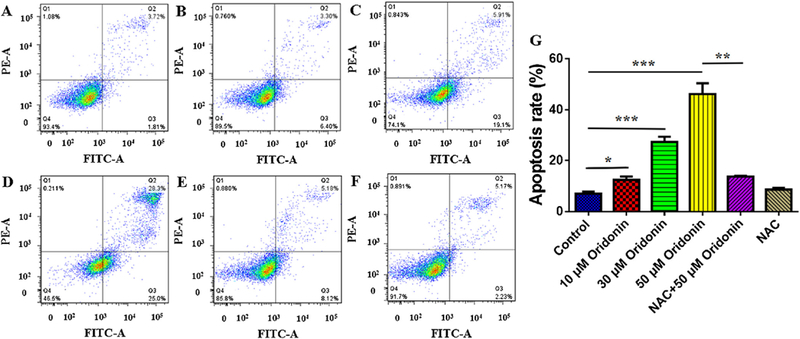
Effects of oridonin on apoptosis of KYSE-150 cells. (A) Control KYSE-150 cells, (B) 10 μM oridonin treated KYSE-150 cells, (C) 30 μM oridonin treated KYSE-150 cells,(D) 50 μM oridonin treated KYSE-150 cells, (E) 2.5 μM MNAC and 50 μM oridonin treated KYSE-150 cells, (F) 2.5 μM MNAC treated KYSE-150 cells. (G) Statistical results of oridonin induced KYSE-150 cell apoptosis, data was expressed as mean ± S.E.M. from three independent experiments, *p < 0.05, **p < 0.01, ***p < 0.001.
Fig. 3.
Fig. 3.
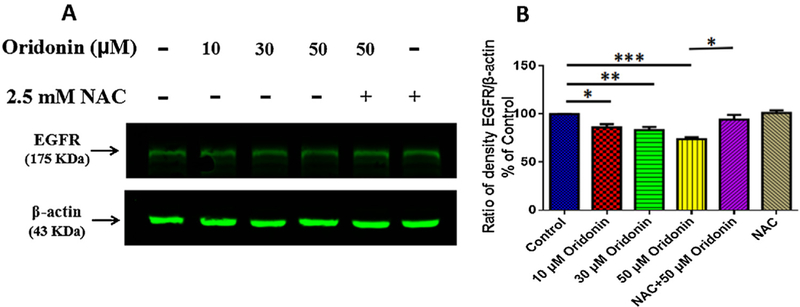
Effects of oridonin on EGFR expression of KYSE-150 cells. (A) Western blot analysis of EGFR expression in KYSE-150 cells. (B) Statistical results of the effects of oridonin on EGFR expression in KYSE-150 cells, data was expressed as mean ± S.E.M. from three independent experiments, *p < 0.05, **p < 0.01, ***p < 0.001.
Fig. 4.
Fig. 4.
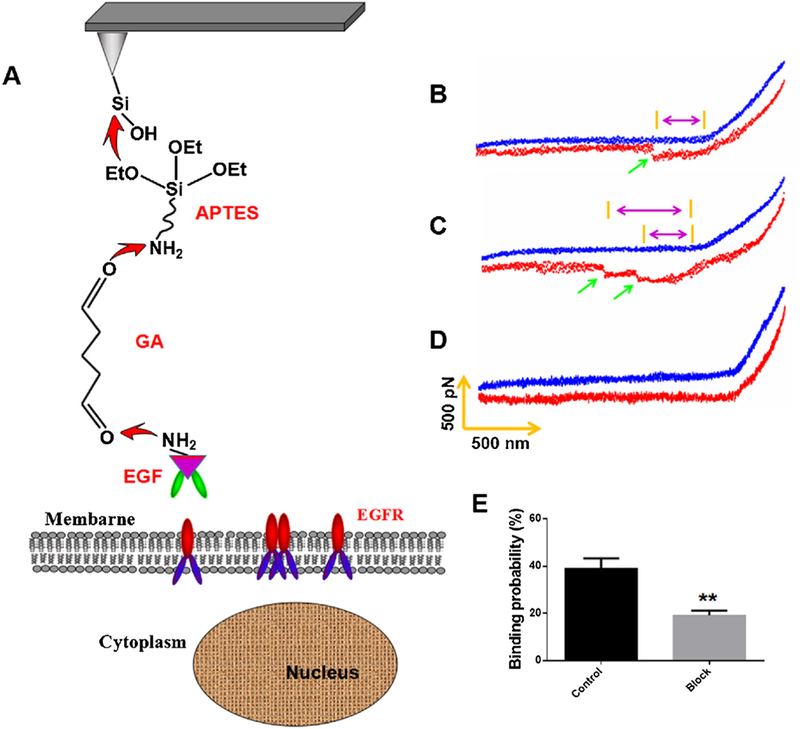
AFM force measurements with EGF-functionalized AFM tip on living KYSE-150 cells. (A) AFM tip functionalization procedure and schematic representation of the single-molecule force measurement between EGF-functionalized AFM tips and EGFR in KYSE-150 cells. (B, C) Representative force curves obtained with EGF-modified AFM tips in KYSE-150 cells, and (D) after the system was blocked with free anti-EGFR antibody. (E) The binding probability of EGF-functionalized tips in KYSE-150 cells before and after blocking, data was expressed as mean ± S.E.M. from four independent experiments, and in each experiments, more than 1000 force curves were measured on living cells, **p < 0.01.
Fig. 5.
Fig. 5.
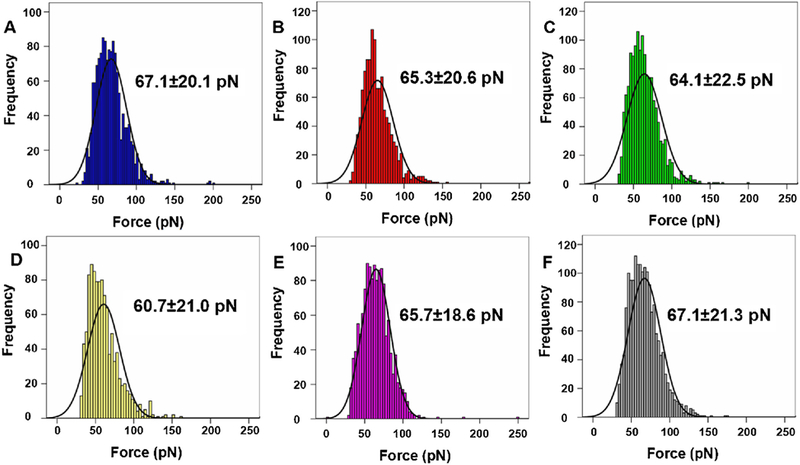
Unbinding forces measured on the surface of KYSE-150 cells by EGF-functionalized AFM tips. Histogram of unbinding forces of EGF-EGFR complexes obtained on (A) control KYSE-150 cells, (B) 10 μM oridonin treated KYSE-150 cells, (C) 30 μM oridonin treated KYSE-150 cells, (D) 50 μM oridonin treated KYSE-150 cells, (E) 2.5 μM MNAC and 50 μM oridonin treated KYSE-150 cells, (F) 2.5 μM MNAC treated KYSE-150 cells. The black lines in the histograms are the corresponding Gaussian fits. Data was expressed as mean ± S.D., n > 6000.
Fig. 6.
Fig. 6.
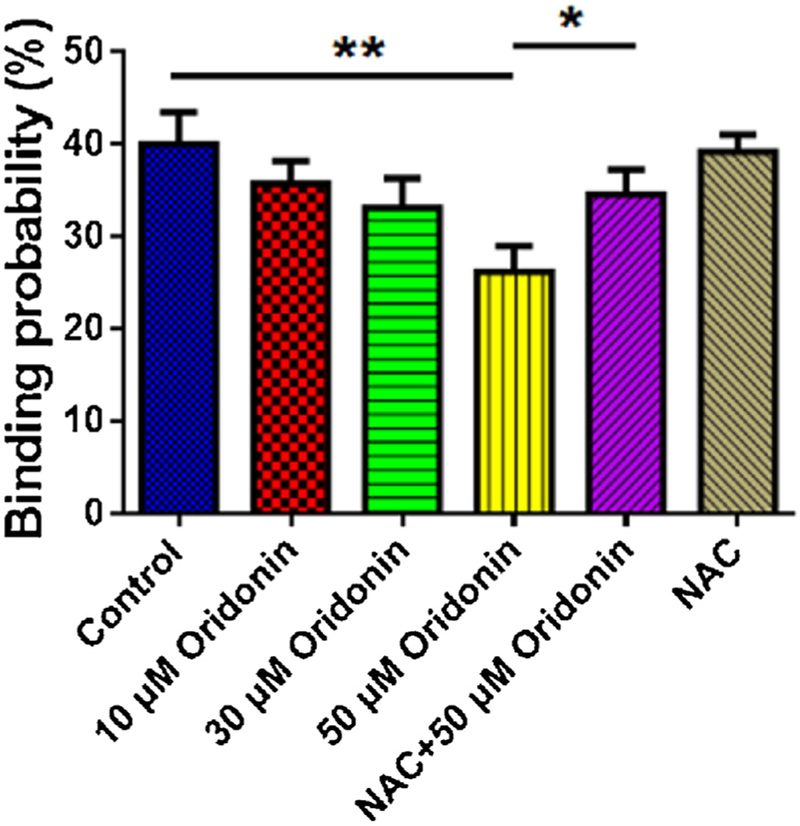
Effects of oridonin on the binding probability for EGF-EGFR complex in KYSE-150 cells, data was expressed as mean ± S.E.M. from five independent experiments, and in each experiments, more than 1000 force curves were calculated, *p < 0.05, **p < 0.01.
Fig. 7.
Fig. 7.
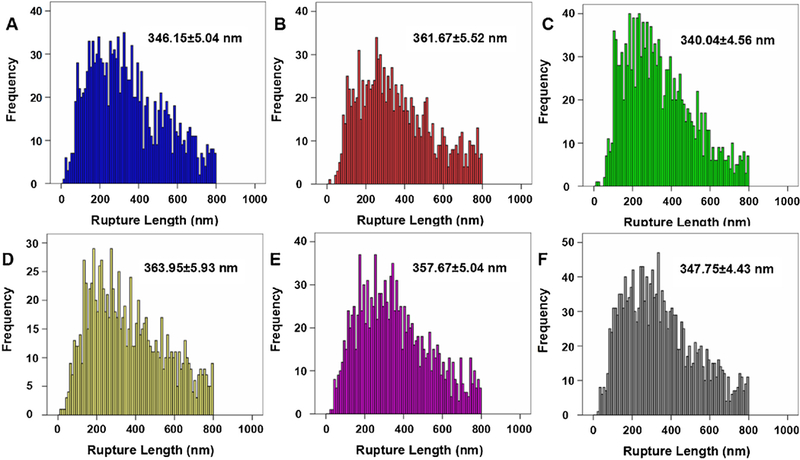
Histogram distribution of the rupture length for EGF-EGFR complex in KYSE-150 cells. Rupture length for EGF-EGFR complex obtained on (A) control KYSE-150 cells, (B) 10 μM oridonin treated KYSE-150 cells, (C) 30 μM oridonin treated KYSE-150 cells, (D) 50 μM oridonin treated KYSE-150 cells, (E) 2.5 mM NAC and 50 μM oridonin treated KYSE-150 cells, (F) 2.5 mM NAC treated KYSE-150 cells by EGF-functionalized AFM tips. Data was expressed as mean ± S.D., n > 6000.
Fig. 8.
Fig. 8.
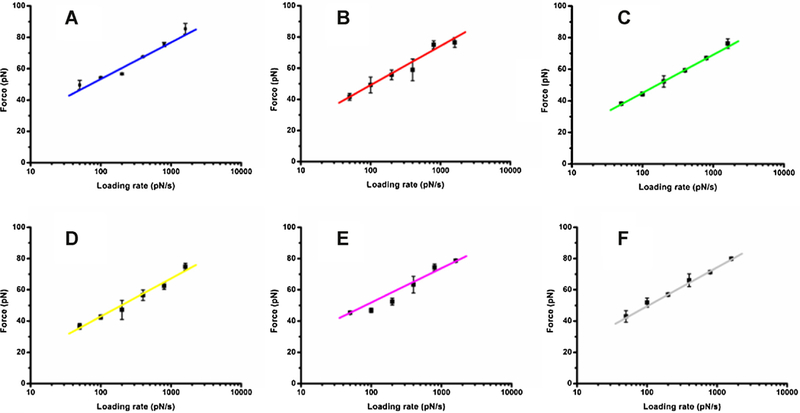
Effects of oridonin on the dynamic force spectra for EGF-EGFR complex in KYSE-150 cells. (A) Control KYSE-150 cells, (B) 10 μM oridonin treated KYSE-150 cells,(C) 30 μM oridonin treated KYSE-150 cells, (D) 50 μM oridonin treated KYSE-150 cells, (E) 2.5 μM MNAC and 50 μM oridonin treated KYSE-150 cells, (F) 2.5 μM MNAC treated KYSE-150 cells. Forces were measured at different loading rates by EGF-modified tips and each data point represented the mean value of three independent experiments with about 1000 effective force curves.
Fig. 9.
Fig. 9.
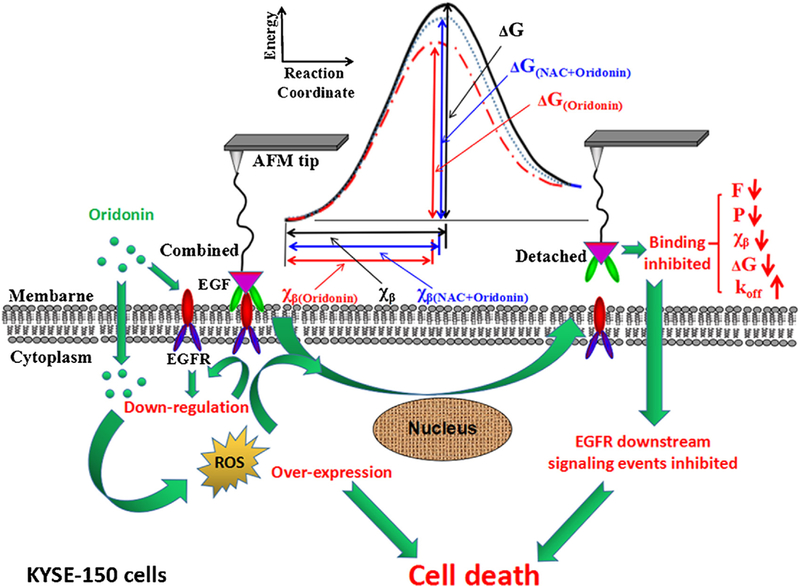
Schematic diagram illustrating the molecular mechanism of oridonin inhibited EGF-EGFR binding and cell death by ROS dependent way in KYSE-150 cells. F, P, xβ, koff and ΔG is the unbinding force, binding probability, energy barrier width, dissociation off-rate constant and activation energy for EGF-EGFR complex on the surface of KYSE-150 cells, respectively.

References

    1. Oda K, Matsuoka Y, Funahashi A, Kitano H, A comprehensive pathway map of epidermal growth factor receptor signaling, Mol. Syst. Biol 1 (2005) (2005) 0010. - PMC - PubMed
    1. Appert-Collin A, Hubert P, Cremel G, Bennasroune A, Role of erbb receptors in cancer cell migration and invasion, Front. Pharmacol 6 (2015) 283. - PMC - PubMed
    1. Mitsudomi T, Yatabe Y, Epidermal growth factor receptor in relation to tumor development: egfr gene and cancer, FEBS J 277 (2010) 301–308. - PubMed
    1. Lin G, Sun XJ, Han QB, Wang Z, Xu YP, Gu JL, Wu W, Zhang GU, Hu JL, Sun WY, Mao WM, Epidermal growth factor receptor protein overexpression and gene amplification are associated with aggressive biological behaviors of esophageal squamous cell carcinoma, Oncol. Lett 10 (2015) 901–906. - PMC - PubMed
    1. Cui Y, Dong C, Wu BQ, Duan XC, Shi G, Gong M, Wang TY, Expression of cyclooxygenase-2, vascular endothelial growth factor, and epidermal growth factor receptor in chinese patients with esophageal squamous cell carcinoma, J. Cancer Res. Ther 11 (Suppl. 1) (2015) C44–C48. - PubMed

MeSH terms