


No Acute Changes in LVEF Observed With Concurrent Trastuzumab and Breast Radiation With Low Heart Doses
- PMID: 28412326
- PMCID: PMC7710666
- DOI: 10.1016/j.clbc.2017.03.011
No Acute Changes in LVEF Observed With Concurrent Trastuzumab and Breast Radiation With Low Heart Doses
Abstract
Introduction/background: Treatment for HER2-postitive breast cancer often includes trastuzumab, breast/chest wall (CW) radiation (RT), and anthracyclines, all of which have cardiac toxicity. We aimed to evaluate the relationship between heart dose and acute left ventricular ejection fraction (LVEF) changes in patients who received concurrent trastuzumab and breast/CW RT with and without anthracycline use.
Patients and methods: We retrospectively reviewed all nonmetastatic breast cancer patients from 2008 to 2015 who received concurrent trastuzumab and breast/CW RT. Baseline LVEF was compared with the LVEF closest to treatment completion as well as with the lowest post-treatment LVEF. LVEF changes were correlated with laterality, heart dosimetric parameters, and doxorubicin use.
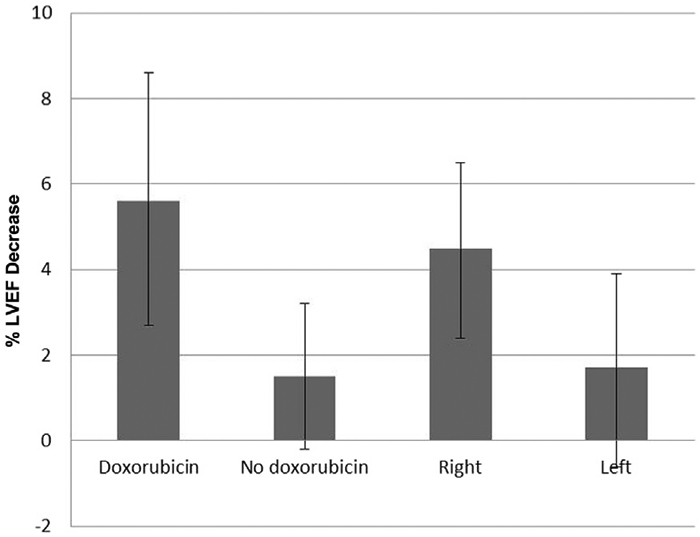
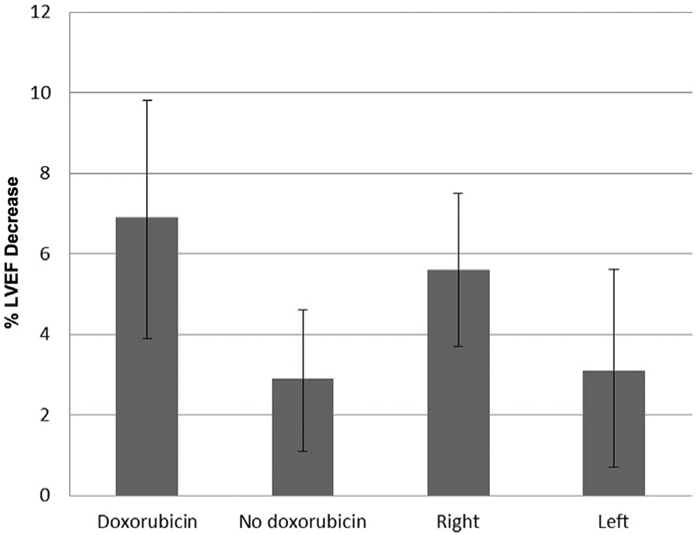
Results: Eighty-eight patients were included in our analysis. The median follow-up was 45 months. Forty-one patients were right-sided and 47 left-sided. Thirty-one patients received doxorubicin, 16 right-sided and 15 left-sided. Mean heart dose was 1.10 Gy and 3.63 Gy for right- and left-sided patients, respectively (P < .001). In the entire cohort, a significant LVEF decrease of 3.0% was observed pre- and post-treatment. There was a significant effect of doxorubicin (P = .013) and a nonsignificant effect of RT laterality (P = .088) on LVEF change. The test of interaction between doxorubicin and laterality was not significant (P = .90). No significant association was found between LVEF change and heart dosimetric parameters, including percent volume of heart receiving 5 Gy (V5), 10 Gy (V10), 20 Gy (V20), and 45 Gy (V45), and maximum dose. Similar results were found when baseline LVEF was compared with the lowest post-treatment LVEF.
Conclusion: With cardiac doses < 4 Gy, declines in LVEF were not related to tumor laterality or heart dosimetric parameters. Statistically significant LVEF decreases were mainly attributed to doxorubicin.
Keywords: Breast; Cardiac toxicity; Herceptin; Radiation; Trastuzumab.
Copyright © 2017 Elsevier Inc. All rights reserved.
Conflict of interest statement
Disclosure
The authors have stated that they have no conflicts of interest.
Figures
Comment in
-
Cardiac Morbidity and Radiation Therapy for Breast Cancer.Int J Radiat Oncol Biol Phys. 2018 Feb 1;100(2):283-286. doi: 10.1016/j.ijrobp.2017.06.2443. Int J Radiat Oncol Biol Phys. 2018. PMID: 29353643 No abstract available.
References
-
- Pietras RJ, Poen JC, Gallardo D, et al. Monoclonal antibody to HER2/neureceptor modulates repair of radiation-induced DNA damage and enhances radiosensitivity of human breast cancer cells overexpressing this oncogene. Cancer Res 1999; 59:1347–55. - PubMed
-
- De Azambuja E, Procter MJ, Van Veldhuisen DJ, et al. Trastuzumab-associated cardiac events at 8 years of median follow-up in the herceptin adjuvant trial (BIG 1-01). J Clin Oncol 2014; 32:2159–65. - PubMed
-
- Tan-Chiu E, Yothers G, Romond E, et al. Assessment of cardiac dysfunction in a randomized trial comparing doxorubicin and cyclophosphamide followed by paclitaxel, with or without trastuzumab as adjuvant therapy in node-positive, human epidermal growth factor receptor 2-overexpressing breast can. J Clin Oncol 2005; 23:7811–9. - PubMed
-
- Darby SC, Ewertz M, McGale P, et al. Risk of ischemic heart disease in women after radiotherapy for breast cancer. N Engl J Med 2013; 368:987–98. - PubMed
MeSH terms
Substances
Grants and funding
LinkOut - more resources
Full Text Sources
Other Literature Sources
Medical
Research Materials
Miscellaneous
