Review
doi: 10.14797/mdcj-13-1-37.
A Case of Iatrogenic Aortic Intramural Hematoma
Affiliations
- PMID: 28413582
- PMCID: PMC5385795
- DOI: 10.14797/mdcj-13-1-37
Item in Clipboard
Review
A Case of Iatrogenic Aortic Intramural Hematoma
Methodist Debakey Cardiovasc J.
2017 Jan-Mar.
Abstract
Iatrogenic aortic dissection during percutaneous coronary intervention is a rare but serious complication. Both conservative and surgical approaches have been proposed as management strategies. We describe a case of an 87-year-old female who presented with an acute coronary syndrome complicated by the development of an ascending aortic dissection during percutaneous intervention, and we provide a brief review of the literature.
Keywords: iatrogenic aortic dissection; percutaneous coronary intervention.
Conflict of interest statement
The authors have completed and submitted the Methodist DeBakey Cardiovascular Journal Conflict of Interest Statement and none were reported.
Figures
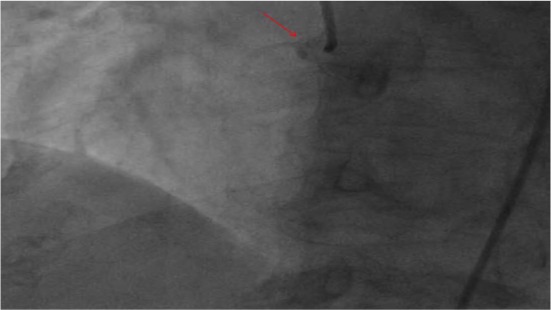
Coronary angiogram showing a proximal right coronary artery (RCA) occlusion. See online video 1.
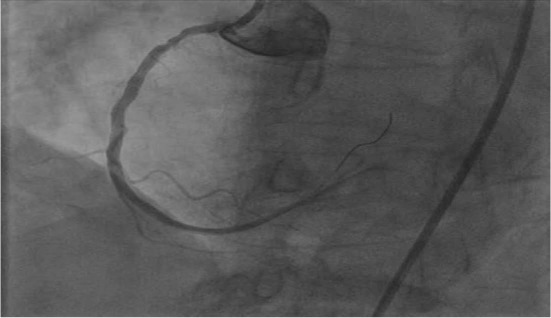
Percutanous intervention with stent deployment in the proximal right coronary artery. See online video 2.
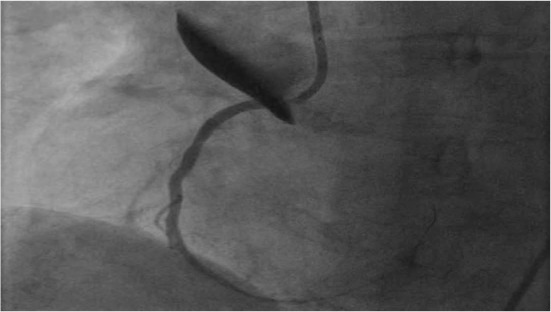
Contrast injection after stent deployment resulting in acute dissection of the right coronary cusp with extension into the proximal ascending aorta. See online video 3.
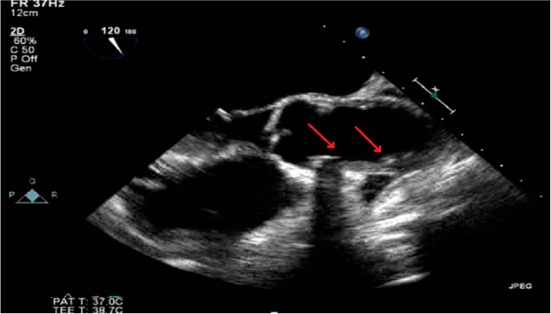
Transesophageal echocardiogram showing an ascending aortic intramural hematoma (red arrows).
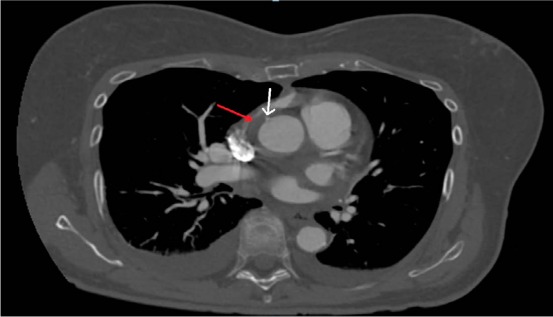
Computed tomography (CT) scan showed a small aortic intimal tear (white arrow) with an associated intramural hematoma (red arrow).
References
-
- Yip HK, Wu CJ, Yeh KH, . et al. Unusual complication of retrograde dissection to the coronary sinus of valsalva during percutaneous revascularization: a single-center experience and literature review. Chest. 2001. February; 119( 2): 493– 501. - PubMed
-
- Pérez-Castellano N, García-Fernández MA, García EJ, Delcán JL.. Dissection of the aortic sinus of valsalva complicating coronary catheterization: cause, mechanism, evolution, and management. Cathet Cardiovasc Diagn. 1998. March; 43( 3): 273– 9. - PubMed
-
- Doyle B, Juergens CP. Conservative management of ascending aortic dissection caused by percutaneous coronary intervention. J Invasive Cardiol. 2004. February; 16( 2): 92– 4. - PubMed
-
- Minicucci F, Galizia G, Ascione L, . et al. Iatrogenic aortic haematoma during primary PTCA: Diagnostic value of transesophageal echocardiography in cath lab. Eur J Echocardiography. 2006. October; 7( 5): 390– 3. - PubMed
Publication types
MeSH terms
LinkOut - more resources
Full Text Sources
Other Literature Sources
Medical