


Cerebrospinal fluid biomarkers for Alzheimer's disease in Down syndrome
- PMID: 28413821
- PMCID: PMC5384293
- DOI: 10.1016/j.dadm.2017.02.006
Cerebrospinal fluid biomarkers for Alzheimer's disease in Down syndrome
Abstract
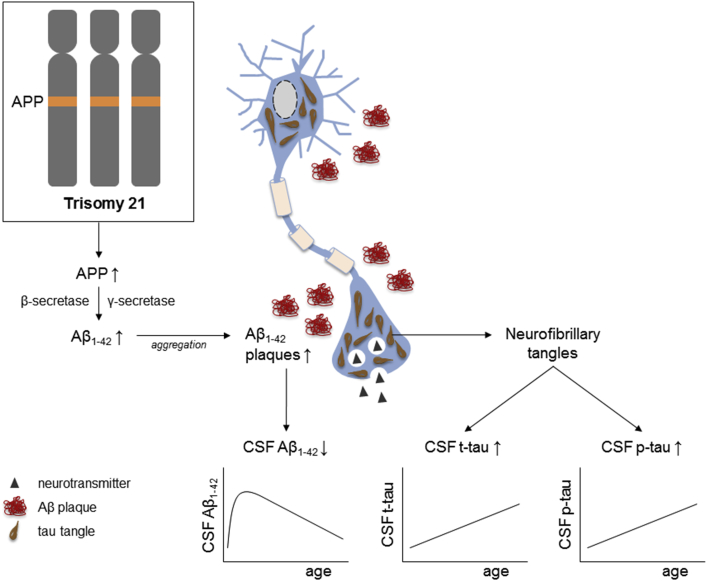
Down syndrome (DS), present in nearly six million people, is associated with an extremely high risk to develop Alzheimer's disease (AD). Amyloid-β and tau pathology are omnipresent from age 40 years onward, but clinical symptoms do not appear in all DS individuals. Dementia diagnostics is complex in this population, illustrating the great need for predictive biomarkers. Although blood biomarkers have not yet proven useful, cerebrospinal fluid (CSF) biomarkers (low amyloid-β42, high t-tau, and high p-tau) effectively contribute to AD diagnoses in the general population and are increasingly used in clinical practice. Surprisingly, CSF biomarkers have been barely evaluated in DS. Breaking the taboo on CSF analyses would finally allow for the elucidation of its utility in (differential) diagnoses and staging of disease severity. A sensitive and specific biomarker profile for AD in DS would be of paramount importance to daily care, adaptive caregiving, and specific therapeutic interventions.
Keywords: Alzheimer's disease; Biomarkers; Cerebrospinal fluid; Dementia; Down syndrome.
Figures
References
-
- Ballard C., Mobley W.C., Hardy J., Williams G., Corbett A. Dementia in Down's syndrome. Lancet Neurol. 2016;15:622–636. - PubMed
-
- Bittles A.H., Bower C., Hussain R., Glasson E.J. The four ages of Down syndrome. Eur J Public Health. 2007;17:221–225. - PubMed
-
- Alzheimer's Assocation 2016 Alzheimer's disease facts and figures. Alzheimers Dement. 2016;12:459–509. - PubMed
-
- Glasson E.J., Sullivan S.G., Hussain R., Petterson B.A., Montgomery P.D., Bittles A.H. Comparative survival advantage of males with Down syndrome. Am J Hum Biol. 2003;15:192–195. - PubMed
LinkOut - more resources
Full Text Sources
Other Literature Sources