


EMT-like circulating tumor cells in ovarian cancer patients are enriched by platinum-based chemotherapy
- PMID: 28415744
- PMCID: PMC5564727
- DOI: 10.18632/oncotarget.16179
EMT-like circulating tumor cells in ovarian cancer patients are enriched by platinum-based chemotherapy
Abstract
Background: Assuming that tumor cell dissemination requires a shift to a mesenchymal phenotype, we analyzed the incidence of epithelial-to-mesenchymal-transition (EMT)-like circulating tumor cells (CTCs) in ovarian cancer patients and inquired, how their molecular phenotypes respond to platinum-based chemotherapy and influence outcome.
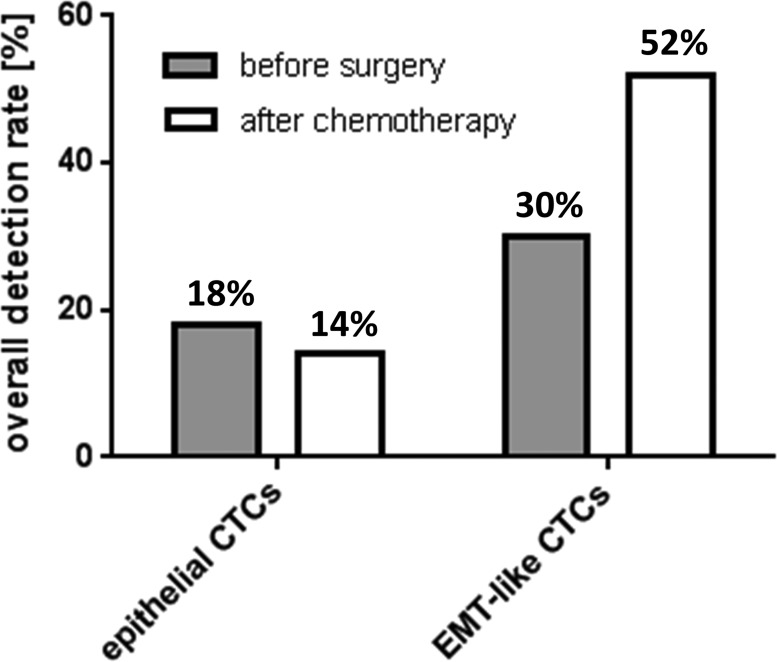
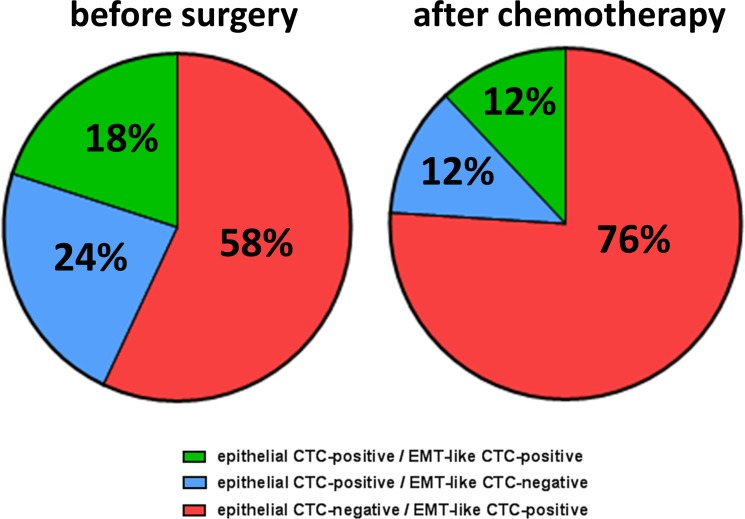
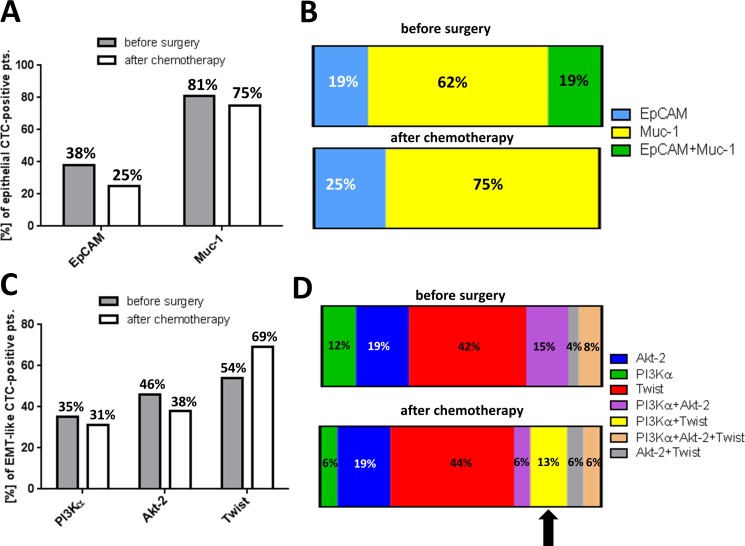
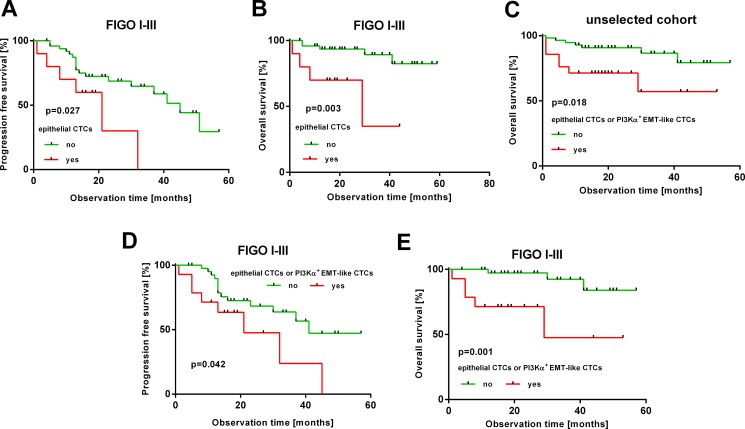
Results: Before surgery, overall detection rate for epithelial CTCs was 18%. EMT-like CTCs were more frequently observed (30%) and were mutually exclusive to epithelial CTCs in the majority of patients (82%). After chemotherapy, EMT-like CTCs increased up to 52%, accompanied by the "de novo" emergence of PI3Kα+/Twist+ EMT-like CTCs. Before surgery, PI3K+ EMT-like CTCs in combination with epithelial CTCs indicated decreased OS (p = 0.02) and FIGO I-III patients with residual tumor burden after surgery were more likely to be positive for EMT-like CTCs after chemotherapy (p = 0.02). In the latter group, epithelial CTCs alone significantly correlated with decreased PFS and OS (p = 0.02, p = 0.002), supported by an additional inclusion of PI3K+ CTCs (OS, p = 0.001).
Materials and methods: Blood samples of 91 ovarian cancer patients before surgery and 31 matched samples after adjuvant chemotherapy were evaluated for CTCs with the AdnaTest ovarian cancer and EMT-1, analyzing the epithelial-associated transcripts EpCAM, Muc-1 and CA125 and the EMT-associated transcripts PI3Kα, Akt-2 and Twist.
Conclusions: Platinum-based chemotherapy seems to select for EMT-like CTCs in ovarian cancer patients and provokes a shift towards PI3Kα and Twist expressing CTCs, which may reflect clonal tumor evolution towards therapy resistance. It has to be determined, whether this CTC subgroup may serve as a biomarker to identify patients at high risk.
Keywords: Akt-2; PI3Kα; circulating tumor cells; epithelial-to-mesenchymal-transition; ovarian cancer.
Conflict of interest statement
Sabine Kasimir-Bauer is a consultant for QIAGEN, Hilden, Germany.
Siegfried Hauch is an employee of QIAGEN, Hilden, Germany.
All other authors declare that they have no conflict of interest.
Figures
References
-
- Goodman MT, Howe HL, Tung KH, Hotes J, Miller BA, Coughlin SS, Chen VW. Incidence of ovarian cancer by race and ethnicity in the United States, 1992–1997. Cancer. 2003;97:2676–2685. - PubMed
-
- du Bois A, Quinn M, Thigpen T, Vermorken J, Avall-Lundqvist E, Bookman M, Bowtell D, Brady M, Casado A, Cervantes A, Eisenhauer E, Friedlaender M, Fujiwara K, et al. 2004 consensus statements on the management of ovarian cancer: final document of the 3rd International Gynecologic Cancer Intergroup Ovarian Cancer Consensus Conference (GCIG OCCC 2004) Ann Oncol. 2005;16:viii7–viii12. - PubMed
-
- du Bois A, Reuss A, Pujade-Lauraine E, Harter P, Ray-Coquard I, Pfisterer J. Role of surgical outcome as prognostic factor in advanced epithelial ovarian cancer: a combined exploratory analysis of 3 prospectively randomized phase 3 multicenter trials: by the Arbeitsgemeinschaft Gynaekologische Onkologie Studiengruppe Ovarialkarzinom (AGO-OVAR) and the Groupe d'Investigateurs Nationaux Pour les Etudes des Cancers de l'Ovaire (GINECO) Cancer. 2009;115:1234–1244. - PubMed
-
- Wimberger P, Lehmann N, Kimmig R, Burges A, Meier W, Du Bois A, Arbeitsgemeinschaft Gynaekologische Onkologie Ovarian Cancer Study G Prognostic factors for complete debulking in advanced ovarian cancer and its impact on survival. An exploratory analysis of a prospectively randomized phase III study of the Arbeitsgemeinschaft Gynaekologische Onkologie Ovarian Cancer Study Group (AGO-OVAR) Gynecol Oncol. 2007;106:69–74. - PubMed
-
- Wimberger P, Wehling M, Lehmann N, Kimmig R, Schmalfeldt B, Burges A, Harter P, Pfisterer J, du Bois A. Influence of residual tumor on outcome in ovarian cancer patients with FIGO stage IV disease: an exploratory analysis of the AGO-OVAR (Arbeitsgemeinschaft Gynaekologische Onkologie Ovarian Cancer Study Group) Annals of Surgical Oncology. 2010;17:1642–1648. - PubMed
MeSH terms
Substances
LinkOut - more resources
Full Text Sources
Other Literature Sources
Medical
Research Materials
Miscellaneous
