. 2017 May 2;114(18):4679-4684.
doi: 10.1073/pnas.1702750114. Epub 2017 Apr 17.

Small molecule-mediated inhibition of myofibroblast transdifferentiation for the treatment of fibrosis

Affiliations

Small molecule-mediated inhibition of myofibroblast transdifferentiation for the treatment of fibrosis

Michael J Bollong et al. Proc Natl Acad Sci U S A. .

Abstract

Fibrosis, a disease in which excessive amounts of connective tissue accumulate in response to physical damage and/or inflammatory insult, affects nearly every tissue in the body and can progress to a state of organ malfunction and death. A hallmark of fibrotic disease is the excessive accumulation of extracellular matrix-secreting activated myofibroblasts (MFBs) in place of functional parenchymal cells. As such, the identification of agents that selectively inhibit the transdifferentiation process leading to the formation of MFBs represents an attractive approach for the treatment of diverse fibrosis-related diseases. Herein we report the development of a high throughput image-based screen using primary hepatic stellate cells that identified the antifungal drug itraconazole (ITA) as an inhibitor of MFB cell fate in resident fibroblasts derived from multiple murine and human tissues (i.e., lung, liver, heart, and skin). Chemical optimization of ITA led to a molecule (CBR-096-4) devoid of antifungal and human cytochrome P450 inhibitory activity with excellent pharmacokinetics, safety, and efficacy in rodent models of lung, liver, and skin fibrosis. These findings may serve to provide a strategy for the safe and effective treatment of a broad range of fibrosis-related diseases.

Keywords: drug discovery; fibrosis; itraconazole; myofibroblast; transdifferentiation.


Conflict of interest statement

The authors declare no conflict of interest.

Figures
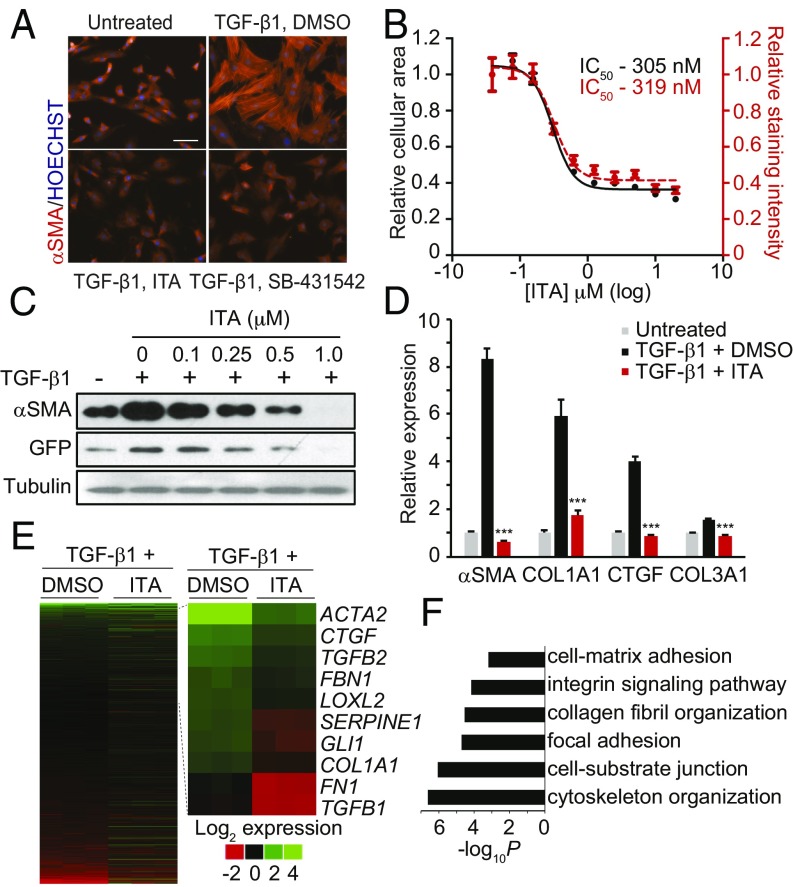
Fig. 1.
Fig. 1.
ITA inhibits MFB transdifferentiation. (A) Images of rat HSCs treated with ITA (0.5 μM) or SB-431542 (10 μM) in MFB formation conditions immunostained for αSMA (Scale bar, 100 μm). (B) Image analysis quantification of rat HSCs treated with ITA in MFB formation conditions (n = 9, mean and SEM). (C) Western blot analyses of αSMA and GFP from COL1–GFP HSCs subjected to MFB conditions and treated with ITA. (D) qRT-PCR analyses of MFB identity genes from human lung fibroblasts (HLFs) treated for 72 h (ITA, 0.3 μM; n = 3, mean and SD; ***P < 0.0005, t test). (E) Heatmap displaying the log2 fold change from untreated controls of all active transcripts (Left) or core MFB genes (Right) as measured by RNA-seq from HLFs treated with TGF-β1+DMSO or ITA (300 nM) for 72 h. (F) Enrichment P values from DAVID analyses for selected GO categories of genes up-regulated by TGF-β1 but suppressed by ITA treatment.
Fig. 2.
Fig. 2.
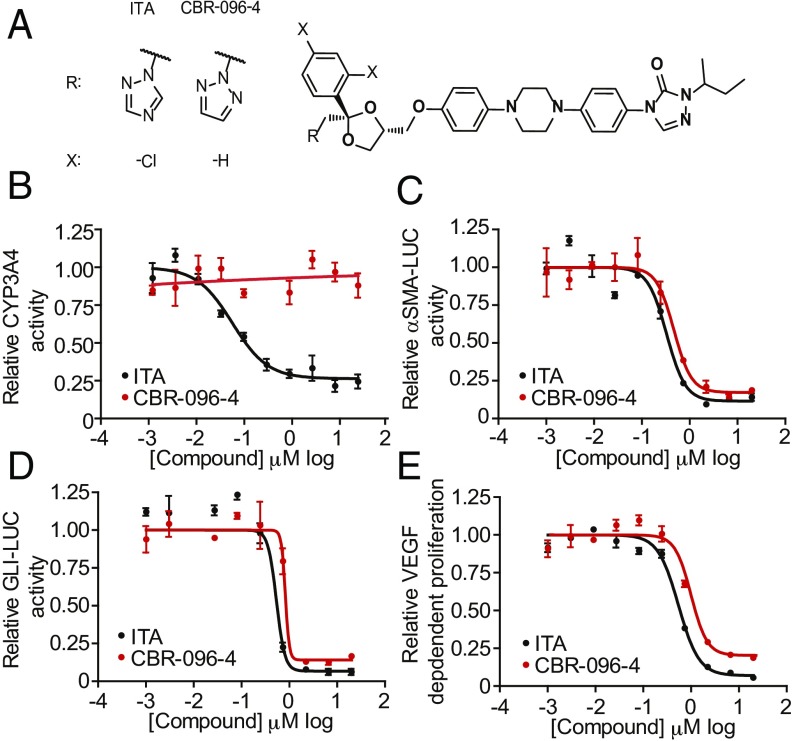
CBR-096-4, an antifibrotic agent with no CYP3A4 inhibitory activity. (A) Structures of ITA and CBR-096-4. (B) Results of CYP3A4 in vitro activity (B), αSMA-luciferase (C), GLI-luciferase (D), and VEGF-dependent proliferation (E) assays in the presence of indicated doses of ITA and CBR-096-4 (n = 3, mean and SEM).
Fig. 3.
Fig. 3.
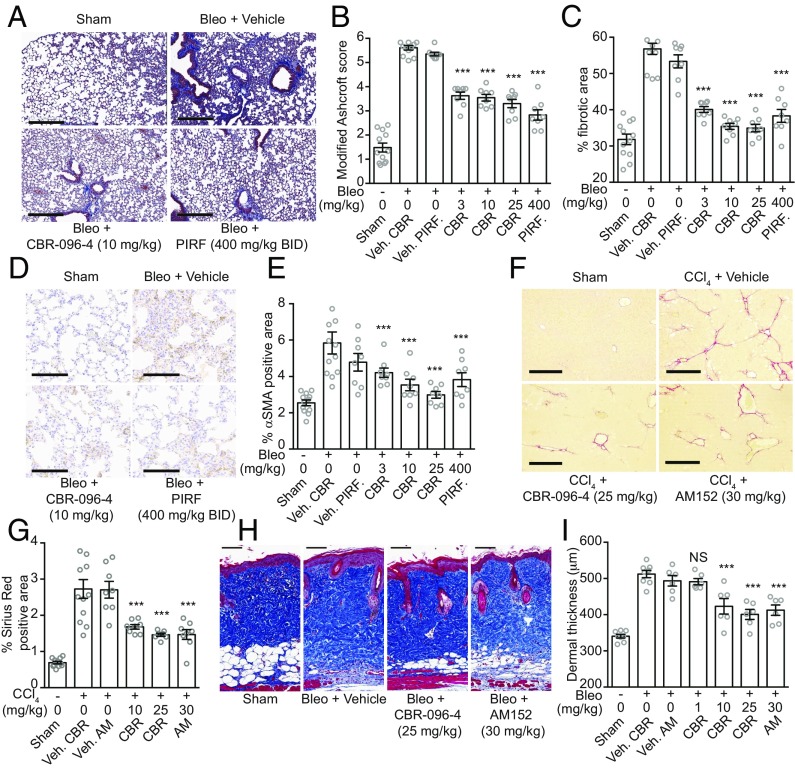
CBR-096-4 decreases disease severity in rodent models of fibrotic disease. (A) Representative Masson’s trichrome-stained lung sections from mice subjected to bleomycin treatment. (Scale bars, 300 μm.) Modified Ashcroft scores (B) and histological staining quantification of percent fibrotic area (C) from the bleomycin-induced lung fibrosis model. (D) Representative lung sections immunostained for αSMA from mice subjected to bleomycin treatment. (Scale bars, 100 μm.) (E) Quantification of percent αSMA positive area measurements from the bleomycin-induced lung fibrosis model. Images of representative Sirius Red-stained liver sections (F) and quantification of total Sirius Red positive area (G) for indicated treatment groups from mice subjected to the CCl4-induced liver fibrosis model. (Scale bars, 400 μm.) Representative images of Masson’s trichrome-stained skin sections (H) and quantification of dermal thickness (I) from mice exposed to the bleomycin-induced skin fibrosis model. (Scale bars, 100 μm.) (n = 8 per treatment group; mean and SEM; white circles indicate mean measurements from individual animals; ***P < 0.0005, NS, not significant, one-way ANOVA with Dunnett's correction.) (AM, AM152; BID, twice daily; CBR, CBR-096-4; PIRF, pirfenidone; Veh. AM, AM152 vehicle; Veh. CBR, CBR-096-4 vehicle; and Veh. PIRF, pirfenidone vehicle.)

References

    1. Rockey DC, Bell PD, Hill JA. Fibrosis: A common pathway to organ injury and failure. N Engl J Med. 2015;372:1138–1149. - PubMed
    1. Wynn TA, Ramalingam TR. Mechanisms of fibrosis: Therapeutic translation for fibrotic disease. Nat Med. 2012;18:1028–1040. - PMC - PubMed
    1. Friedman SL. Hepatic stellate cells: Protean, multifunctional, and enigmatic cells of the liver. Physiol Rev. 2008;88:125–172. - PMC - PubMed
    1. Deshmukh VA, et al. A regenerative approach to the treatment of multiple sclerosis. Nature. 2013;502:327–332. - PMC - PubMed
    1. Johnson K, et al. A stem cell-based approach to cartilage repair. Science. 2012;336:717–721. - PubMed

Publication types

MeSH terms