


Changes in peripheral blood T-cell balance after percutaneous tumor ablation
- PMID: 28417678
- PMCID: PMC9382907
- DOI: 10.1080/13645706.2017.1310737
Changes in peripheral blood T-cell balance after percutaneous tumor ablation
Abstract
Purpose: To evaluate the changes in T-cell balance in peripheral blood following percutaneous tumor ablation.
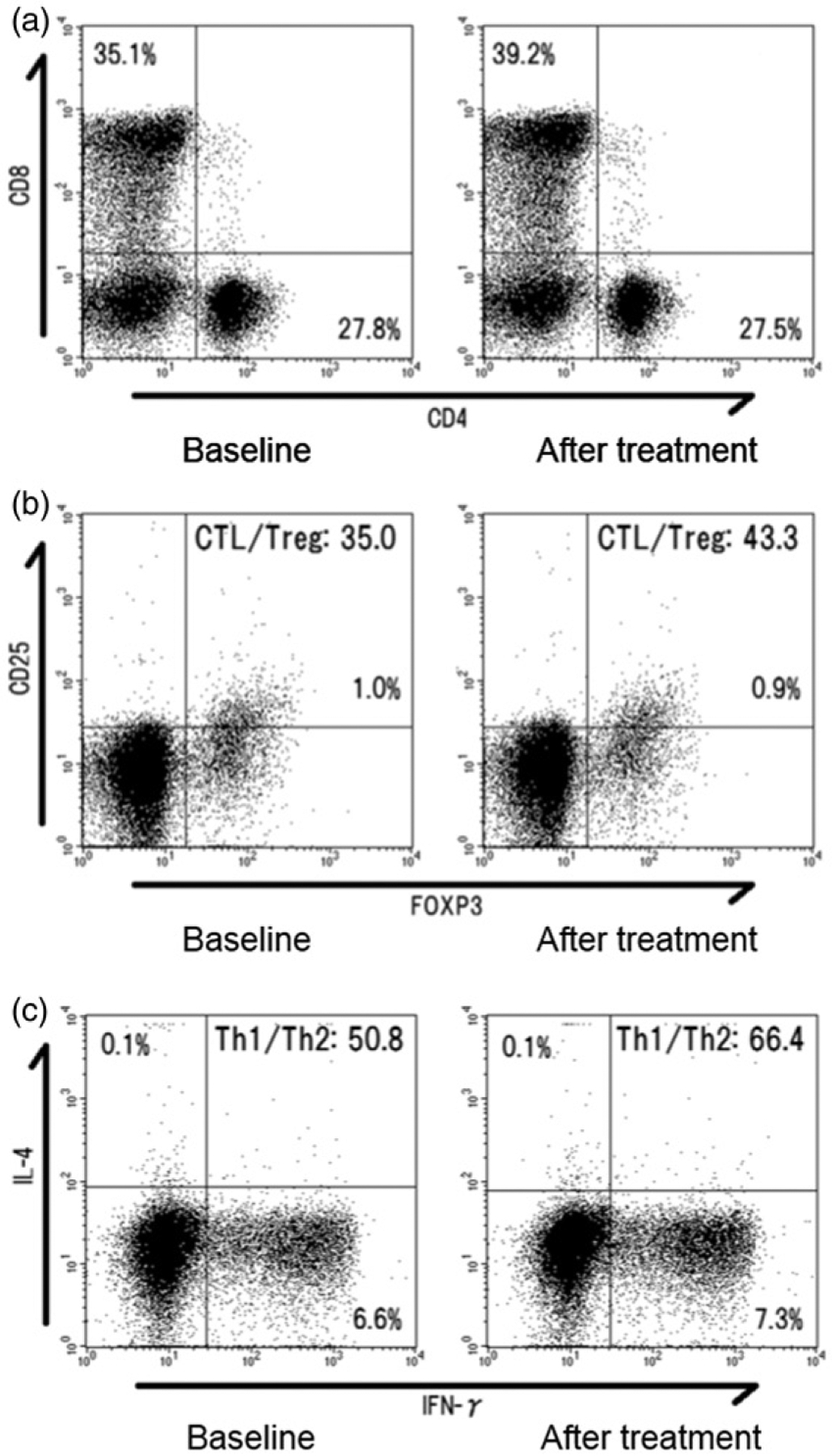
Material and methods: Patients underwent thermal ablation including radiofrequency (n = 9) and microwave ablation (n = 5), or cryoablation (n = 5). Target tumors were located in the lung (n = 7), soft tissue (n = 5), liver (n = 4), and bone (n = 3). Patient peripheral blood samples were collected before and within 14 days after ablation. Peripheral blood populations of cytotoxic T-cells (CTL), type-1 (Th1) and type-2 helper T-cells (Th2), and regulatory T-cells (Treg) were measured using flow cytometry. Changes in CTL/Treg and Th1/Th2 ratios before and after ablation therapy were compared using paired t-tests.
Results: Peripheral blood CTL population (27.5 ± 2.1% to 30.2 ± 2.5%, p < .03) and CTL/Treg ratios (18.8 ± 3.7% to 21.6 ± 3.6%, p < .05) increased significantly after ablation. Although a significant increase in CTL/Treg ratios was found after heat-based ablation (18.0 ± 4.4% to 21.6 ± 4.7%, p < .02), it remained unchanged after cryoablation (21.0 ± 7.0% to 21.5 ± 4.3%, p = .92). Th1/Th2 ratio (13.7 ± 3.0% to 17.2 ± 3.5%, p = .12) remained unchanged after ablation.
Conclusion: Ablation therapy alters the T-cell balance by increasing the systemic CTL/Treg, ratio. Heat-based ablation might be a more effective approach than cryoablation to enhance systemic anti-tumor immunity.
Keywords: Radiofrequency ablation; T-cell; cryoablation; lymphocyte; microwave ablation.
Conflict of interest statement
Disclosure statement
The authors report no conflict of interest.
Figures
References
-
- Liapi E, Geschwind JF. Transcatheter and ablative therapeutic approaches for solid malignancies. J Clin Oncol 2007;25:978–86. - PubMed
-
- Chu KF, Dupuy DE. Thermal ablation of tumours: biological mechanisms and advances in therapy. Nat Rev Cancer 2014;14:199–208. - PubMed
-
- den Brok MH, Sutmuller RP, van der Voort R, Bennink EJ, Figdor CG, Ruers TJ, et al. In situ tumor ablation creates an antigen source for the generation of antitumor immunity. Cancer Res 2004;64:4024–9. - PubMed
MeSH terms
Grants and funding
LinkOut - more resources
Full Text Sources
Other Literature Sources
