Cost-effectiveness of Common Diagnostic Approaches for Evaluation of Asymptomatic Microscopic Hematuria
- PMID: 28418451
- PMCID: PMC5818826
- DOI: 10.1001/jamainternmed.2017.0739
Cost-effectiveness of Common Diagnostic Approaches for Evaluation of Asymptomatic Microscopic Hematuria
Abstract
Importance: Asymptomatic microscopic hematuria (AMH) is highly prevalent and may signal occult genitourinary (GU) malignant abnormality. Common diagnostic approaches differ in their costs and effectiveness in detecting cancer. Given the low prevalence of GU malignant abnormality among patients with AMH, it is important to quantify the cost implications of detecting cancer for each approach.
Objective: To estimate the effectiveness, costs, and incremental cost per cancer detected (ICCD) for 4 common diagnostic approaches evaluating AMH.
Design, setting, and participants: A decision-analytic model-based cost-effectiveness analysis using inputs from the medical literature. PubMed searches were performed to identify relevant literature for all key model inputs, each of which was derived from the clinical study with the most robust data and greatest applicability. Analysis included adult patients with AMH on routine urinalysis with subgroups of high-risk patients (males, smokers, age ≥50 years) seen in the primary care or urologic referral setting.
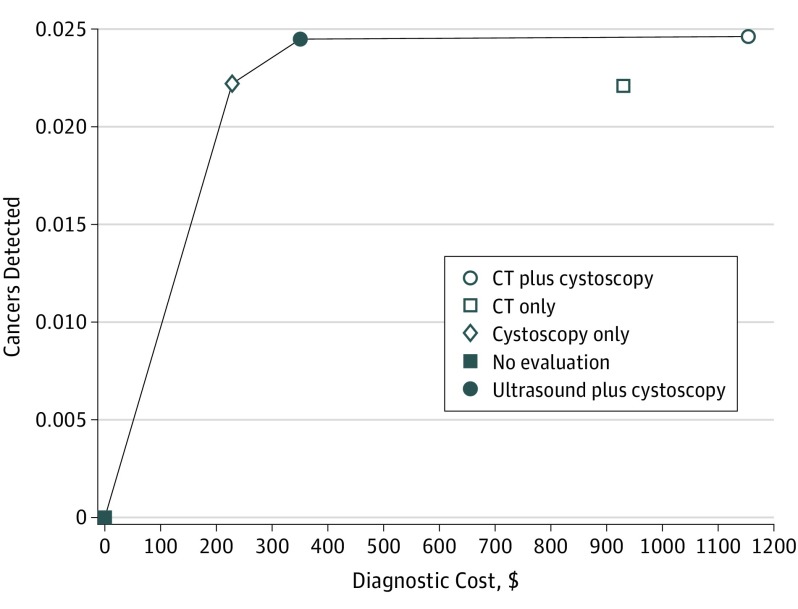
Interventions: Four diagnostic approaches were evaluated relative to the reference case of no evaluation: (1) computed tomography (CT) alone; (2) cystoscopy alone; (3) CT and cystoscopy combined; and (4) renal ultrasound and cystoscopy combined.
Main outcomes and measures: At termination of the diagnostic period, cancers detected, costs (payer perspective), and ICCD per 10 000 patients evaluated for AMH.
Results: Of the 4 diagnostic approaches analyzed, CT alone was dominated by all other strategies, detecting 221 cancers at a cost of $9 300 000. Ultrasound and cystoscopy detected 245 cancers and was most cost-effective with an ICCD of $53 810. Replacing ultrasound with CT detected just 1 additional cancer at an ICCD of $6 480 484. Ultrasound and cystoscopy remained the most cost-effective approach in subgroup analysis. The model was not sensitive to any inputs within the proposed ranges. Using probabilistic sensitivity analysis, ultrasound and cystoscopy was the dominant strategy in 100% of simulations.
Conclusions and relevance: The combination of renal ultrasound and cystoscopy is the most cost-effective among 4 diagnostic approaches for the initial evaluation of AMH. The use of ultrasound in lieu of CT as the first-line diagnostic strategy will optimize cancer detection and reduce costs associated with evaluation of AMH. Given our findings, we need to critically evaluate the appropriateness of our current clinical practices, and potentially alter our guidelines to reflect the most effective screening strategies for patients with AMH.
Conflict of interest statement
Figures
Comment in
-
Asymptomatic Microscopic Hematuria-Rethinking the Diagnostic Algorithm.JAMA Intern Med. 2017 Jun 1;177(6):808-809. doi: 10.1001/jamainternmed.2017.0758. JAMA Intern Med. 2017. PMID: 28418525 No abstract available.
-
Search Images and Extrapolation Risk.JAMA Intern Med. 2017 Dec 1;177(12):1869-1870. doi: 10.1001/jamainternmed.2017.4910. JAMA Intern Med. 2017. PMID: 29204629 No abstract available.
-
Search Images and Extrapolation Risk.JAMA Intern Med. 2017 Dec 1;177(12):1870. doi: 10.1001/jamainternmed.2017.6310. JAMA Intern Med. 2017. PMID: 29204634 No abstract available.
-
Search Images and Extrapolation Risk-Reply.JAMA Intern Med. 2017 Dec 1;177(12):1871. doi: 10.1001/jamainternmed.2017.4922. JAMA Intern Med. 2017. PMID: 29204636 No abstract available.
References
-
- Mohr DN, Offord KP, Melton LJ III. Isolated asymptomatic microhematuria: a cross-sectional analysis of test-positive and test-negative patients. J Gen Intern Med. 1987;2(5):318-324. - PubMed
-
- Loo RK, Lieberman SF, Slezak JM, et al. Stratifying risk of urinary tract malignant tumors in patients with asymptomatic microscopic hematuria. Mayo Clin Proc. 2013;88(2):129-138. - PubMed
-
- Mohr DN, Offord KP, Owen RA, Melton LJ III. Asymptomatic microhematuria and urologic disease: a population-based study. JAMA. 1986;256(2):224-229. - PubMed
-
- Carson CC III, Segura JW, Greene LF. Clinical importance of microhematuria. JAMA. 1979;241(2):149-150. - PubMed
-
- Golin AL, Howard RS. Asymptomatic microscopic hematuria. J Urol. 1980;124(3):389-391. - PubMed
Publication types
MeSH terms
LinkOut - more resources
Full Text Sources
Other Literature Sources
Medical