


Mobile health treatment support intervention for HIV and tuberculosis in Mozambique: Perspectives of patients and healthcare workers
- PMID: 28419149
- PMCID: PMC5395223
- DOI: 10.1371/journal.pone.0176051
Mobile health treatment support intervention for HIV and tuberculosis in Mozambique: Perspectives of patients and healthcare workers
Abstract
Background: Studies have been conducted in developing countries using SMS to communicate with patients to reduce the number of missed appointments and improve retention in treatment, however; very few have been scaled up. One possible reason for this could be that patients or staff are dissatisfied with the method in some way. This paper reports a study of patients' and healthcare workers' (HCW) views on an mHealth intervention aiming to support retention in antiretroviral therapy (ART) and tuberculosis (TB) treatment in Mozambique.
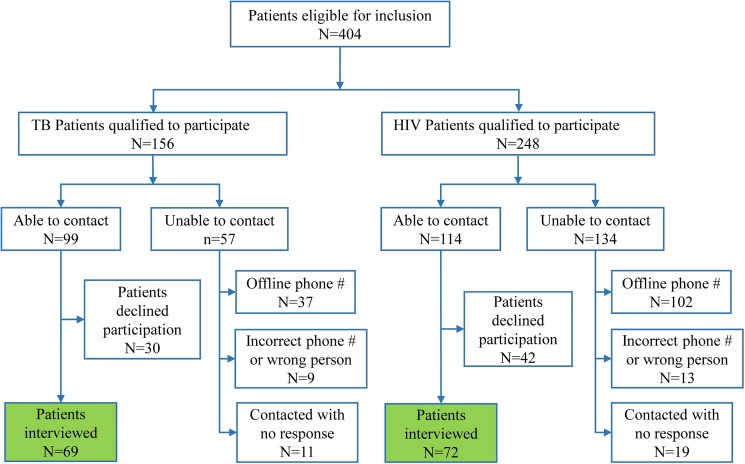
Methods: The study was conducted at five healthcare centres in Mozambique. Automated SMS health promotions and reminders were sent to patients in a RCT. A total of 141 patients and 40 HCWs were interviewed. Respondents rated usefulness, perceived benefits, ease of use, satisfaction, and risks of the SMS system using a Likert scale questionnaire. A semi-structured interview guide was followed. Interviews were transcribed and thematic analysis was conducted.
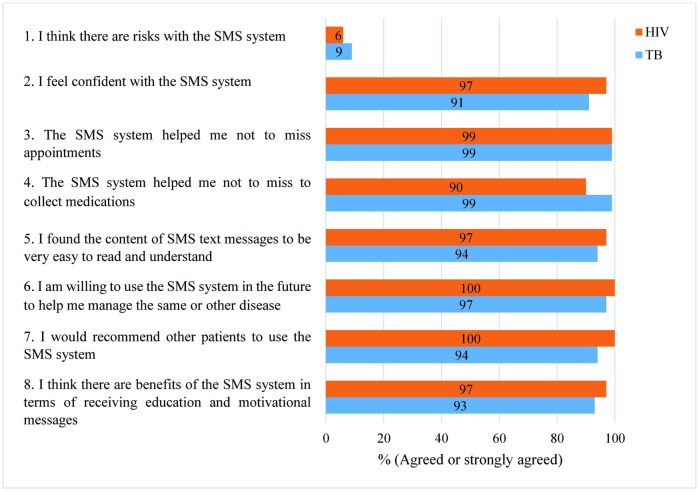
Results: Both patients and HCW found the SMS system useful and reliable. Most highly rated positive effects were reducing the number of failures to collect medication and avoiding missing appointments. Patients' confidence in the system was high. Most perceived the system to improve communication between health-care provider and patient and assist in education and motivation. The automatic recognition of questions from patients and the provision of appropriate answers (a unique feature of this system) was especially appreciated. A majority would recommend the system to other patients or healthcare centres. Risks also were mentioned, mostly by HCW, of unintentional disclosure of health status in cases where patients use shared phones.
Conclusions: The results suggest that SMS technology for HIV and TB should be used to transmit reminders for appointments, medications, motivational texts, and health education to increase retention in care. Measures must be taken to reduce risks of privacy intrusion, but these are not a main obstacle for scaling up systems of this kind.
Conflict of interest statement
Figures
References
-
- World Health Organization. Uniting to end TB/HIV coinfection [Internet]. 2016 [cited 2016 Apr 6]. Available from: http://www.who.int/hiv/mediacentre/news/tb-hiv-day-2016/en/
-
- Conselho Nacional de Combate ao HIV e SIDA (CNCS). Resposta Global à SIDA, Relatório do Progresso, Moçambique [Internet]. Maputo, Mozambique; 2016 [cited 2016 Apr 6]. Available from: http://www.unaids.org/sites/default/files/country/documents/MOZ_narrativ...
-
- Instituto Nacional de Saúde (INS). National Survey on Prevalence, Behavioral Risks, and Information about HIV and AIDS in Mozambique [Internet]. 2010 [cited 2016 Apr 6]. Available from: http://www.measuredhs.com/pubs/pdf/HF33/HF33y.pdf
-
- World Health Organization. Mozambique: Tuberculosis Profile [Internet]. 2015 [cited 2016 Apr 9]. Available from: https://extranet.who.int/sree/Reports?op=Replet&name=/WHO_HQ_Reports/G2/...
Publication types
MeSH terms
Substances
LinkOut - more resources
Full Text Sources
Other Literature Sources
Medical
