


Effect of Continuous Positive Airway Pressure Treatment on Health-Related Quality of Life and Sleepiness in High Cardiovascular Risk Individuals With Sleep Apnea: Best Apnea Interventions for Research (BestAIR) Trial
- PMID: 28419387
- PMCID: PMC5806548
- DOI: 10.1093/sleep/zsx040
Effect of Continuous Positive Airway Pressure Treatment on Health-Related Quality of Life and Sleepiness in High Cardiovascular Risk Individuals With Sleep Apnea: Best Apnea Interventions for Research (BestAIR) Trial
Abstract
Study objectives: The long-term effect of continuous positive airway pressure (CPAP) on health-related quality of life (HRQOL) in patients with high cardiovascular disease risk and obstructive sleep apnea (OSA) without severe sleepiness is uncertain. We aimed to determine the effect of CPAP treatment on HRQOL in individuals with moderate or severe OSA and cardiovascular disease (CVD) or multiple CVD risk factors without severe sleepiness.
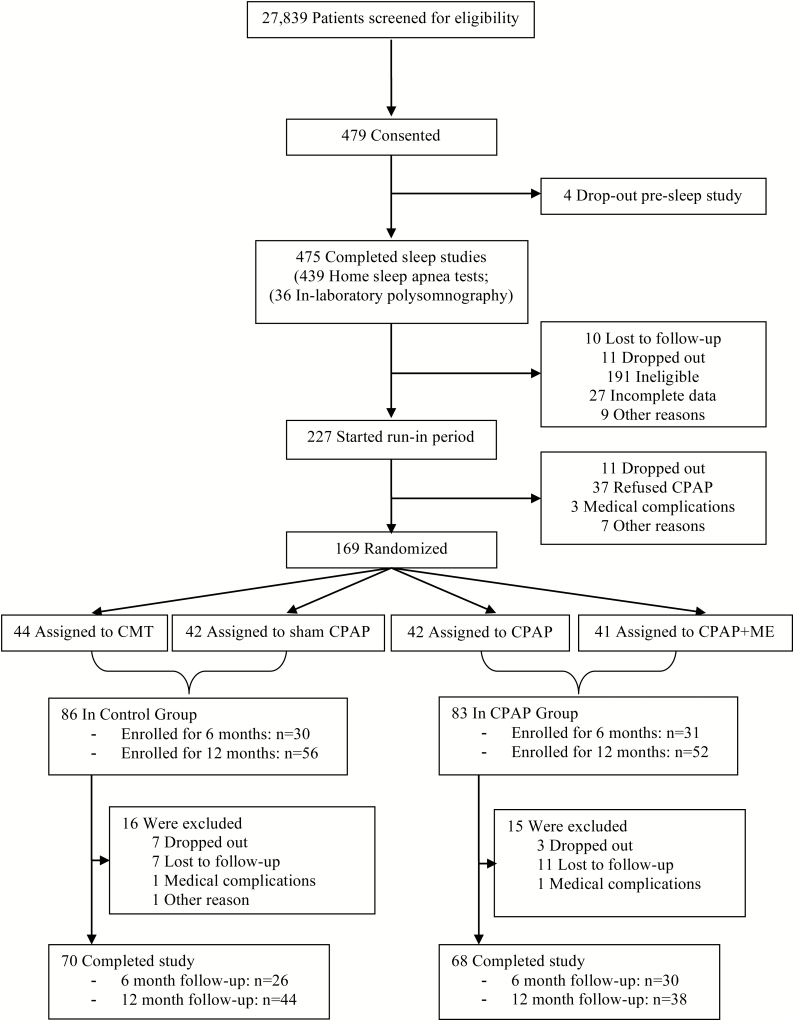
Methods: In this randomized, controlled, parallel group study, 169 participants were assigned to treatment with CPAP or the control group (conservative medical therapy [CMT] or CMT with sham CPAP). Analyses were based on an intention-to-treat approach. Linear mixed effect models were fitted to compare the changes in the Medical Outcomes Study Short Form-36 (SF-36) and in subjective sleepiness (Epworth Sleepiness Scale [ESS]) between groups from baseline to the average of 6- and 12-month measurements.
Results: CPAP improved several domains of HRQOL including bodily pain (treatment effect 9.7 [95% confidence interval, CI 3.9 to 15.4]; p = .001), vitality (5.7 [95% CI 1.5 to 9.9]; p = .008), general health (8.2 [95% CI 3.7 to 12.7]; p < .001), physical functioning (5.5 [95% CI 1.1 to 10.0]; p = .016), and the physical health summary score (3.3 [95% CI 1.4 to 5.3]; p = .001). CPAP also resulted in less daytime sleepiness (mean change in ESS -1.0 point [95% CI -2.0 to -0.0]; p = .040).
Conclusions: In patients with moderate-severe OSA at high risk of cardiovascular events and without severe sleepiness, CPAP improved daytime sleepiness and multiple domains of HRQOL over 6 to 12 months of follow-up, with the largest improvement observed for bodily pain.
Keywords: CPAP; clinical trial; quality of life; sleep apnea; sleepiness..
© Sleep Research Society 2017. Published by Oxford University Press on behalf of the Sleep Research Society. All rights reserved. For permissions, please e-mail journals.permissions@oup.com.
References
-
- Mozaffarian D, Benjamin EJ, Go AS, et al. ; American Heart Association Statistics Committee and Stroke Statistics Subcommittee. Heart disease and stroke statistics–2015 update: a report from the American Heart Association. Circulation. 2015; 131(4): e29–e322. - PubMed
-
- Kasai T, Floras JS, Bradley TD. Sleep apnea and cardiovascular disease: a bidirectional relationship. Circulation. 2012; 126(12): 1495–1510. - PubMed
-
- Somers VK, White DP, Amin R, et al. Sleep apnea and cardiovascular disease: an American Heart Association/American College of Cardiology Foundation Scientific Statement from the American Heart Association Council for High Blood Pressure Research Professional Education Committee, Council on Clinical Cardiology, Stroke Council, and Council on Cardiovascular Nursing. J Am Coll Cardiol. 2008; 52(8): 686–717. - PubMed
Publication types
MeSH terms
Grants and funding
LinkOut - more resources
Full Text Sources
Other Literature Sources
