Review
. 2017 Mar 23;18(4):686.
doi: 10.3390/ijms18040686.

Future Prospects for the Development of Cost-Effective Adenovirus Vaccines

Affiliations
Review

Future Prospects for the Development of Cost-Effective Adenovirus Vaccines

Cyrielle Fougeroux et al. Int J Mol Sci. .

Abstract

Vaccination is one of the most efficient tools for disease prevention, and a continuously growing field of research. However, despite progress, we still need more efficient and cost-effective vaccines that would improve access to those in need. In this review, we will describe the status of virus-vectored vaccine technology with a focus on adenoviral-based vaccines. Adenovirus (Ad) vaccines have proven to be efficient in military vaccinations against Ad4 and Ad7 and as highly efficient vectored vaccines against rabies. The question of how other adenovirus-based vaccines can become as efficient as the rabies vaccine is the underlying theme in this review. Here, we will first give an overview of the basic properties of vectored vaccines, followed by an introduction to the characteristics of adenoviral vectors and previously tested modifications of the vector backbone and expression cassettes, with a focus on how they can contribute to increased vaccine cost-effectiveness. Finally, we will highlight a few successful examples of research that have attempted to improve the use of adenoviral-based vaccines by improving the transgene immunogenicity.

Keywords: adenovirus; affordable vaccine candidates; immune responses; protective immunity; replication competent; transgene; vaccine; vaccine technology platform.


Conflict of interest statement

The authors declare no conflict of interest.

Figures
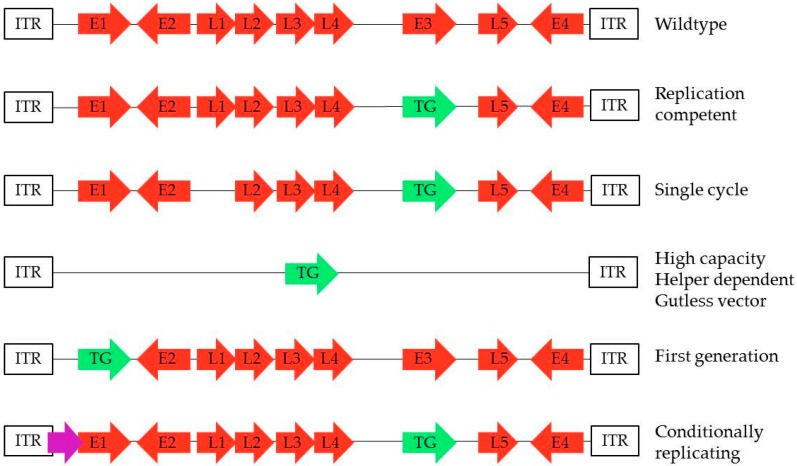
Figure 1
Figure 1
Different possibilities of transgene insertion in the adenoviral genome. The transgene can be inserted in different places in the adenoviral genome, thus offering different characteristics to the adenovirus vector. Transgene can be inserted in place of E3 gene, leaving E1 intact together with the capacity of replication, which is the case for most replication-competent (RC), single cycle (SC), and conditionally replicating (CRAd) adenoviruses. The transgene is usually inserted in place of E1, thus preventing replication in the host as seen with first generation (FG). Gutless vectors only contain the ITR domains of the adenovirus and are depleted of all adenoviral genes. These are also called helper-dependent adenoviruses, as they require a helper virus to deliver the capsid genes during production.
Figure 2
Figure 2
Qualitative comparison of encoded transgene immunodominance as compared to immunodominance induced by the adenoviral vector. Transgenes have different intrinsic immunodominance that competes with different immunodominance of vector antigens in the adenoviral vectors, thus influencing the immune response [37]. As mentioned before, rabies antigens have a really high immunodominance (A) as compared to HIV or influenza antigens. The adenoviral vectors also influence the transgene immunodominance offering a strong (B), mild (C), or low (D) competition for the transgene. Thus, antigens like rabies might only require replication-competent adenovirus, but HIV and influenza antigens probably require new adjuvant or other techniques for increased immunodominance, particularly when delivered in replicating vectors.
Figure 3
Figure 3
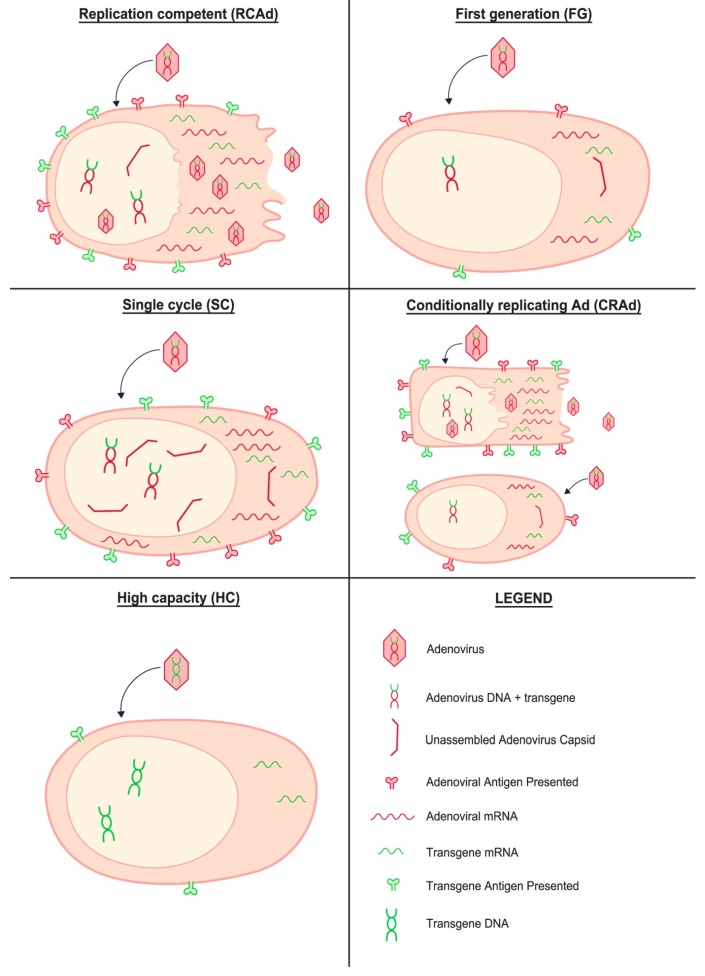
Overview of the quantitative vector and transgene expression using different adenovirus platforms for vaccination.

References

    1. Andre F.E., Booy R., Bock H.L., Clemens J., Datta S.K., John T.J., Lee B.W., Lolekha S., Peltola H., Ruff T.A., et al. Vaccination greatly reduces disease, disability, death and inequity worldwide. Bull. World Health Organ. 2008;86:140–146. doi: 10.2471/BLT.07.040089. - DOI - PMC - PubMed
    1. Folb P.I., Bernatowska E., Chen R., Clemens J., Dodoo A.N., Ellenberg S.S., Farrington C.P., John T.J., Lambert P.H., Macdonald N.E., et al. A global perspective on vaccine safety and public health: The Global Advisory Committee on Vaccine Safety. Am. J. Public Health. 2004;94:1926–1931. doi: 10.2105/AJPH.94.11.1926. - DOI - PMC - PubMed
    1. Zhou W., Pool V., Iskander J.K., English-Bullard R., Ball R., Wise R.P., Haber P., Pless R.P., Mootrey G., Ellenberg S.S., et al. Surveillance for safety after immunization: Vaccine Adverse Event Reporting System (VAERS)—United States, 1991–2001. MMWR Surveill. Summ. 2003;52:1–24. - PubMed
    1. Shimizu H., Thorley B., Paladin F.J., Brussen K.A., Stambos V., Yuen L., Utama A., Tano Y., Arita M., Yoshida H., et al. Circulation of type 1 vaccine-derived poliovirus in the Philippines in 2001. J. Virol. 2004;78:13512–13521. doi: 10.1128/JVI.78.24.13512-13521.2004. - DOI - PMC - PubMed
    1. Artenstein A.W., Opal J.M., Opal S.M., Tramont E.C., Peter G., Russell P.K. History of U.S. military contributions to the study of vaccines against infectious diseases. Mil. Med. 2005;170(Suppl. S4):3–11. doi: 10.7205/MILMED.170.4S.3. - DOI - PubMed

Substances

LinkOut - more resources