Review
. 2017 Apr;17(4):25.
doi: 10.1007/s11882-017-0694-1.

New Insights into Cockroach Allergens

Affiliations
Review

New Insights into Cockroach Allergens

Anna Pomés et al. Curr Allergy Asthma Rep. 2017 Apr.

Abstract

Purpose of review: This review addresses the most recent developments on cockroach allergen research in relation to allergic diseases, especially asthma.

Recent findings: The number of allergens relevant to cockroach allergy has recently expanded considerably up to 12 groups. New X-ray crystal structures of allergens from groups 1, 2, and 5 revealed interesting features with implications for allergen standardization, sensitization, diagnosis, and therapy. Cockroach allergy is strongly associated with asthma particularly among children and young adults living in inner-city environments, posing challenges for disease control. Environmental interventions targeted at reducing cockroach allergen exposure have provided conflicting results. Immunotherapy may be a way to modify the natural history of cockroach allergy and decrease symptoms and asthma severity among sensitized and exposed individuals. The new information on cockroach allergens is important for the assessment of allergen markers of exposure and disease, and for the design of immunotherapy trials.

Keywords: Allergen structure; Allergy diagnosis; Asthma; Cockroach allergy; IgE; Recombinant allergens.


Conflict of interest statement

Conflict of Interest

Drs. Randall and Mueller declare no conflicts of interest relevant to this manuscript.

Figures
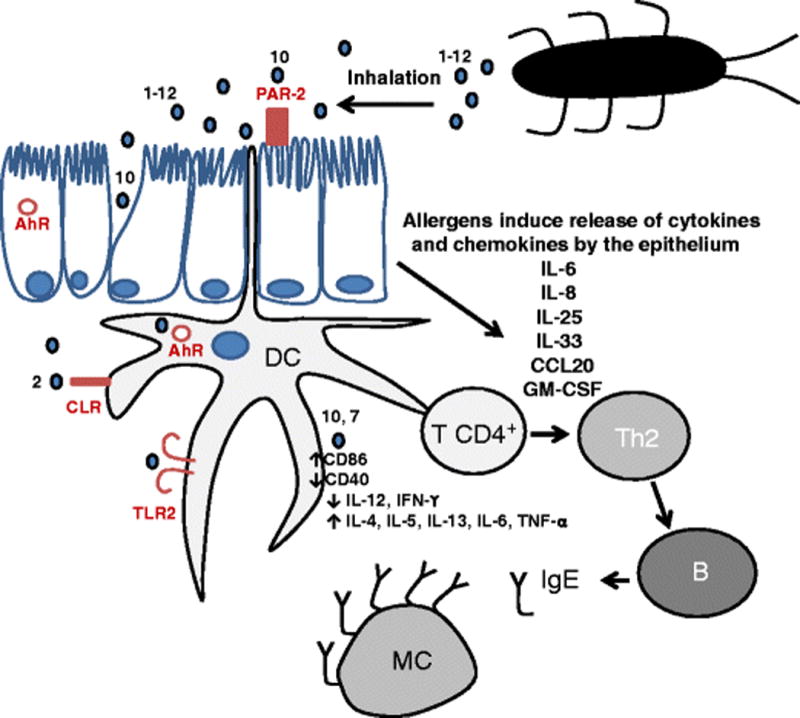
Figure 1
Figure 1. Proposed mechanisms of cockroach allergy
Cockroach allergens, belonging to 12 different groups, are carried by particles that are inhaled to the human lung, where they activate innate and adaptive immune responses. Mechanisms involved in the process include: a) disruption of epithelial integrity by proteases (such as Per a 10) that facilitate allergen penetration, b) activation of release of pro-inflammatory cytokines from the epithelium in a PAR-2 dependent manner by proteases, c) allergen interaction with different receptors (some of which contribute to the uptake of allergens by dendritic cells -TLR, CLR-), and subsequent activation of the adaptive immunity with production of IgE antibodies that bind to the high affinity IgE receptors on mast cells. Numbers indicate the allergen group number. TLR: Toll like receptors, CLR: C-type lectin receptors including mannose receptors, AhR: Aryl hydrocarbon receptor, DC: dendritic cell; T CD4+ and Th2: T cells; B: B cell; MC: mast cell.
Figure 2
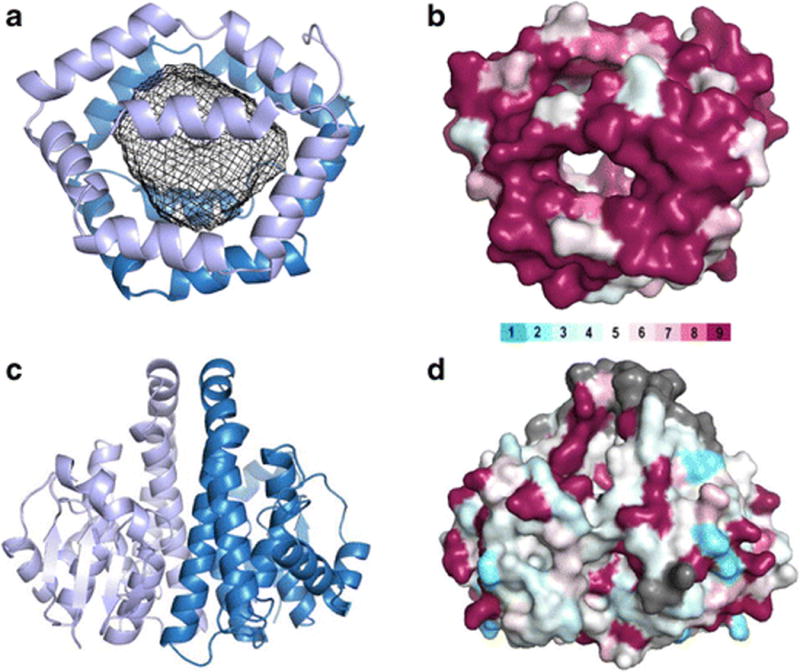
Figure 2. Structural analyses of Bla g 1 and Bla g 5
Bla g 1 (4JRB, panels A and B) and Bla g 5 (4QR5, panels C and D) are presented as ribbon diagrams (panels A and C) and surface representations (panels B and D). Bla g 1 in panel A is colored blue and light blue to differentiate the two hemispheres of 6 helices (all from one polypeptide chain) that encapsulate a large hydrophobic cavity, shown with a mesh rendering. Bla g 5 in panel C is colored blue and light blue to show the two polypeptide chains that come together to form a typical GST dimer. In panel B, Bla g 1 is colored based on similarity to Per a 1, and in panel D, Bla g 5 is colored with respect to similarity to Der p 8. The color bar represents residue similarity from low (light blue) to high (maroon) [95]. Gray represents gaps or insertions in the sequence alignment. Visual analysis of the coloring shows the structural basis of cross-reactivity for Bla g 1 and Per a 1 and the lack of significant cross-reactivity between Bla g 5 and Der p 8, which has been experimentally confirmed.

References

    1. Bernton HS, Brown H. Insect allergy--Preliminary studies of the cockroach. J Allergy Clin Immunol. 1964;35:506–13. - PubMed
    1. Kang B, Vellody D, Homburger H, Yunginger JW. Cockroach cause of allergic asthma. Its specificity and immunologic profile. J Allergy Clin Immunol. 1979;63:80–6. - PubMed
    1. Cornwell PB. The cockroach. London: Hutchinson; 1968.
    1. Pomés A. Cockroach and other inhalant insect allergens. Clin Allergy Immunol. 2008;21:183–200. - PubMed
    1. Pomés A, Arruda LK. Investigating cockroach allergens: Aiming to improve diagnosis and treatment of cockroach allergic patients. Methods. 2014;66:75–85. - PMC - PubMed