


Preferences for the Return of Individual Results From Research on Pediatric Biobank Samples
- PMID: 28421887
- PMCID: PMC5407299
- DOI: 10.1177/1556264617697839
Preferences for the Return of Individual Results From Research on Pediatric Biobank Samples
Abstract
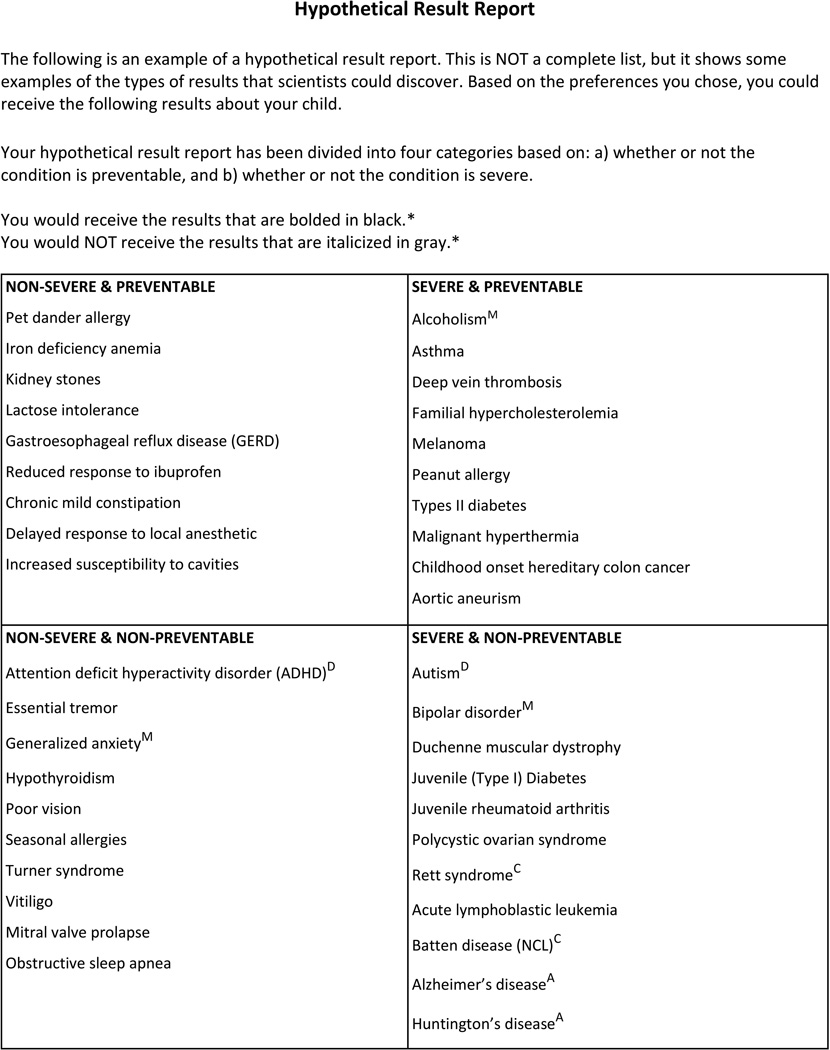
Discussions about disclosing individual genetic research results include calls to consider participants' preferences. In this study, parents of Boston Children's Hospital patients set preferences for disclosure based on disease preventability and severity, and could exclude mental health, developmental, childhood degenerative, and adult-onset disorders. Participants reviewed hypothetical reports and reset preferences, if desired. Among 661 participants who initially wanted all results (64%), 1% reset preferences. Among 336 participants who initially excluded at least one category (36%), 38% reset preferences. Participants who reset preferences added 0.9 categories, on average; and their mean satisfaction on 0 to 10 scales increased from 4.7 to 7.2 ( p < .001). Only 2% reduced the number of categories they wanted disclosed. Findings demonstrate the benefits of providing examples of preference options and the tendency of participants to want results disclosed. Findings also suggest that preference-setting models that do not provide specific examples of results could underestimate participants' desires for information.
Keywords: biorepositories/biobanks; children and adolescent/pediatrics; genetic research; incidental findings/return of results; preferences.
Conflict of interest statement
The authors declared no potential conflicts of interest with respect to the research, authorship, and/or publication of this article.
Figures
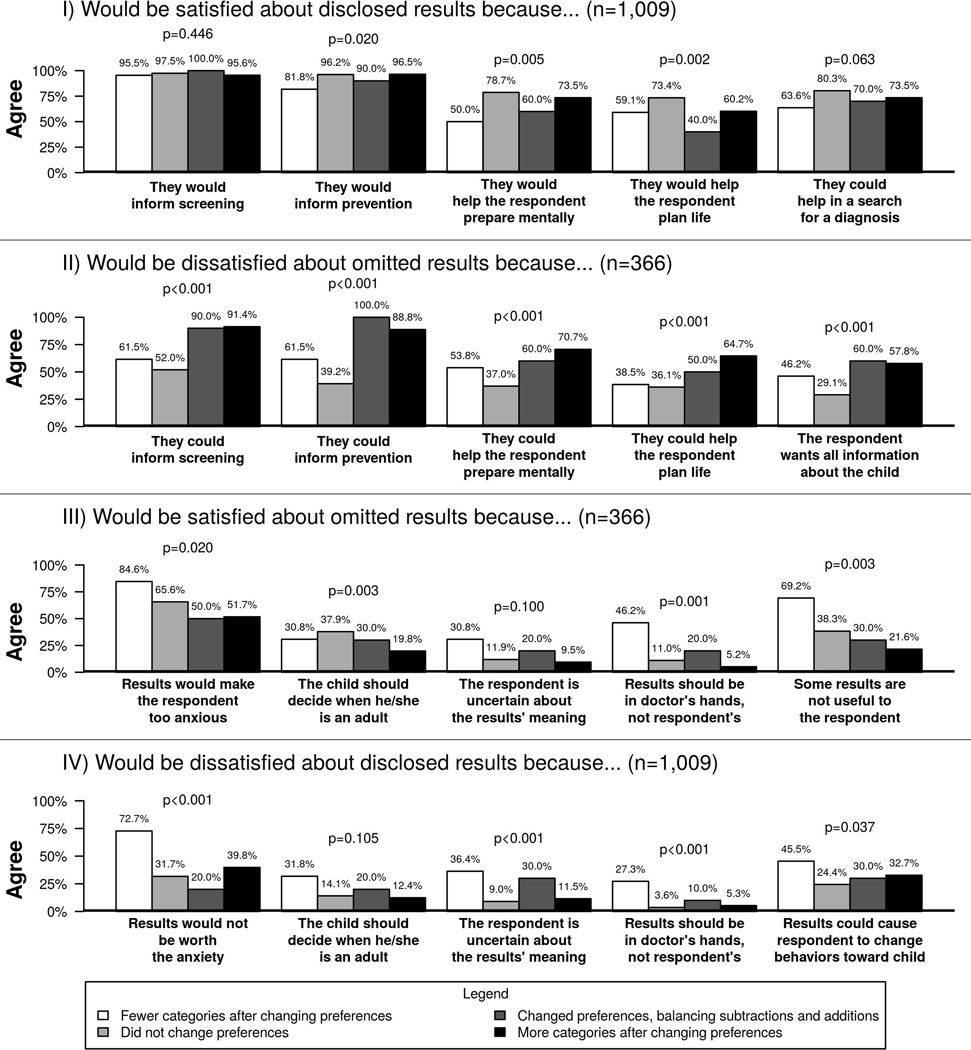
 Fewer categories after changing preferences
  Did not change preferences
  Changed preferences, balancing subtractions and additions
  More categories after changing preferences
Similar articles
-
Participant Satisfaction With a Preference-Setting Tool for the Return of Individual Research Results in Pediatric Genomic Research.J Empir Res Hum Res Ethics. 2015 Oct;10(4):414-26. doi: 10.1177/1556264615599620. J Empir Res Hum Res Ethics. 2015. PMID: 26376753 Free PMC article. Clinical Trial.
-
Enhancing Autonomy in Biobank Decisions: Too Much of a Good Thing?J Empir Res Hum Res Ethics. 2018 Apr;13(2):125-138. doi: 10.1177/1556264617753483. Epub 2018 Feb 23. J Empir Res Hum Res Ethics. 2018. PMID: 29471711 Free PMC article. Clinical Trial.
-
Guidelines for return of research results from pediatric genomic studies: deliberations of the Boston Children's Hospital Gene Partnership Informed Cohort Oversight Board.Genet Med. 2014 Jul;16(7):547-52. doi: 10.1038/gim.2013.190. Epub 2014 Jan 9. Genet Med. 2014. PMID: 24406460
-
Research participants' perceptions and views on consent for biobank research: a review of empirical data and ethical analysis.BMC Med Ethics. 2015 Sep 9;16:60. doi: 10.1186/s12910-015-0053-5. BMC Med Ethics. 2015. PMID: 26354520 Free PMC article. Review.
-
Funding considerations for the disclosure of genetic incidental findings in biobank research.Clin Genet. 2013 Nov;84(5):397-406. doi: 10.1111/cge.12190. Epub 2013 Jun 10. Clin Genet. 2013. PMID: 23662709 Free PMC article. Review.
Cited by
-
Adolescents' and Parents' Perspectives on a Novel Decision-Making Process for Return of Results in Genomic Research.J Empir Res Hum Res Ethics. 2023 Oct;18(4):278-283. doi: 10.1177/15562646231190826. Epub 2023 Jul 25. J Empir Res Hum Res Ethics. 2023. PMID: 37491850 Free PMC article.
-
Sharing and Safeguarding Pediatric Data.Front Genet. 2022 Jun 20;13:872586. doi: 10.3389/fgene.2022.872586. eCollection 2022. Front Genet. 2022. PMID: 35795212 Free PMC article.
-
Return of individual research results from genomic research: A systematic review of stakeholder perspectives.PLoS One. 2021 Nov 8;16(11):e0258646. doi: 10.1371/journal.pone.0258646. eCollection 2021. PLoS One. 2021. PMID: 34748551 Free PMC article.
-
Adolescent and Parental Attitudes About Return of Genomic Research Results: Focus Group Findings Regarding Decisional Preferences.J Empir Res Hum Res Ethics. 2018 Oct;13(4):371-382. doi: 10.1177/1556264618776613. Epub 2018 May 28. J Empir Res Hum Res Ethics. 2018. PMID: 29806518 Free PMC article.
-
Paediatric biobanking for health: The ethical, legal, and societal landscape.Front Public Health. 2022 Sep 27;10:917615. doi: 10.3389/fpubh.2022.917615. eCollection 2022. Front Public Health. 2022. PMID: 36238242 Free PMC article. Review.
References
-
- American Academy of Pediatrics Committee on Bioethics, & Committee on Genetics, Committee on Genetics, the American College of Medical Genetics and Genomics Social, Ethical, and Legal Issues Committe. Ethical and policy issues in genetic testing and screening of children. Pediatrics. 2013;131(3):620–622. - PubMed
-
- Bacon PL, Harris ED, Ziniel SI, Savage SK, Weitzman ER, Green RC, Holm IA. The development of a preference-setting model for the return of individual genomic research results. Journal of Empirical Research on Human Research Ethics. 2015;10(2):107–120. - PubMed
-
- Berg JS, Khoury MJ, Evans JP. Deploying whole genome sequencing in clinical practice and public health: meeting the challenge one bin at a time. Genetics in Medicine. 2011;13(6):499–504. - PubMed
-
- Breitkopf CR, Petersen GM, Wolf SM, Chaffee KG, Robinson ME, Gordon DR, Koenig BA. Preferences regarding return of genomic results to relatives of research participants, including after participant death: empirical results from a cancer biobank. The Journal of Law, Medicine & Ethics. 2015;43(3):464–475. - PMC - PubMed
Publication types
MeSH terms
Grants and funding
LinkOut - more resources
Full Text Sources
Other Literature Sources
Medical
