. 2017 Apr 19;12(4):e0174886.
doi: 10.1371/journal.pone.0174886. eCollection 2017.

Revising mtDNA haplotypes of the ancient Hungarian conquerors with next generation sequencing

Affiliations

Revising mtDNA haplotypes of the ancient Hungarian conquerors with next generation sequencing

Endre Neparáczki et al. PLoS One. .

Abstract

As part of the effort to create a high resolution representative sequence database of the medieval Hungarian conquerors we have resequenced the entire mtDNA genome of 24 published ancient samples with Next Generation Sequencing, whose haplotypes had been previously determined with traditional PCR based methods. We show that PCR based methods are prone to erroneous haplotype or haplogroup determination due to ambiguous sequence reads, and many of the resequenced samples had been classified inaccurately. The SNaPshot method applied with published ancient DNA authenticity criteria is the most straightforward and cheapest PCR based approach for testing a large number of coding region SNP-s, which greatly facilitates correct haplogroup determination.


Conflict of interest statement

Competing Interests: Dr. Bihari and Dr. Nagy had consulting positions at SeqOmics Biotechnology Ltd. at the time the study was conceived. SeqOmics Biotechnology Ltd. was not directly involved in the design and execution of the experiments or in the writing of the manuscript. This does not alter the authors' adherence to all the PLOS ONE policies on sharing data and materials.

Figures

Fig 1
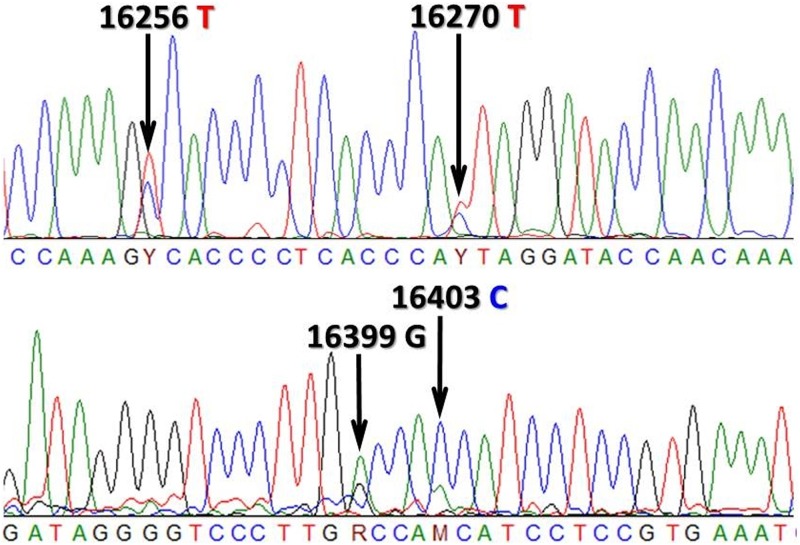
Fig 1. Chromatogram of two HVR-I sequence fragments of the Karos-III/16 sample from [9].
Arrows label double peaks, correct reads according to NGS data are listed above the arrows.
Fig 2
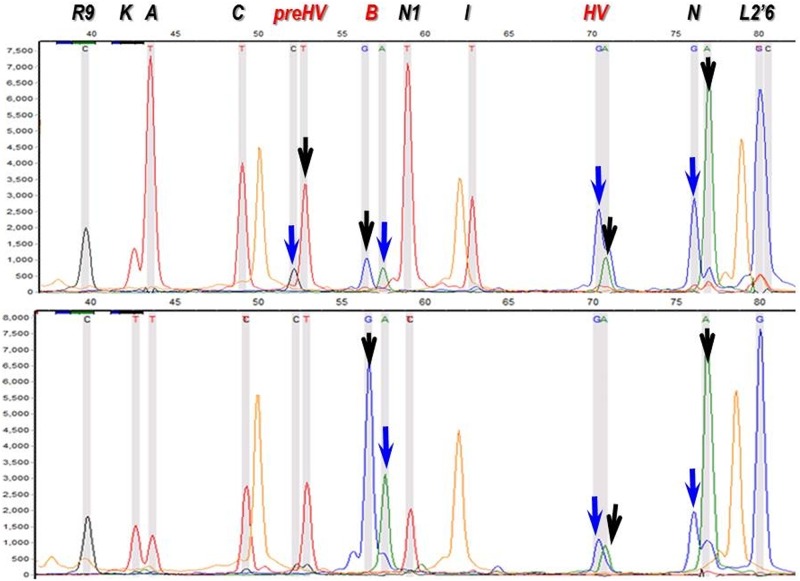
Fig 2. Electropherograms of two SNaPshot SBE-II reactions from two extracts of the same Karos-III/6 sample [9].
Characters at the top indicate Hg-s defined by the corresponding peaks. Black characters indicate peaks defining the ancestral allele, read characters indicate peaks defining the derived allele. Arrows point at double peaks. As each dye has a different influence on DNA mobility, positions of identical fragments with different dyes are not the same. Black arrows point at peaks taken into account, while blue arrows indicate neglected peaks, considered to have been derived from contamination. Orange peaks are size standards (GeneScan-120 LIZ, Applied Biosystems).

References

    1. Pickrell JK, Reich D. Toward a new history and geography of human genes informed by ancient DNA. Trends in Genetics. 2014. pp. 377–389. 10.1016/j.tig.2014.07.007 - DOI - PMC - PubMed
    1. Richards MB, Sykes BC, Hedges REM. Authenticating DNA Extracted From Ancient Skeletal Remains. J Archaeol Sci. 1995;22: 291–299.
    1. Malmström H, Storå J, Dalén L, Holmlund G, Götherström A. Extensive human DNA contamination in extracts from ancient dog bones and teeth. Mol Biol Evol. 2005;22: 2040–2047. 10.1093/molbev/msi195 - DOI - PubMed
    1. Pilli E, Modi A, Serpico C, Achilli A, Lancioni H, Lippi B, et al. Monitoring DNA Contamination in Handled vs. Directly Excavated Ancient Human Skeletal Remains. PLoS One. 2013;8. - PMC - PubMed
    1. Heupink TH, Subramanian S, Wright JL, Endicott P, Westaway MC, Huynen L, et al. Ancient mtDNA sequences from the First Australians revisited. Proc Natl Acad Sci. 2016; 201521066. - PMC - PubMed

Publication types