. 2017 Apr 19;18(1):71.
doi: 10.1186/s13059-017-1196-0.

The within-host population dynamics of Mycobacterium tuberculosis vary with treatment efficacy

Affiliations

The within-host population dynamics of Mycobacterium tuberculosis vary with treatment efficacy

Andrej Trauner et al. Genome Biol. .

Abstract

Background: Combination therapy is one of the most effective tools for limiting the emergence of drug resistance in pathogens. Despite the widespread adoption of combination therapy across diseases, drug resistance rates continue to rise, leading to failing treatment regimens. The mechanisms underlying treatment failure are well studied, but the processes governing successful combination therapy are poorly understood. We address this question by studying the population dynamics of Mycobacterium tuberculosis within tuberculosis patients undergoing treatment with different combinations of antibiotics.

Results: By combining very deep whole genome sequencing (~1000-fold genome-wide coverage) with sequential sputum sampling, we were able to detect transient genetic diversity driven by the apparently continuous turnover of minor alleles, which could serve as the source of drug-resistant bacteria. However, we report that treatment efficacy has a clear impact on the population dynamics: sufficient drug pressure bears a clear signature of purifying selection leading to apparent genetic stability. In contrast, M. tuberculosis populations subject to less drug pressure show markedly different dynamics, including cases of acquisition of additional drug resistance.

Conclusions: Our findings show that for a pathogen like M. tuberculosis, which is well adapted to the human host, purifying selection constrains the evolutionary trajectory to resistance in effectively treated individuals. Nonetheless, we also report a continuous turnover of minor variants, which could give rise to the emergence of drug resistance in cases of drug pressure weakening. Monitoring bacterial population dynamics could therefore provide an informative metric for assessing the efficacy of novel drug combinations.

Trial registration: ClinicalTrials.gov NCT01071603.

Keywords: Combination therapy; Drug resistance; Tuberculosis; Whole genome sequencing; Within-host evolution.


Figures

Fig. 1
Fig. 1
Characteristics of the study population. Our study was based on serial sputum isolates obtained from 12 TB patients at 2-week intervals. We obtained three sputum samples at each time point and cultured each on Löwenstein–Jenssen solid medium (L-J) or in a mycobacterial growth indicator tube (MGIT); we chose one culture per patient per time point for deep sequencing. Eight patients (P01–P08) were treated with a combination composed of at least four effective antibiotics (sampling indicated by red circles). While four patients (P09–P12) were treated with fewer than four effective antibiotics (grey circles). Phenotypic drug susceptibility testing (Phenotypic DST) and genotypic drug susceptibility testing (Genotypic DST) results are shown for each patient with light blue dots indicating drug susceptibility (DS) and red dots reflecting drug resistance (DR). The antibiotics are abbreviated as: RIF rifampicin, INH isoniazid, EMB ethambutol, STR streptomycin, INJ injectable aminoglycosides, FQ fluoroquinolones, PZA pyrazinamide. Resistance profiles of strains are given as: DS drug susceptible, INH-R isoniazid monoresistant, MDR multidrug resistant, P-XDR pre-extensively drug resistant, XDR extensively drug resistant. MDR is defined as RIF and INH resistant, XDR is MDR with additional resistance to FQ and INJ, and P-XDR is MDR with either FQ or INJ resistance
Fig. 2
Fig. 2
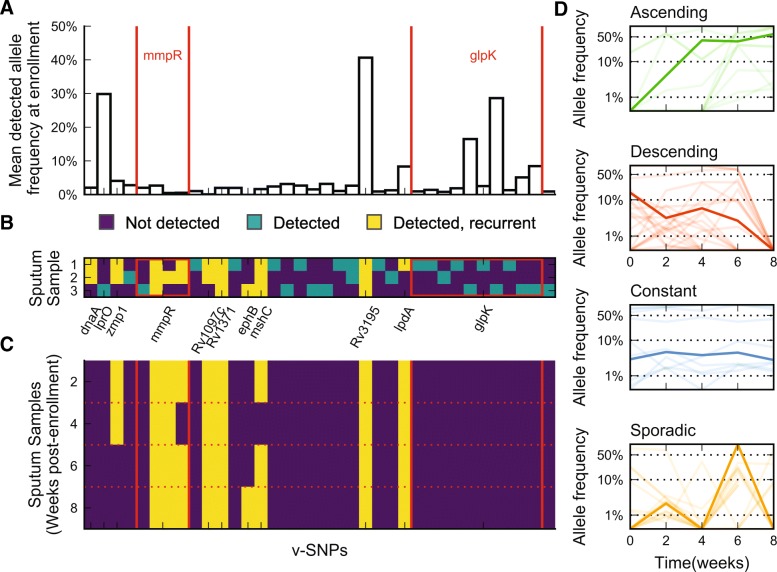
Sputum samples under-represent the true genetic diversity of MTBC populations in the lung. We sequenced three samples from the enrollment time point of patient 12 and compared the detected population heterogeneity. a Mean frequency of detected v-SNPs across samples. Four v-SNPs affecting Rv0678 (mmpR) and ten v-SNPs affecting Rv3696c (glpK) are marked with red lines. b Detection pattern of v-SNPs across the three sputum samples. v-SNPs were classified as recurrent if they were detected in at least one sputum sample from a later time point. c Temporal detection pattern for listed v-SNPs across sputum samples isolated from patient 12 2, 4, 6, and 8 weeks post-enrollment. d Patterns of v-SNP temporal dynamics detected across all patients. One trajectory per type is highlighted for illustration purposes
Fig. 3
Fig. 3
Structure of MTBC populations in TB patients. a Folded site frequency spectrum: a histogram of estimated variable allele frequencies within MTBC populations in TB patients. Cumulative distributions of allele frequencies for all variable SNPs (v-SNPs) are shown in black—80% of all the v-SNPs are present at an estimated frequency of less than 20% (dotted line). The corresponding distributions for v-SNPs that were detected in sputa from a single time point (unstable, yellow) or from multiple time points (recurrent, blue) are also shown. The observed distribution of alleles could arise from b a dominant clone of MTBC colonizing the lung and minor genetic variants continuously emerging from it which are selected against by purifying selection. Alternatively, c a large number of physically separated populations each produce minor variants. In this setting selection would be less efficient and population dynamics would be driven by genetic drift
Fig. 4
Fig. 4
Allele dynamics in patients are congruent with purifying selection acting on MTBC populations treated with an efficacious drug combination. a We framed the allele dynamics within patients as a Markov process where alleles are either detected (D) or not detected (ND). We estimated each transition probability by re-sampling (N = 1000) the data with replacement. We stratified the SNPs by treatment efficacy experienced by the population and translational impact. The estimated transition probabilities for all alleles separated by translational impact showing the 95% confidence interval for b all v-SNPs in efficaciously treated patients (red symbols), c all v-SNPs in non-efficaciously treated patients (dark gray symbols). NSY nonsynonymous, SYN synonymous
Fig. 5
Fig. 5
Efficacious treatment leads to a predominance of purifying selection of MTBC populations. a The proportion of nonsynonymous to synonymous mutations (pNS) for observed fixed SNPs in each patient (N = 12). We used computer simulation to estimate the outcome of mutating the same codons as were affected in patients but under a neutral scenario of genetic drift. b pNS calculated for each efficaciously treated patient at each time point (N = 30) with the corresponding neutral estimate. Patients given efficacious treatment show a pNS that is lower than expected in the absence of selection. c pNS calculated for each non-efficaciously treated patient at each time point (N = 21) with the corresponding neutral estimate. Patients given non-efficacious treatment do not show a significant decrease of pNS when compared to the expectation of no selection. All reported p values were calculated with the Mann Whitney U-test comparing the observed pNS to a simulated result generated using the assumption of genetic drift. n.s. not significant
Fig. 6
Fig. 6
Emergence of fluoroquinolone resistance in patient 10 is driven by selection and modulated by clonal interference. The trajectory of estimated allele frequencies for two independent v-SNPs in gyrA: alanine 90 to valine (GyrAAla90Val, yellow dots) and aspartate 94 to glycine (GyrAAsp94Gly, blue dots)

Comment in

References

    1. Smith R, Coast J. The true cost of antimicrobial resistance. BMJ. 2013;346:f1493. doi: 10.1136/bmj.f1493. - DOI - PubMed
    1. Laxminarayan R, Matsoso P, Pant S, Brower C, Røttingen J-A, Klugman K, et al. Access to effective antimicrobials: a worldwide challenge. Lancet. 2016;387:168–75. doi: 10.1016/S0140-6736(15)00474-2. - DOI - PubMed
    1. Bergstrom CT, Lo M, Lipsitch M. Ecological theory suggests that antimicrobial cycling will not reduce antimicrobial resistance in hospitals. Proc Natl Acad Sci U S A. 2004;101:13285–90. doi: 10.1073/pnas.0402298101. - DOI - PMC - PubMed
    1. Bonhoeffer S, Lipsitch M, Levin BR. Evaluating treatment protocols to prevent antibiotic resistance. Proc Natl Acad Sci U S A. 1997;94:12106–11. doi: 10.1073/pnas.94.22.12106. - DOI - PMC - PubMed
    1. Fox W, Ellard GA, Mitchison DA. Studies on the treatment of tuberculosis undertaken by the British Medical Research Council tuberculosis units, 1946-1986, with relevant subsequent publications. Int J Tuberc Lung Dis. 1999;3:S231–79. - PubMed

Publication types

MeSH terms

Substances

Associated data