


Loss of chromosome Y (LOY) in blood cells is associated with increased risk for disease and mortality in aging men
- PMID: 28424864
- PMCID: PMC5418310
- DOI: 10.1007/s00439-017-1799-2
Loss of chromosome Y (LOY) in blood cells is associated with increased risk for disease and mortality in aging men
Abstract
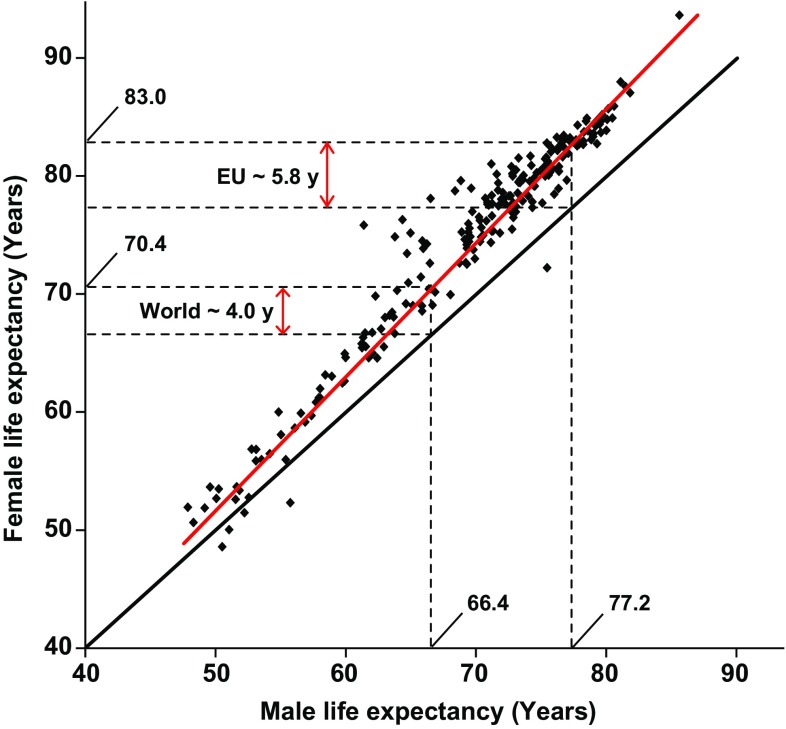
Recent discoveries have shown that harboring cells without the Y chromosome in the peripheral blood is associated with increased risk for all-cause mortality and disease such as different forms of cancer, Alzheimer's disease, as well as other conditions in aging men. In the entire world, the life expectancy of men is shorter compared to women, a sex difference that has been known for centuries, but the underlying mechanism(s) are not well understood. As a male-specific genetic risk factor, an increased risk for pathology and mortality associated with mosaic loss of chromosome Y (LOY) in blood cells could help to explain that men on average live shorter lives compared to women. This review primarily focuses on observed associations between LOY in blood and various diseases in aging men. Other topics covered are known risk factors for LOY, methods to detect LOY, and a discussion regarding mechanisms such as immunosurveillance, that could possibly explain how an acquired mutation in blood cells can be associated with disease processes in other organs.
Conflict of interest statement
LA.F. is co-founder and shareholder in Cray Innovation AB.
Figures
References
-
- Chapiro E, Antony-Debre I, Marchay N, Parizot C, Lesty C, Cung HA, Mathis S, Grelier A, Maloum K, Choquet S, Azgui Z, Uzunov M, Leblond V, Merle-Beral H, Sutton L, Davi F, Nguyen-Khac F. Sex chromosome loss may represent a disease-associated clonal population in chronic 6 lymphocytic leukemia. Genes Chromosomes Cancer. 2014;53:240–247. doi: 10.1002/gcc.22134. - DOI - PubMed
-
- Dumanski JP, Rasi C, Lonn M, Davies H, Ingelsson M, Giedraitis V, Lannfelt L, Magnusson PK, Lindgren CM, Morris AP, Cesarini D, Johannesson M, Tiensuu Janson E, Lind L, Pedersen NL, Ingelsson E, Forsberg LA. Smoking is associated with mosaic loss of chromosome Y. Science. 2015;347(17):81–83. doi: 10.1126/science.1262092. - DOI - PMC - PubMed
-
- Dumanski JP, Lambert JC, Rasi C, Giedraitis V, Davies H, Grenier-Boley B, Lindgren CM, Campion D, Dufouil C, Pasquier F, Amouyel P P, Lannfelt L, Ingelsson M, Kilander L, Lind L, Forsberg LA, European Alzheimer’s Disease Initiative I Mosaic loss of chromosome y in blood is associated with Alzheimer Disease. Am J Hum Genet. 2016;98:1208–1219. doi: 10.1016/j.ajhg.2016.05.014. - DOI - PMC - PubMed
Publication types
MeSH terms
Grants and funding
LinkOut - more resources
Full Text Sources
Other Literature Sources
Medical
Research Materials
