Review
. 2017 Apr 20;18(4):878.
doi: 10.3390/ijms18040878.

EDIM-TKTL1/Apo10 Blood Test: An Innate Immune System Based Liquid Biopsy for the Early Detection, Characterization and Targeted Treatment of Cancer

Affiliations
Review

EDIM-TKTL1/Apo10 Blood Test: An Innate Immune System Based Liquid Biopsy for the Early Detection, Characterization and Targeted Treatment of Cancer

Johannes F Coy. Int J Mol Sci. .

Abstract

Epitope detection in monocytes (EDIM) represents a liquid biopsy exploiting the innate immune system. Activated monocytes (macrophages) phagocytose unwanted cells/cell fragments from the whole body including solid tissues. As they return to the blood, macrophages can be used for a non-invasive detection of biomarkers, thereby providing high sensitivity and specificity, because the intracellular presence of biomarkers is due to an innate immune response. Flow cytometry analysis of blood enables the detection of macrophages and phagocytosed intracellular biomarkers. In order to establish a pan-cancer test, biomarkers for two fundamental biophysical mechanisms have been exploited. The DNaseX/Apo10 protein epitope is a characteristic of tumor cells with abnormal apoptosis and proliferation. Transketolase-like 1 (TKTL1) is a marker for an anaerobic glucose metabolism (Warburg effect), which is concomitant with invasive growth/metastasis and resistant to radical and apoptosis inducing therapies. The detection of Apo10 and TKTL1 in blood macrophages allowed a sensitive (95.8%) and specific (97.3%) detection of prostate, breast and oral squamous cell carcinomas. Since TKTL1 represents a drugable target, the EDIM based detection of TKTL1 enables a targeted cancer therapy using the vitamin derivatives oxythiamine or benfo-oxythiamine.

Keywords: DNase; DNaseX; EDIM; Szent-Györgyi; TKTL1; Warburg; liquid biopsy; macrophage; phagocytosis; transketolase.


Conflict of interest statement

The author declares conflicts of interest due to the use of TKTL1 and DNaseX/Apo10 for the diagnosis of cancer and benfo-oxythiamine for the treatment of cancer. The author is the owner of corresponding patents and a shareholder of Zyagnum AG, City, Country and Tavargenix GmbH, City, Country.

Figures
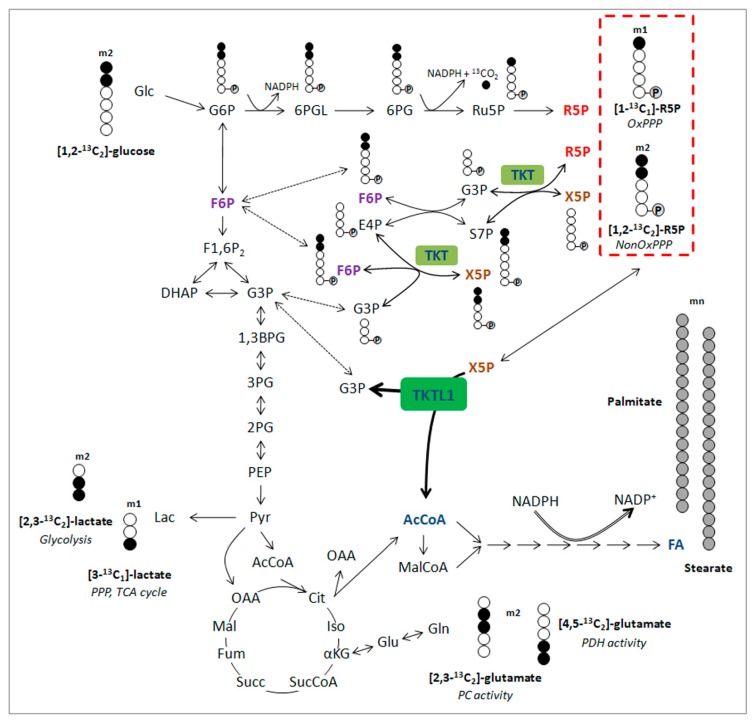
Figure 1
Figure 1
Overview of isotopomer formation through carbon distribution of [1,2-13C2]-glucose. Distribution of carbon atoms from [1,2-13C2]-glucose results in the presence of different kinds of isotopomers from lactate, glutamate and ribose-5-phosphate and reflect the involvement of specific pathways (italic). Ribose-5-phosphate incorporating 3, 4 or 5 13C atoms (m3, m4 and m5) is generated through recirculation of labeled molecules in the pentose phosphate pathway PPP. Carbons are represented by circles. Filled circles represent carbons that have incorporated label form [1,2-13C2]-glucose, open circles represent unlabeled carbons. Circles containing P represent phosphate groups. Abbreviations: m1, m2, isotopologues; 1,3BPG, 1,3-bisphosphoglycerate; 2PG, 2-phosphoglycerate; 3PG, 3-phosphoglycerate; 6PG, 6-phosphogluconate; 6PGL, 6-phosphogluconolactone; AcCoA, acetyl-CoA; Cit, citrate; DHAP, dihydroxyacetone phosphate; E4P, erythrose-4-phosphate; FA, fatty acids; F1,6P2, fructose-1,6-bisphosphate; F6P, fructose-6-phosphate; Fum, fumarate; G3P, glyceraldehyde-3-phosphate; Glc, glucose; G6P, glucose-6-phosphate; Iso, isocitrate; Lac, lactate; Mal, malate; MalCoA, malonyl-CoA; NonOx, nonoxidative; OAA, oxaloacetate; PC, pyruvatecarboxylase; PDH, pyruvatedehydrogenase; PEP, phosphoenolpyruvate; Pyr, pyruvate; R5P, ribose-5-phosphate; Ru5P, ribulose-5-phosphate; S7P, sedoheptulose-7-phosphate; Succ, succinate; SucCoA, succinyl- CoA; TCA, tricarboxylic acid; TKT, Transketolase; TKTL1, Transketolase-like 1; X5P, xylulose-5-phosphate; αKG, α-ketoglutarate. Figure published in [25].
Figure 2
Figure 2
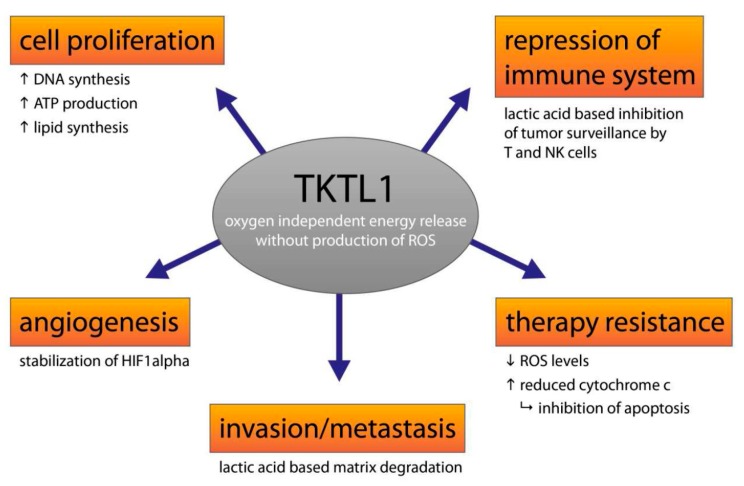
Role of TKTL1 in cancer cells. Contribution of TKTL1 and its metabolites to important hallmarks of cancer leading to increased malignity, survival, immune escape, therapy resistance and distribution of cancer cells in the body. “arrow up” indicates increase, arrow down indicates decrease.
Figure 3
Figure 3
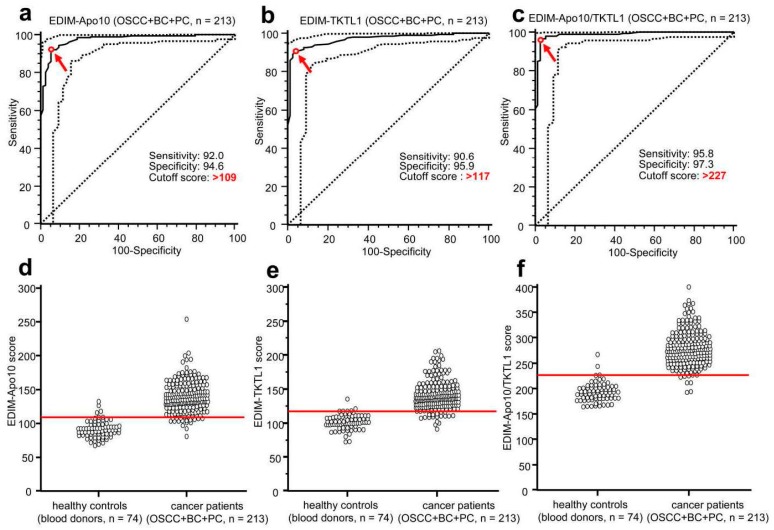
Receiver Operating Characteristics (ROC) analysis of epitope detection in monocytes (EDIM)-Apo10, EDIM-TKTL1, and combined EDIM Apo10/TKTL1 score in all cancer samples (OSCC, breast and prostate cancer, n = 213) compared with healthy individuals (n = 74). The true positive rates (sensitivity) are plotted in functions of the false positive rate (100-specificity) for measurement of the cut-off point: ROC analysis for the diagnosis of all cancer samples/entities (OSCC, breast and prostate cancer, ac) shows calculated cut-off value with highest diagnostic accuracy (arrows) of EDIM-Apo10 (a), EDIM-TKTL1 (b), and combined EDIM Apo10/TKTL1 (c) score (a, EDIM-Apo10 score >109: sensitivity 92.0%, 95% confidence interval (CI) 87.5–95.3%, specificity 94.6%, 95% CI 86.7–98.5%; b, EDIM-TKTL1 score >117: sensitivity 90.6%, 95% CI 85.9–94.2%, specificity 95.9%, 95% CI 88.6–99.2%; c, combined EDIM-Apo10 plus EDIM-TKTL1 score >227: sensitivity 95.8%, 95% CI 92.1–98.0%, specificity 97.3%, 95% CI 90.6–99.7%). Dotted lines show 95% CI. OSCC, oral squamous cell carcinoma; BC, breast cancer; PC, prostate cancer. In the interactive dot diagrams (part of ROC curve analysis, df), the data of healthy controls and cancer group are displayed as dots on two vertical axes. The horizontal line indicates the cut-off points with the best separation/highest accuracy (minimal false negative and false positive results) between healthy controls and cancer group. The corresponding test characteristics sensitivity and specificity are shown above. Figure published in [2, additional file 13].

References

    1. Feyen O., Coy J.F., Prasad V., Schierl R., Saenger J., Baum R.P. EDIM-TKTL1 blood test: A noninvasive method to detect upregulated glucose metabolism in patients with malignancies. Future Oncol. 2012;8:1349–1359. doi: 10.2217/fon.12.98. - DOI - PubMed
    1. Grimm M., Schmitt S., Teriete P., Biegner T., Stenzl A., Hennenlotter J., Muhs H.J., Munz A., Nadtotschi T., König K., et al. A biomarker based detection and characterization of carcinomas exploiting two fundamental biophysical mechanisms in mammalian cells. BMC Cancer. 2013;13:569. doi: 10.1186/1471-2407-13-569. - DOI - PMC - PubMed
    1. Grimm M., Kraut W., Hoefert S., Krimmel M., Biegner T., Teriete P., Cetindis M., Polligkeit J., Kluba S., Munz A., et al. Evaluation of a biomarker based blood test for monitoring surgical resection of oral squamous cell carcinomas. Clin. Oral Investig. 2016;20:329–338. doi: 10.1007/s00784-015-1518-0. - DOI - PubMed
    1. Jansen N., Coy J.F. Diagnostic use of epitope detection in monocytes blood test for early detection of colon cancer metastasis. Future Oncol. 2013;9:605–609. doi: 10.2217/fon.13.8. - DOI - PubMed
    1. Penault-Llorca F., Radosevic-Robin N. Ki67 assessment in breast cancer: An update. Pathology. 2017;49:166–171. doi: 10.1016/j.pathol.2016.11.006. - DOI - PubMed

MeSH terms