Framing Mechanisms Linking HIV-Related Stigma, Adherence to Treatment, and Health Outcomes
- PMID: 28426316
- PMCID: PMC5425866
- DOI: 10.2105/AJPH.2017.303744
Framing Mechanisms Linking HIV-Related Stigma, Adherence to Treatment, and Health Outcomes
Abstract
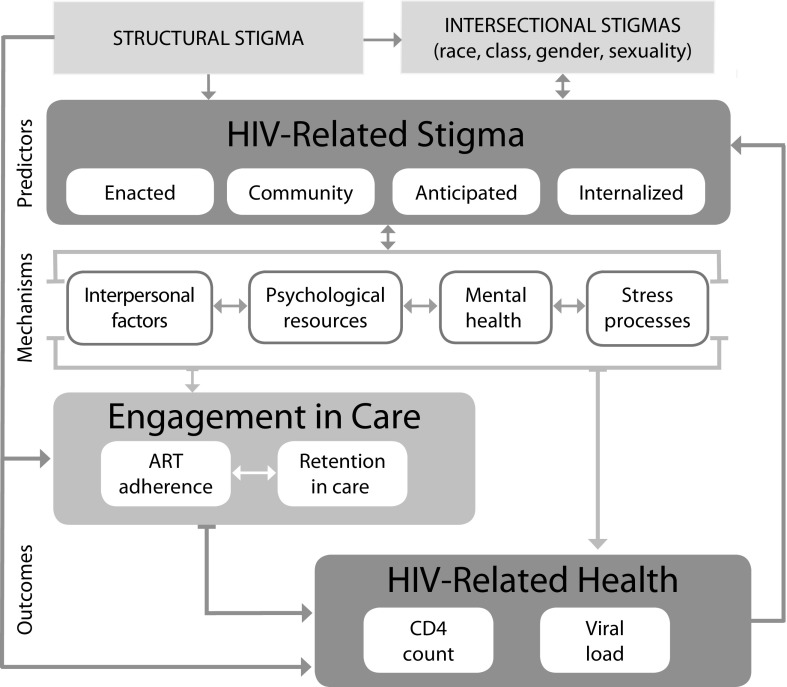
We present a conceptual framework that highlights how unique dimensions of individual-level HIV-related stigma (perceived community stigma, experienced stigma, internalized stigma, and anticipated stigma) might differently affect the health of those living with HIV. HIV-related stigma is recognized as a barrier to both HIV prevention and engagement in HIV care, but little is known about the mechanisms through which stigma leads to worse health behaviors or outcomes. Our conceptual framework posits that, in the context of intersectional and structural stigmas, individual-level dimensions of HIV-related stigma operate through interpersonal factors, mental health, psychological resources, and biological stress pathways. A conceptual framework that encompasses recent advances in stigma science can inform future research and interventions aiming to address stigma as a driver of HIV-related health.
Figures
References
-
- Crepaz N, Tang T, Marks G, Mugavero MJ, Espinoza L, Hall HI. Durable viral suppression among HIV-diagnosed persons—United States, 2012–2013. Paper presented at Conference on Retroviruses and Opportunistic Infections (CROI) February 22–25, 2016; Boston, MA.
-
- Hatzenbuehler ML, Link BG. Introduction to the special issue on structural stigma and health. Soc Sci Med. 2014;103:1–6. - PubMed
MeSH terms
Grants and funding
- P30 AI027767/AI/NIAID NIH HHS/United States
- P30 MH062246/MH/NIMH NIH HHS/United States
- U01 AI031834/AI/NIAID NIH HHS/United States
- U01 AI035004/AI/NIAID NIH HHS/United States
- U01 AI034989/AI/NIAID NIH HHS/United States
- T32 HS013852/HS/AHRQ HHS/United States
- U01 AI034994/AI/NIAID NIH HHS/United States
- UL1 TR000454/TR/NCATS NIH HHS/United States
- P30 AI027763/AI/NIAID NIH HHS/United States
- U01 AI103401/AI/NIAID NIH HHS/United States
- R01 MH104114/MH/NIMH NIH HHS/United States
- UL1 TR000004/TR/NCATS NIH HHS/United States
- U01 AI103408/AI/NIAID NIH HHS/United States
- U01 AI103397/AI/NIAID NIH HHS/United States
- R01 MH095683/MH/NIMH NIH HHS/United States
- U01 AI103390/AI/NIAID NIH HHS/United States
- U01 AI034993/AI/NIAID NIH HHS/United States
- U01 HD032632/HD/NICHD NIH HHS/United States
- U01 AI042590/AI/NIAID NIH HHS/United States
LinkOut - more resources
Full Text Sources
Other Literature Sources
Medical