


Transient exposure to androgens induces a remarkable self-sustained quiescent state in dispersed prostate cancer cells
- PMID: 28426320
- PMCID: PMC5444360
- DOI: 10.1080/15384101.2017.1310345
Transient exposure to androgens induces a remarkable self-sustained quiescent state in dispersed prostate cancer cells
Abstract
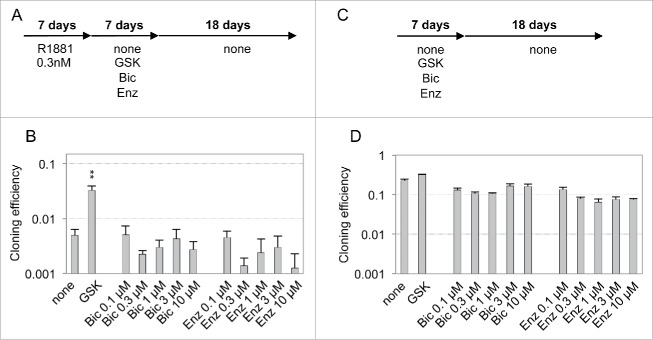
Cellular quiescence is a reversible cell growth arrest that is often assumed to require a persistence of non-permissive external growth conditions for its maintenance. In this work, we showed that androgen could induce a quiescent state that is self-sustained in a cell-autonomous manner through a "hit and run" mechanism in androgen receptor-expressing prostate cancer cells. This phenomenon required the set-up of a sustained redox imbalance and TGFβ/BMP signaling that were dependent on culturing cells at low density. At medium cell density, androgens failed to induce such a self-sustained quiescent state, which correlated with a lesser induction of cell redox imbalance and oxidative stress markers like CDKN1A. These effects of androgens could be mimicked by transient overexpression of CDKN1A that triggered its own expression and a sustained SMAD phosphorylation in cells cultured at low cell density. Overall, our data suggest that self-sustained but fully reversible quiescent states might constitute a general response of dispersed cancer cells to stress conditions.
Keywords: Androgen; BMP; CDKN1A; cellular quiescence; feedback loops; oxidative stress; prostate cancer.
Figures




Comment in
-
Rationale for bipolar androgen therapy (BAT) for metastatic prostate cancer.Cell Cycle. 2017 Sep 17;16(18):1639-1640. doi: 10.1080/15384101.2017.1360645. Epub 2017 Aug 18. Cell Cycle. 2017. PMID: 28820291 Free PMC article. No abstract available.
References
-
- Havard M, Dautry F, Tchenio T. A dormant state modulated by osmotic pressure controls clonogenicity of prostate cancer cells. J Biol Chem 2011; 286:44177-86; PMID:22039055; http://dx.doi.org/ 10.1074/jbc.M111.262709 - DOI - PMC - PubMed
-
- Bui AT, Laurent F, Havard M, Dautry F, Tchenio T. SMAD signaling and redox imbalance cooperate to induce prostate cancer cell dormancy. Cell Cycle 2015; 14:1218-31; PMID:25706341; http://dx.doi.org/ 10.1080/15384101.2015.1014145 - DOI - PMC - PubMed
-
- Wang ZA, Shen MM. Revisiting the concept of cancer stem cells in prostate cancer. Oncogene 2011; 30:1261-71; PMID:21119602; http://dx.doi.org/ 10.1038/onc.2010.530 - DOI - PubMed
-
- Choi N, Zhang B, Zhang L, Ittmann M, Xin L. Adult murine prostate basal and luminal cells are self-sustained lineages that can both serve as targets for prostate cancer initiation. Cancer Cell 2012; 21:253-65; PMID:22340597; http://dx.doi.org/ 10.1016/j.ccr.2012.01.005 - DOI - PMC - PubMed
-
- Wadosky KM, Koochekpour S. Molecular mechanisms underlying resistance to androgen deprivation therapy in prostate cancer. Oncotarget 2016; 7:64447-70; PMID:27487144; http://dx.doi.org/ 10.18632/oncotarget.10901 - DOI - PMC - PubMed
MeSH terms
Substances
LinkOut - more resources
Full Text Sources
Other Literature Sources
Medical
