


The varied distribution and impact of RAS codon and other key DNA alterations across the translocation cyclin D subgroups in multiple myeloma
- PMID: 28427158
- PMCID: PMC5438613
- DOI: 10.18632/oncotarget.15718
The varied distribution and impact of RAS codon and other key DNA alterations across the translocation cyclin D subgroups in multiple myeloma
Abstract
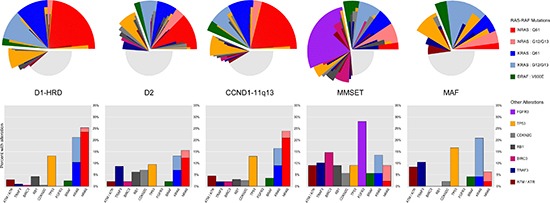
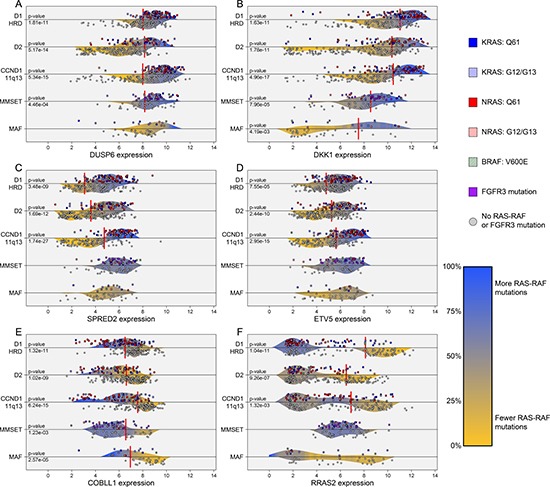
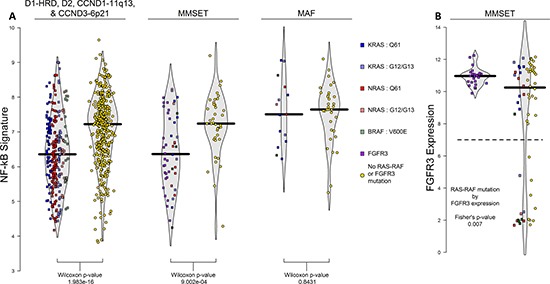
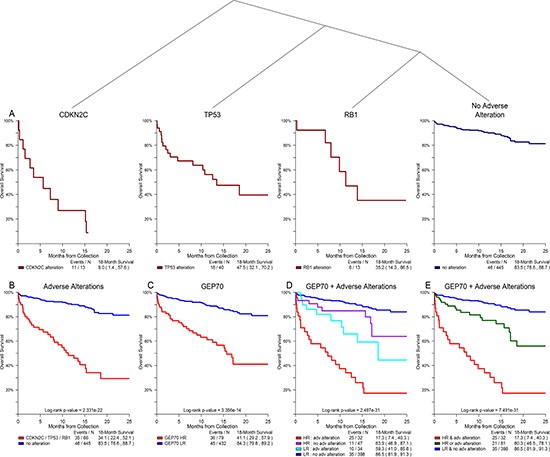
We examined a set of 805 cases that underwent DNA sequencing using the FoundationOne Heme (F1H) targeted sequencing panel and gene expression profiling. Known and likely variant calls from the mutational data were analyzed for significant associations with gene expression defined translocation cyclin D (TC) molecular subgroups. The spectrum of KRAS, NRAS, and BRAF codon mutations varied across subgroups with NRAS mutations at Q61 codon being common in hyperdiploid (HRD) and t(11;14) myeloma while being rare in MMSET and MAF. In addition, the presence of RAS-RAF mutations was inversely associated with NFκB pathway activation in all subgroups excluding MAF. In the MMSET subgroup, cases with low FGFR3 expression frequently had RAS-RAF mutations. Conditional inference tree analysis determined that mutation and homozygous deletion of TP53, CDKN2C, and RB1 were key prognostic factors associated with adverse outcome in a non-relapse clinical setting. In conclusion, this study highlights the heterogeneity in the distribution and clinical outcomes of RAS codon and other mutations in multiple myeloma dependent upon primary molecular subgroup.
Keywords: gene expression profiling; multiple myeloma; mutational analysis; translocation cyclin D (TC).
Conflict of interest statement
GJM has received honoraria from Bristol-Myers Squibb, Celgene, Takeda-Millenium, Janssen, and Amgen, served in a consulting or advisory role for Bristol-Myers Squibb, Celgene, Takeda-Millenium, and Janssen, and has received research funding from Celgene and Janssen. FED has received honoraria from Bristol-Myers Squibb, Celgene, and Takeda-Millenium, served in a consulting or advisory role for Bristol-Myers Squibb, Celgene, and Takeda-Millenium. CP has participated in advisory boards and spoken at meetings for Celgene and Takeda-Millenium, and received travel support to attend meeting from Celgene. Bart Barlogie has received research funding from Celgene and Millennium, is a consultant to Celgene and Millennium, and a co-inventor on patents and patent applications related to use of GEP in cancer medicine. Theremaining authors declare no relevant conflicts of interest.
Figures

References
-
- Fonseca R, Barlogie B, Bataille R, Bastard C, Bergsagel LP, Chesi M, Davies EF, Drach J, Greipp RP, Kirsch RI, Kuehl MW, Hernandez MJ, Minvielle S, et al. Genetics and cytogenetics of multiple myeloma: a workshop report. Cancer Res. 2004;64:1546–58. - PubMed
-
- Cremer FW, Bila J, Buck I, Kartal M, Hose D, Ittrich C, Benner A, Raab SM, Theil CA, Moos M, Goldschmidt H, Bartram RC, Jauch A. Delineation of distinct subgroups of multiple myeloma and a model for clonal evolution based on interphase cytogenetics. Genes Chromosomes Cancer. 2005;44:194–203. - PubMed
-
- Fonseca R, Debes-Marun CS, Picken BE, Dewald WG, Bryant CS, Winkler MJ, Blood E, Oken MM, Santana-Dávila R, González-Paz N. The recurrent IgH translocations are highly associated with nonhyperdiploid variant multiple myeloma. Blood. 2003;102:2562–2567. - PubMed
-
- Bergsagel PL, Kuehl MW. Molecular pathogenesis and a consequent classification of multiple myeloma. J Clin Oncol. 2005;23:6333–8. - PubMed
MeSH terms
Substances
Grants and funding
LinkOut - more resources
Full Text Sources
Other Literature Sources
Medical
Research Materials
Miscellaneous
