


Accuracy of low-density lipoprotein cholesterol estimation at very low levels
- PMID: 28427464
- PMCID: PMC5399386
- DOI: 10.1186/s12916-017-0852-2
Accuracy of low-density lipoprotein cholesterol estimation at very low levels
Abstract
Background: As the approach to low-density lipoprotein cholesterol (LDL-C) lowering becomes increasingly intensive, accurate assessment of LDL-C at very low levels warrants closer attention in individualized clinical efficacy and safety evaluation. We aimed to assess the accuracy of LDL-C estimation at very low levels by the Friedewald equation, the de facto clinical standard, and compare its accuracy with a novel, big data-derived LDL-C estimate.
Methods: In 191,333 individuals with Friedewald LDL-C < 70 mg/dL, we compared the accuracy of Friedewald and novel LDL-C values in relation to direct measurements by Vertical Auto Profile ultracentrifugation. We examined differences (estimate minus ultracentrifugation) and classification according to levels initiating additional safety precautions per clinical practice guidelines.
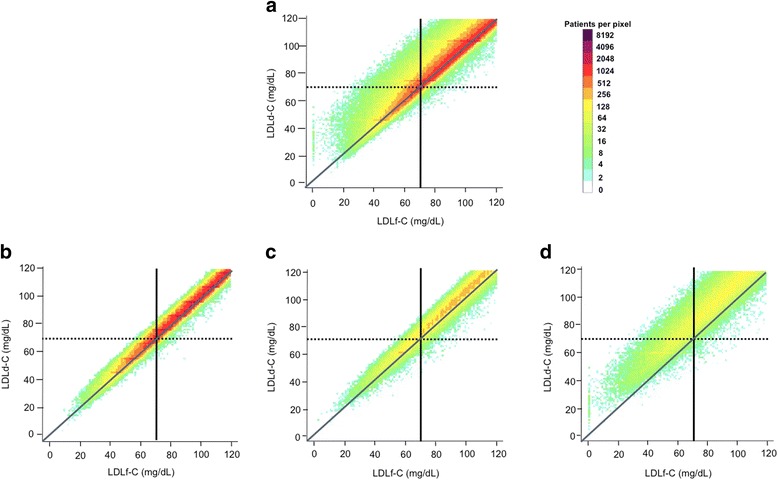
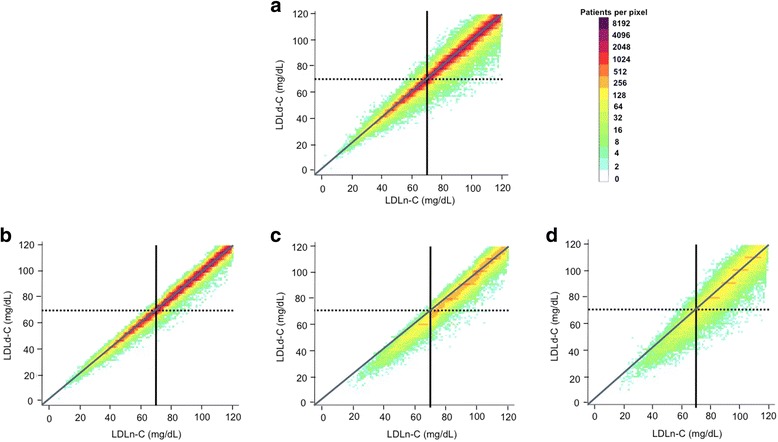
Results: Friedewald values were less than ultracentrifugation measurement, with a median difference (25th to 75th percentile) of -2.4 (-7.4 to 0.6) at 50-69 mg/dL, -7.0 (-16.2 to -1.2) at 25-39 mg/dL, and -29.0 (-37.4 to -19.6) at < 15 mg/dL. The respective values by novel estimation were -0.1 (-1.5 to 1.3), -1.1 (-2.5 to 0.3), and -2.7 (-4.9 to 0.0) mg/dL. Among those with Friedewald LDL-C < 15, 15 to < 25, and 25 to < 40 mg/dL, the classification was discordantly low in 94.9%, 82.6%, and 59.9% of individuals as compared with 48.3%, 42.4%, and 22.4% by novel estimation.
Conclusions: Estimation of even lower LDL-C values (by Friedewald and novel methods) is even more inaccurate. More often than not, a Friedewald value < 40 mg/dL is underestimated, which translates into unnecessary safety alarms that could be reduced in half by estimation using our novel method.
Keywords: Accuracy; Clinical decision making; Friedewald estimation; Low-density lipoprotein cholesterol; Novel method; Very low.
Figures
References
-
- Ference BA, Yoo W, Alesh I, Mahajan N, Mirowska KK, Mewada A, Kahn J, Afonso L, Williams KA, Sr, Flack JM. Effect of long-term exposure to lower low-density lipoprotein cholesterol beginning early in life on the risk of coronary heart disease: a Mendelian randomization analysis. J Am Coll Cardiol. 2012;60(25):2631–9. doi: 10.1016/j.jacc.2012.09.017. - DOI - PubMed
-
- Yusuf S, Hawken S, Ounpuu S, Dans T, Avezum A, Lanas F, McQueen M, Budaj A, Pais P, Varigos J, et al. Effect of potentially modifiable risk factors associated with myocardial infarction in 52 countries (the INTERHEART study): case-control study. Lancet. 2004;364(9438):937–52. doi: 10.1016/S0140-6736(04)17018-9. - DOI - PubMed
-
- Baigent C, Keech A, Kearney PM, Blackwell L, Buck G, Pollicino C, Kirby A, Sourjina T, Peto R, Collins R, et al. Efficacy and safety of cholesterol-lowering treatment: prospective meta-analysis of data from 90,056 participants in 14 randomised trials of statins. Lancet. 2005;366(9493):1267–78. doi: 10.1016/S0140-6736(05)67394-1. - DOI - PubMed
MeSH terms
Substances
LinkOut - more resources
Full Text Sources
Other Literature Sources
Medical
Research Materials
