. 2017 Apr 20;7(1):938.
doi: 10.1038/s41598-017-01058-y.

Network-assisted analysis of GWAS data identifies a functionally-relevant gene module for childhood-onset asthma

Affiliations

Network-assisted analysis of GWAS data identifies a functionally-relevant gene module for childhood-onset asthma

Y Liu et al. Sci Rep. .

Abstract

The number of genetic factors associated with asthma remains limited. To identify new genes with an undetected individual effect but collectively influencing asthma risk, we conducted a network-assisted analysis that integrates outcomes of genome-wide association studies (GWAS) and protein-protein interaction networks. We used two GWAS datasets, each consisting of the results of a meta-analysis of nine childhood-onset asthma GWASs (5,924 and 6,043 subjects, respectively). We developed a novel method to compute gene-level P-values (fastCGP), and proposed a parallel dense-module search and cross-selection strategy to identify an asthma-associated gene module. We identified a module of 91 genes with a significant joint effect on childhood-onset asthma (P < 10-5). This module contained a core subnetwork including genes at known asthma loci and five peripheral subnetworks including relevant candidates. Notably, the core genes were connected to APP (encoding amyloid beta precursor protein), a major player in Alzheimer's disease that is known to have immune and inflammatory components. Functional analysis of the module genes revealed four gene clusters involved in innate and adaptive immunity, chemotaxis, cell-adhesion and transcription regulation, which are biologically meaningful processes that may underlie asthma risk. Our findings provide important clues for future research into asthma aetiology.


Conflict of interest statement

The authors declare that they have no competing interests.

Figures
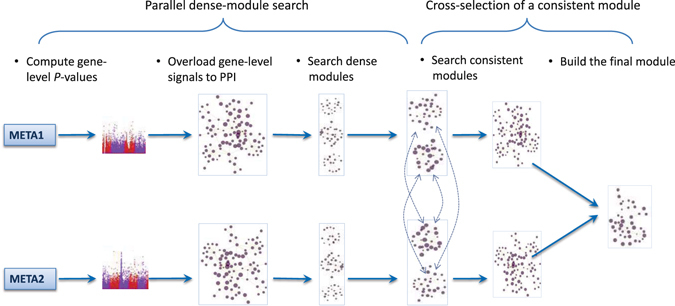
Figure 1
Figure 1
Workflow of the parallel dense-module search and cross-selection strategy. Individual SNP-level P-values from two independent childhood-onset asthma GWAS datasets (META1 and META2) were used as input for our network analysis. Gene-level P-values, computed from SNP-level P-values using fastCGP were converted to z-scores and overloaded to the PPI. The Dense Module Search algorithm was applied to each scored-PPI in parallel to search for dense modules. Modules with highest consistency between the two datasets were selected to build the final module.
Figure 2
Figure 2
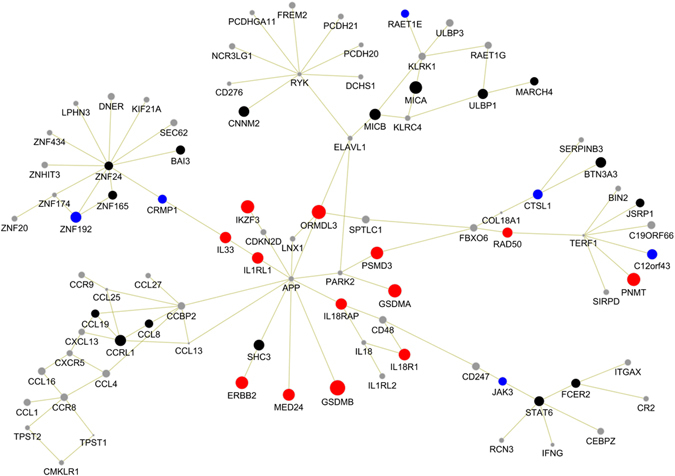
The gene module identified for childhood-onset asthma. The red coloured nodes represent genes at known asthma associated loci and nominally significant in both META1 and META2 datasets; the blue coloured nodes represent new module genes that are nominally significant in both META1 and META2 datasets; the black coloured nodes represent new module genes that are nominally significant in either dataset; the grey coloured nodes are not significant. The node size indicated the strength of the association (the maximum z-score of its corresponding gene in the two datasets).
Figure 3
Figure 3
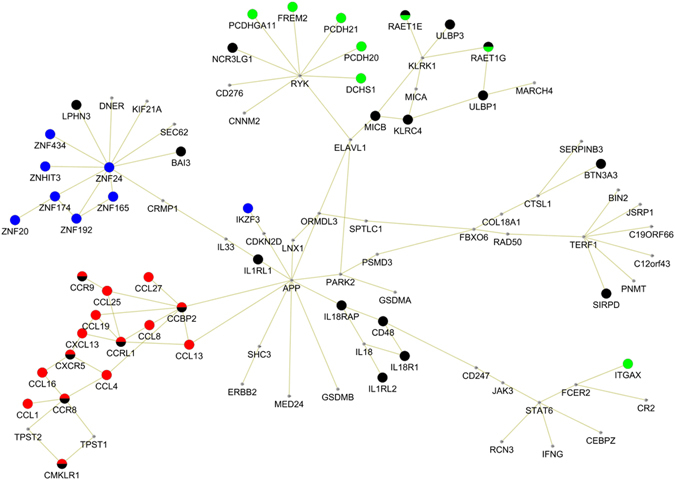
Clusters of functionally-related genes in the COA module. Four genes cluster including a total of 44 out of 91 module genes were identified using DAVID, . The genes coloured in black belong to the Immune Response cluster; the genes coloured in red belong to the Chemokines/Chemotaxis cluster; the genes coloured in green belong to the Cadherins/Cell-adhesion cluster and the genes coloured in blue belong to the Zinc finger proteins/Transcription regulation cluster. Genes belonging to multiple clusters are marked by mixed colours.

References

    1. Martinez FD, Vercelli D. Asthma. The Lancet. 2013;382:1360–1372. doi: 10.1016/S0140-6736(13)61536-6. - DOI - PMC - PubMed
    1. Los H, Koppelman GH, Postma DS. The importance of genetic influences in asthma. Eur. Respir. J. 1999;14:1210–1227. doi: 10.1183/09031936.99.14512109. - DOI - PubMed
    1. Vercelli D. Discovering susceptibility genes for asthma and allergy. Nat. Rev. Immunol. 2008;8:169–182. doi: 10.1038/nri2257. - DOI - PubMed
    1. Welter D, et al. The NHGRI GWAS Catalog, a curated resource of SNP-trait associations. Nucleic Acids Res. 2014;42:D1001–1006. doi: 10.1093/nar/gkt1229. - DOI - PMC - PubMed
    1. Bouzigon E, et al. Effect of 17q21 Variants and Smoking Exposure in Early-Onset Asthma. N. Engl. J. Med. 2008;359:1985–1994. doi: 10.1056/NEJMoa0806604. - DOI - PubMed

Publication types

Substances