


Cyclophosphamide-induced HCN1 channel upregulation in interstitial Cajal-like cells leads to bladder hyperactivity in mice
- PMID: 28428632
- PMCID: PMC6130216
- DOI: 10.1038/emm.2017.31
Cyclophosphamide-induced HCN1 channel upregulation in interstitial Cajal-like cells leads to bladder hyperactivity in mice
Abstract
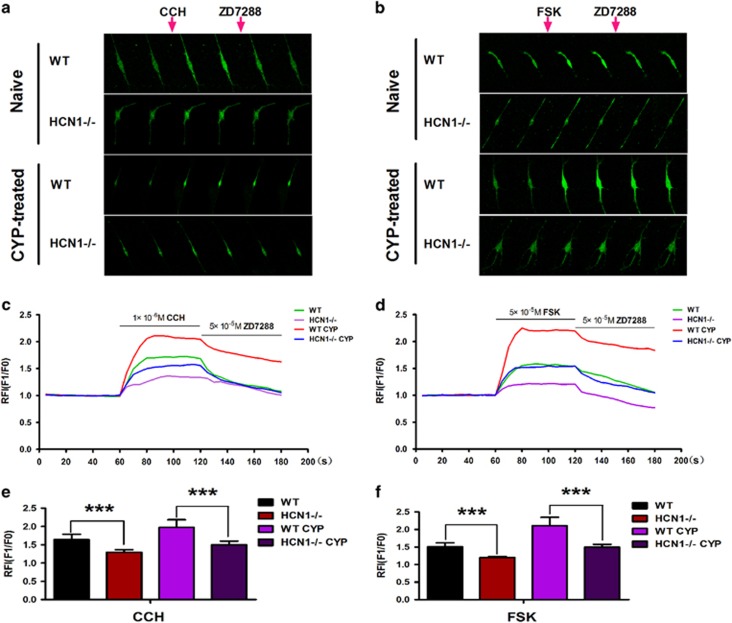
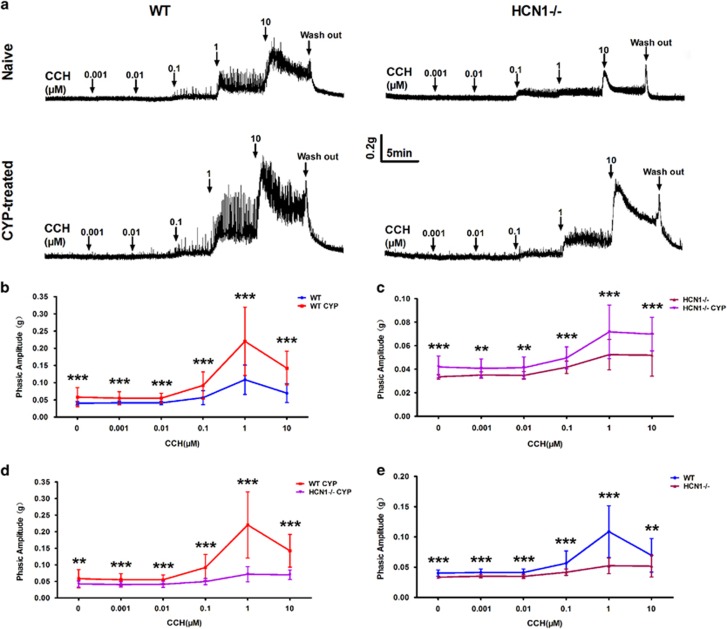
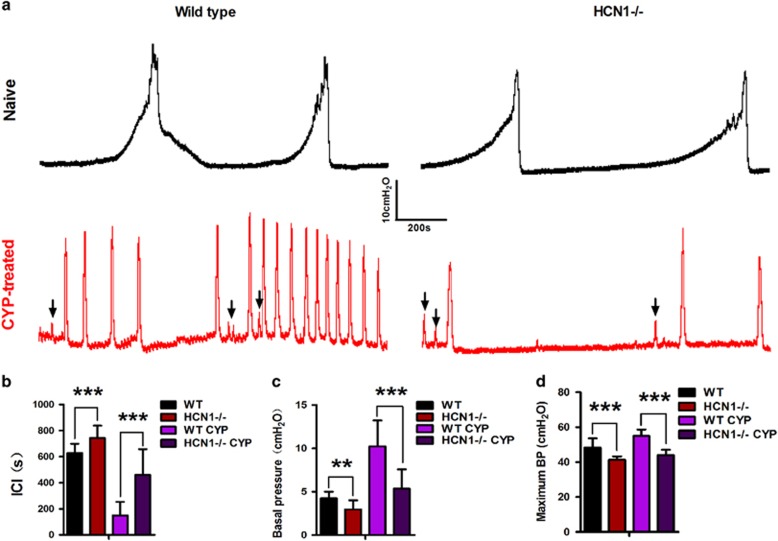
Hyperpolarization-activated cyclic nucleotide-gated (HCN) channels are confirmed to be expressed in bladder interstitial Cajal-like cells (ICC-LCs), but little is known about their possible role in cystitis-associated bladder dysfunction. The present study aimed to determine the functional role of HCN channels in regulating bladder function under inflammatory conditions. Sixty female wild-type C57BL/6J mice and sixty female HCN1-knockout mice were randomly assigned to experimental and control groups, respectively. Cyclophosphamide (CYP)-induced cystitis models were successfully established in these mice. CYP treatment significantly enhanced HCN channel protein expression and Ih density and significantly altered bladder HCN1 channel regulatory proteins. Carbachol (CCH) and forskolin (FSK) exerted significant effects on bladder ICC-LC [Ca2+]i in CYP-treated wild-type (WT) mice, and HCN1 channel ablation significantly decreased the effects of CCH and FSK on bladder ICC-LC [Ca2+]i in both naive and CYP-treated mice. CYP treatment significantly potentiated the spontaneous contractions and CCH (0.001-10 μM)-induced phasic contractions of detrusor strips, and HCN1 channel deletion significantly abated such effects. Finally, we demonstrated that the development of CYP-induced bladder overactivity was reversed in HCN1-/- mice. Taken together, our results suggest that CYP-induced enhancements of HCN1 channel expression and function in bladder ICC-LCs are essential for cystitis-associated bladder hyperactivity development, indicating that the HCN1 channel may be a novel therapeutic target for managing bladder hyperactivity.
Conflict of interest statement
The authors declare no conflict of interest.
Figures
References
-
- Andersson KE, Arner A. Urinary bladder contraction and relaxation: physiology and pathophysiology. Physiol Rev 2004; 84: 935–986. - PubMed
-
- Kairys AE, Schmidt-Wilcke T, Puiu T, Ichesco E, Labus JS, Martucci K et al. Increased brain gray matter in the primary somatosensory cortex is associated with increased pain and mood disturbance in patients with interstitial cystitis/painful bladder syndrome. J Urol 2015; 193: 131–137. - PMC - PubMed
-
- Humphrey L, Arbuckle R, Moldwin R, Nordling J, van de Merwe JP, Meunier J et al. The bladder pain/interstitial cystitis symptom score: development, validation, and identification of a cut score. Eur Urol 2012; 61: 271–279. - PubMed
-
- Kuo YC, Kuo HC. Potential factors that can be used to differentiate between interstitial cystitis/painful bladder syndrome and bladder oversensitivity in women. Int J Clin Pract 2012; 66: 146–151. - PubMed
Publication types
MeSH terms
Substances
LinkOut - more resources
Full Text Sources
Other Literature Sources
Research Materials
Miscellaneous
