


Employee Age Alters the Effects of Justice on Emotional Exhaustion and Organizational Deviance
- PMID: 28428764
- PMCID: PMC5382225
- DOI: 10.3389/fpsyg.2017.00479
Employee Age Alters the Effects of Justice on Emotional Exhaustion and Organizational Deviance
Abstract
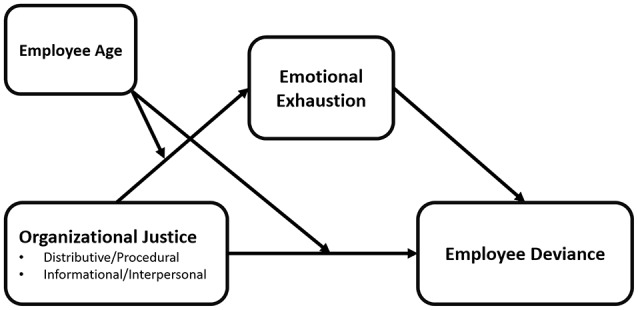
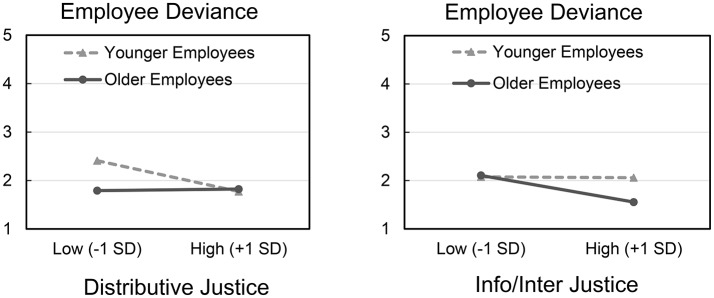
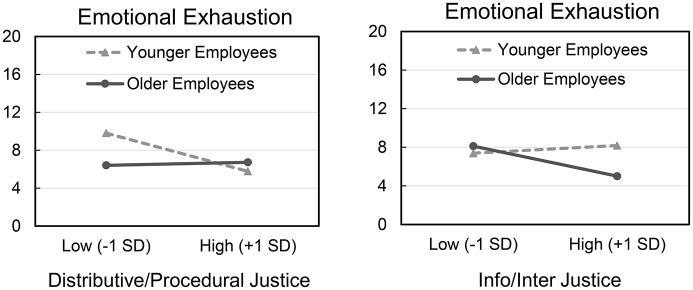
Fairness in the workplace attenuates a host of negative individual and organizational outcomes. However, research on the psychology of aging challenges the assumption that fairness operates similarly across different age groups. The current research explored how older workers, vis-à-vis younger workers, react to perceptions of fairness. Integrating socioemotional selectivity theory and the multiple needs theory of organizational justice, we generated novel predictions regarding the relations between perceptions of workplace justice, emotional exhaustion, and employee deviance. Specifically, we hypothesized and found that employee age moderates the negative relation between justice facets and deviance (Study 1) and emotional exhaustion (Study 2). We also found that emotional exhaustion mediates the differential effects of justice on deviance, and that this relation depends on employee age (Study 2). Relative to younger workers, older workers are more sensitive to informational and interpersonal justice; in contrast, relative to older workers, younger workers are more sensitive to distributive and procedural justice. The research supports and extends existing theory on organizational justice and on the psychology of aging. Moreover, it highlights the importance of considering employee age as a focal variable of interest in the study of justice processes, and in organizational research more generally.
Keywords: deviance; emotional exhaustion; employee age; instrumental and relational needs; organizational justice.
Figures
References
-
- Adams J. S. (1965). Inequity in social exchange, in Advances in Experimental Social Psychology, vol. 2, ed Berkowitz L. (New York, NY: Academic Press; ), 267–299.
-
- Aiken L. S., West S. G. (1991). Multiple Regression: Testing and Interpreting Interactions. Thousand Oaks, CA: Sage.
-
- Aquino K., Lewis M. U., Bradfield M. (1999). Justice constructs, negative affectivity, and employee deviance: a proposed model and empirical test. Organ. Behav. 20, 1073–1091.
LinkOut - more resources
Full Text Sources
Other Literature Sources
