Impact of adverse drug events and treatment satisfaction on patient adherence with antihypertensive medication - a study in ambulatory patients
- PMID: 28429533
- PMCID: PMC5555859
- DOI: 10.1111/bcp.13312
Impact of adverse drug events and treatment satisfaction on patient adherence with antihypertensive medication - a study in ambulatory patients
Abstract
Aims: The aim of the present study was to evaluate the impact of adverse drug events (ADEs) and treatment satisfaction on antihypertensive medication adherence.
Methods: A cross-sectional study was conducted in six public hospitals in Ethiopia. We included adult ambulatory patients on antihypertensive medication. Adherence was measured using the eight-point Morisky Medication Adherence Scale, which categorizes as low (0-5), medium (6-7) and high (8) adherence. Treatment satisfaction was measured using the Treatment Satisfaction Questionnaire for Medication (TSQM) version 1.4, which included questions about ADEs. Data were analysed using generalized ordered logistic regression with 95% confidence intervals (CIs).
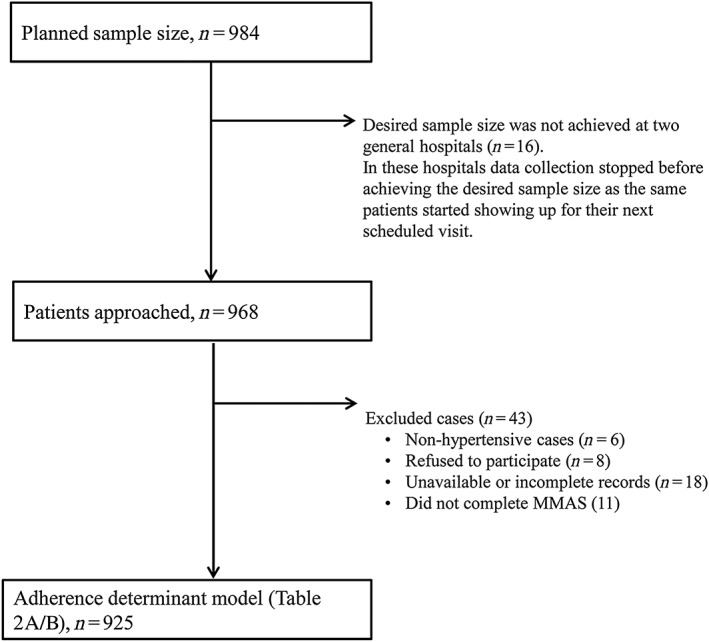
Results: We included 925 out of 968 patients. Overall, 42% of patients scored low, 37% medium and 21% high adherence. Satisfaction with treatment was low, with a mean (standard deviation) TSQM score for global satisfaction of 51 (14). A total of 193 (21%) patients experienced 421 ADEs - mainly dyspeptic symptoms (12%), headache (11%) and cough (11). Experiencing more ADEs reduced the odds of being adherent [low vs. medium/high: odds ratio (OR) OR1 0.77 (95% CI 0.67, 0.89), and low/medium vs. high: OR2 0.55 (05% CI 0.41, 0.73)]. Being more satisfied increased the odds of being adherent [low vs. medium/high: OR1 1.02 (95% CI 1.01, 1.03)]. Taking medication >1 year [OR1 = 2 , 0.60 (95% CI 0.43, 0.83)] and taking calcium channel blockers [OR1 = 2 0.71 (95% CI 0.54, 0.92)] decreased the odds for both low vs. medium/high and low/medium vs. high adherence.
Conclusions: Only one in five patients reported perfect (high) adherence to their antihypertensive treatment regimen. Experiencing ADEs and being dissatisfied with treatment were associated with lower adherence. In addition to addressing treatment satisfaction and drug safety in first-world countries, these should also be addressed in resource-poor settings, within patient consultations, to enhance adherence.
Keywords: adverse drug event; ambulatory patients; antihypertensive medication; generalized ordered logistic regression; hypertension; medication adherence; treatment satisfaction.
© 2017 The British Pharmacological Society.
Figures

References
-
- Corrao G, Parodi A, Nicotra F, Zambon A, Merlino L, Cesana G, et al. Better compliance to antihypertensive medications reduces cardiovascular risk. J Hypertens 2011; 29: 610–618. - PubMed
-
- Sabaté E. Adherence to long‐term therapies: evidence for action. Geneva: World Health Organization, 2003.
MeSH terms
Substances
LinkOut - more resources
Full Text Sources
Other Literature Sources
Medical
Molecular Biology Databases