


LncRNA CHRF-induced miR-489 loss promotes metastasis of colorectal cancer via TWIST1/EMT signaling pathway
- PMID: 28430582
- PMCID: PMC5482664
- DOI: 10.18632/oncotarget.16850
LncRNA CHRF-induced miR-489 loss promotes metastasis of colorectal cancer via TWIST1/EMT signaling pathway
Abstract
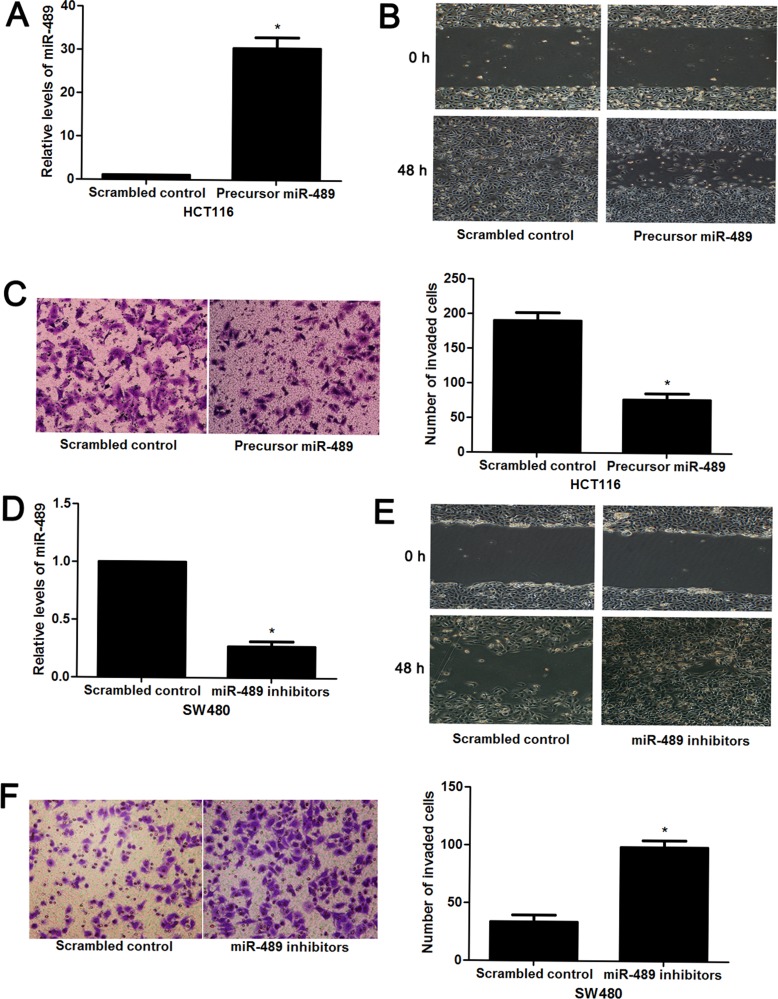
microRNA-489 (miR-489) is a novel cancer-related miRNAs and functions as a tumor suppressor in human cancers. While, the clinical significance of miR-489 and its role in colorectal cancer (CRC) remain rarely known. Here, we found that the levels of miR-489 in CRC tissues were significantly lower than those in matched tumor-adjacent tissues. Furthermore, decreased levels of miR-489 also observed in CRC cell lines compared to HIEC cells. Clinicopathological analysis revealed that miR-489 underexpression was positively correlated with advanced pT stage, pN stage and AJCC stage. Moreover, miR-489 low expressing CRC patients showed a obvious shorter survival. Functionally, miR-489 restoration inhibited cell migration and invasion as well as epithelial-mesenchymal transition (EMT) in HCT116 cells, while miR-489 loss facilitated these cellular processes in SW480 cells. In vivo experiments revealed that miR-489 overexpression reduced the number of metastatic nodules in nude mice liver. Notably, TWIST1 was recognized as a direct downstream target of miR-489 in CRC cells. Interestingly, TWIST1 restoration abrogated the effects of miR-489 on CRC cells with enhanced cell migration, invasion and EMT process. Furthermore, overexpression of long noncoding RNA cardiac hypertrophy-related factor (lncRNA CHRF) was inversely correlated with miR-489 expression in CRC tissues. CHRF knockdown increased the expression of miR-489 and suppressed EMT events of HCT116 cells, while CHRF overexpression showed opposite effects on miR-489 expression and EMT in SW480 cells. Taken together, this work support the first evidence that lncRNA CHRF-induced miR-489 loss facilitates metastasis and EMT process of CRC cells probably via TWIST1/EMT signaling pathway.
Keywords: CRC; LncRNA CHRF; TWIST1/EMT; metastasis; miR-489.
Conflict of interest statement
All authors declare no conflicts of interest.
Figures



References
-
- Potter JD, Hunter D. In: Genetics of Colorectal Cancer. Springer; 2009. Colorectal cancer: epidemiology; pp. 5–25.
-
- Van Cutsem E, Nordlinger B, Cervantes A, Group EGW. Advanced colorectal cancer: ESMO Clinical Practice Guidelines for treatment. Annals of Oncology. 2010;21:v93–v97. - PubMed
-
- De Roock W, Piessevaux H, De Schutter J, Janssens M, De Hertogh G, Personeni N, Biesmans B, Van Laethem JL, Peeters M, Humblet Y. KRAS wild-type state predicts survival and is associated to early radiological response in metastatic colorectal cancer treated with cetuximab. Annals of Oncology. 2008;19:508–515. - PubMed
-
- Cao H, Xu E, Liu H, Wan L, Lai M. Epithelial-mesenchymal transition in colorectal cancer metastasis: A system review. Pathol Res Pract. 2015;211:557–569. - PubMed
MeSH terms
Substances
LinkOut - more resources
Full Text Sources
Other Literature Sources
Medical
