


Effects of Delay Duration on the WMS Logical Memory Performance of Older Adults with Probable Alzheimer's Disease, Probable Vascular Dementia, and Normal Cognition
- PMID: 28431036
- PMCID: PMC5400025
- DOI: 10.1093/arclin/acx005
Effects of Delay Duration on the WMS Logical Memory Performance of Older Adults with Probable Alzheimer's Disease, Probable Vascular Dementia, and Normal Cognition
Abstract
Objective: To examine how the duration of time delay between Wechsler Memory Scale (WMS) Logical Memory I and Logical Memory II (LM) affected participants' recall performance.
Method: There are 46,146 total Logical Memory administrations to participants diagnosed with either Alzheimer's disease (AD), vascular dementia (VaD), or normal cognition in the National Alzheimer's Disease Coordinating Center's Uniform Data Set.
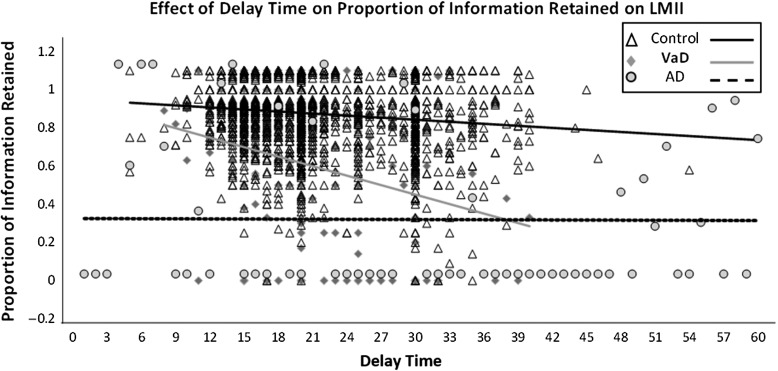
Results: Only 50% of the sample was administered the standard 20-35 min of delay as specified by WMS-R and WMS-III. We found a significant effect of delay time duration on proportion of information retained for the VaD group compared to its control group, which remained after adding LMI raw score as a covariate. There was poorer retention of information with longer delay for this group. This association was not as strong for the AD and cognitively normal groups. A 24.5-min delay was most optimal for differentiating AD from VaD participants (47.7% classification accuracy), an 18.5-min delay was most optimal for differentiating AD versus normal participants (51.7% classification accuracy), and a 22.5-min delay was most optimal for differentiating VaD versus normal participants (52.9% classification accuracy).
Conclusions: Considering diagnostic implications, our findings suggest that test administration should incorporate precise tracking of delay periods. We recommend a 20-min delay with 18-25-min range. Poor classification accuracy based on LM data alone is a reminder that story memory performance is only one piece of data that contributes to complex clinical decisions. However, strict adherence to the recommended range yields optimal data for diagnostic decisions.
Keywords: Non-standard test administration; Sensitivity; Specificity; Training.
© The Author 2017. Published by Oxford University Press. All rights reserved. For permissions, please e-mail: journals.permissions@oup.com.
Figures
References
-
- Baddeley A., & Lewis V. (1984). When does rapid presentation enhance digit span. Bulletin of the Psychonomic Society, 22, 403–405. doi:10.3758/BF03333858. - DOI
-
- Berry D. T., & Carpenter G. S. (1992). Effect of four different delay periods on recall of the Rey-Osterrieth Complex Figure by older persons. The Clinical Neuropsychologist, 6, 80–84. doi:10.1080/13854049208404119. - DOI
-
- Cullum C. M., & Liff C. D. (2014). Mild cognitive impairment and Alzheimer disease In Stucky K. J., Kirkwood M. W., & Donders J. (Eds.). Neuropsychology study guide & board review (pp. 448–465). New York: Oxford University Press.
-
- Desmond D. W. (2004). The neuropsychology of vascular cognitive impairment: Is there a specific cognitive deficit. Journal of the Neurological Sciences, 226, 3–7. - PubMed
-
- Dillon R. F. (1981). Analogical reasoning under different methods of test administration. Applied Psychological Measurement, 5, 341–347. doi:10.1177/014662168100500307. - DOI
MeSH terms
Grants and funding
- P30 AG013854/AG/NIA NIH HHS/United States
- P50 AG005142/AG/NIA NIH HHS/United States
- P50 AG016573/AG/NIA NIH HHS/United States
- P50 AG047266/AG/NIA NIH HHS/United States
- P30 AG010161/AG/NIA NIH HHS/United States
- P50 AG025688/AG/NIA NIH HHS/United States
- P50 AG005133/AG/NIA NIH HHS/United States
- P50 AG005138/AG/NIA NIH HHS/United States
- P50 AG047366/AG/NIA NIH HHS/United States
- P30 AG010129/AG/NIA NIH HHS/United States
- P30 AG019610/AG/NIA NIH HHS/United States
- P30 AG028383/AG/NIA NIH HHS/United States
- P50 AG033514/AG/NIA NIH HHS/United States
- P30 AG010124/AG/NIA NIH HHS/United States
- P50 AG023501/AG/NIA NIH HHS/United States
- P50 AG005131/AG/NIA NIH HHS/United States
- P30 AG010133/AG/NIA NIH HHS/United States
- P50 AG016574/AG/NIA NIH HHS/United States
- P50 AG005146/AG/NIA NIH HHS/United States
- P30 AG035982/AG/NIA NIH HHS/United States
- P50 AG008702/AG/NIA NIH HHS/United States
- U01 AG016976/AG/NIA NIH HHS/United States
- P30 AG008051/AG/NIA NIH HHS/United States
- P50 AG005681/AG/NIA NIH HHS/United States
- P30 AG013846/AG/NIA NIH HHS/United States
- P50 AG047270/AG/NIA NIH HHS/United States
- P50 AG005136/AG/NIA NIH HHS/United States
- P30 AG012300/AG/NIA NIH HHS/United States
- P50 AG016570/AG/NIA NIH HHS/United States
- P50 AG005134/AG/NIA NIH HHS/United States
- P30 AG008017/AG/NIA NIH HHS/United States
LinkOut - more resources
Full Text Sources
Other Literature Sources
Medical
