Randomized Controlled Trial
. 2017 Aug;40(4):294-310.
doi: 10.1002/nur.21797. Epub 2017 Apr 21.

Timing for the Introduction of Cycled Light for Extremely Preterm Infants: A Randomized Controlled Trial

Affiliations
Randomized Controlled Trial

Timing for the Introduction of Cycled Light for Extremely Preterm Infants: A Randomized Controlled Trial

Debra H Brandon et al. Res Nurs Health. 2017 Aug.

Abstract

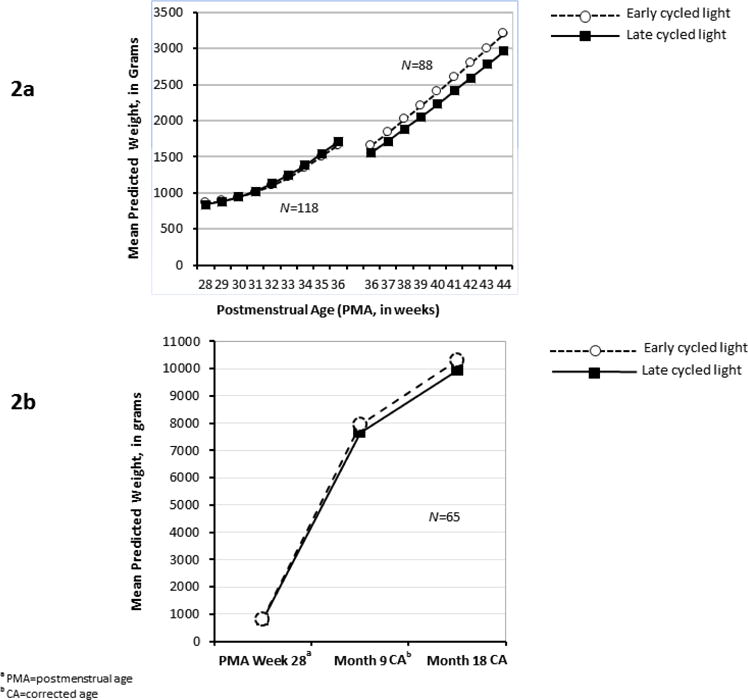
Day-night cycled light improves health outcomes in preterm infants, yet the best time to institute cycled light is unclear. The hypothesis of this study was that extremely preterm infants receiving early cycled light would have better health and developmental outcomes than infants receiving late cycled light. Infants born at ≤28 weeks gestation were randomly assigned to early cycled light (ECL) starting at 28 weeks postmenstrual age [PMA] or late cycled light (LCL), starting at 36 weeks PMA. Daylight was 200-600 lux and night was 5-30 lux. Primary outcomes were weight over time and length of hospitalization. Secondary outcomes were hospital costs, sleep development, and neurodevelopment at 9, 18, and 24 months corrected age. Of 121 infants randomized, 118 were included in analysis. Weight gain in the two groups did not differ significantly but increased across time in both groups. In PMA weeks 36-44, the mean weight gain was 193.8 grams in the ECL group compared to 176.3 grams in the LCL group. Effect sizes for weight were Cohen d = 0.26 and 0.36 for 36 and 44 weeks PMA. Infants in the ECL group went home an average of 5.5 days earlier than the LCL group, but this difference was not statistically significant. There were no group differences on neurodevelopmental outcomes. Although statistically non-significant, clinically important differences of improved weight gain and decreased hospital stay were observed with ECL. The small observed effect sizes on weight during hospitalization should be considered in future cycled light research with extremely preterm infants. © 2017 Wiley Periodicals, Inc.

Keywords: child development; circadian rhythms; cycled light; extremely preterm; infant weight gain; prematurity; sleep.


Conflict of interest statement

Financial Disclosure: The authors have no financial relationships to disclose.

Conflict of Interest: The authors do not have any conflict of interests.

Figures

Figure 1
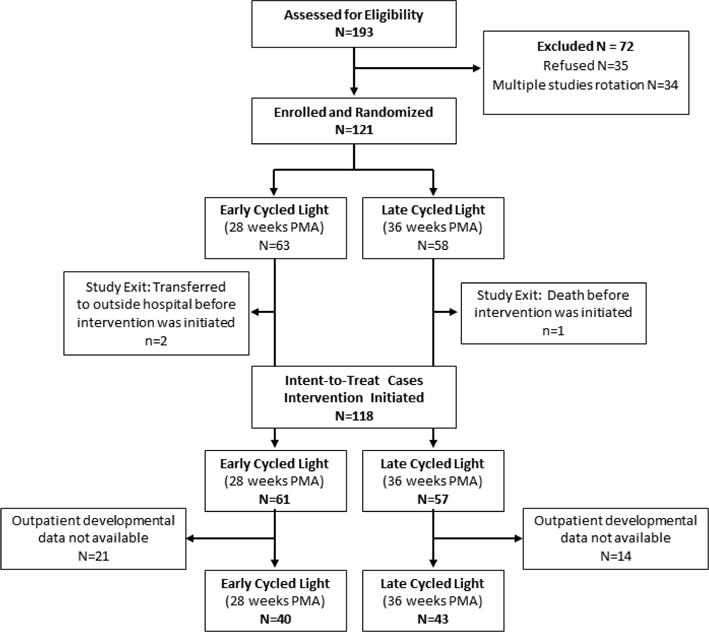
Figure 1
Patient Flow
Figure 2
Figure 2
Weight Gain Over Time aPMA=postmenstrual age
Figure 3
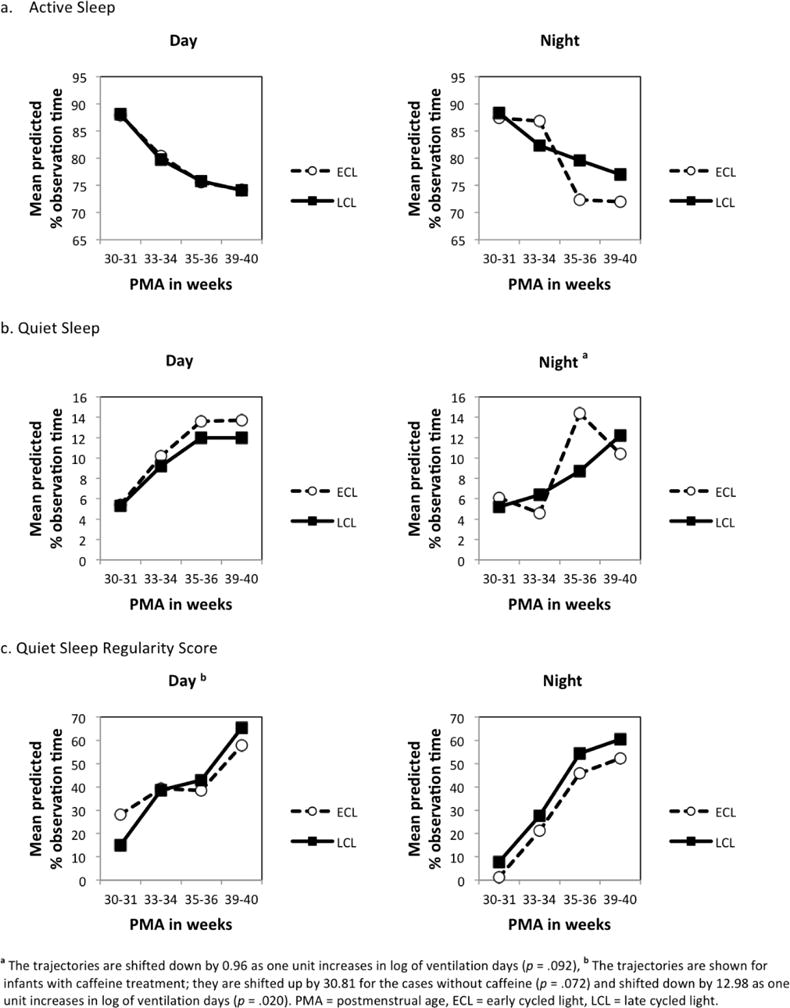
Figure 3
Changes in Sleep Variables During Hospitalization by Intervention Group aThe trajectories are shifted down by 0.96 as one unit increases in log of ventilation days (p = .092),b The trajectories are shown for infants with caffeine treatment; they are shifted up by 30.81 for the cases without caffeine (p = .072) and shifted down by 12.98 as one unit increases in log of ventilation days (p = .020). PMA = postmenstrual age, ECL = early cycled light, LCL = late cycled light.
Figure 4
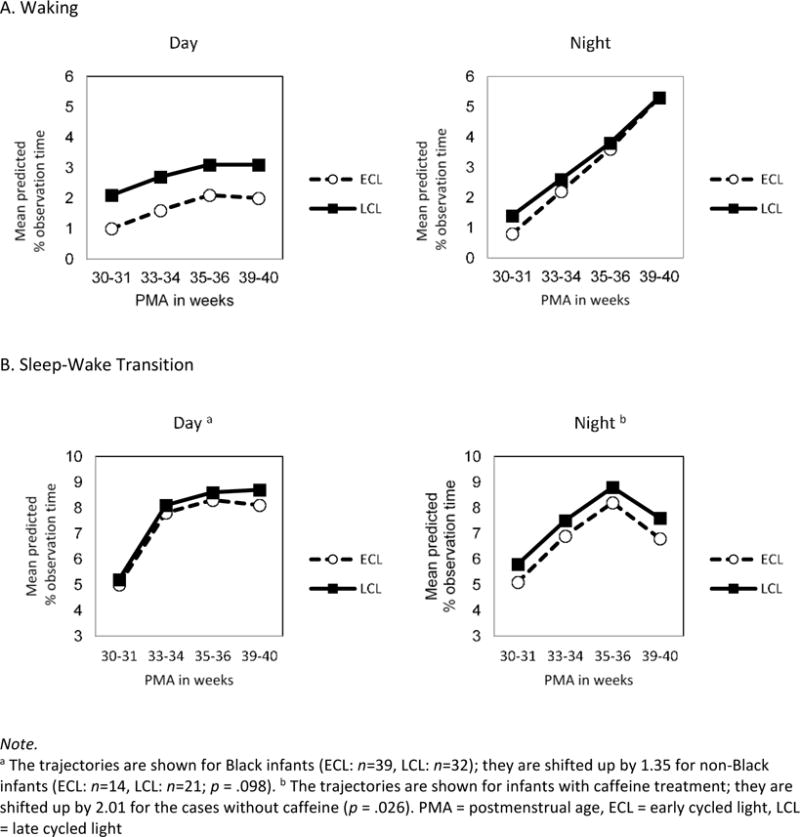
Figure 4
Changes in Sleep-related Variables During Hospitalization by Intervention Group Note. aThe trajectories are shown for Black infants (ECL: n=39, LCL: n=32); they are shifted up by 1.35 for non-Black infants (ECL: n=14, LCL: n=21; p = .098).b The trajectories are shown for infants with caffeine treatment; they are shifted up by 2.01 for the cases without caffeine (p = .026). PMA = postmenstrual age, ECL = early cycled light, LCL = late cycled light
Figure 5
Figure 5
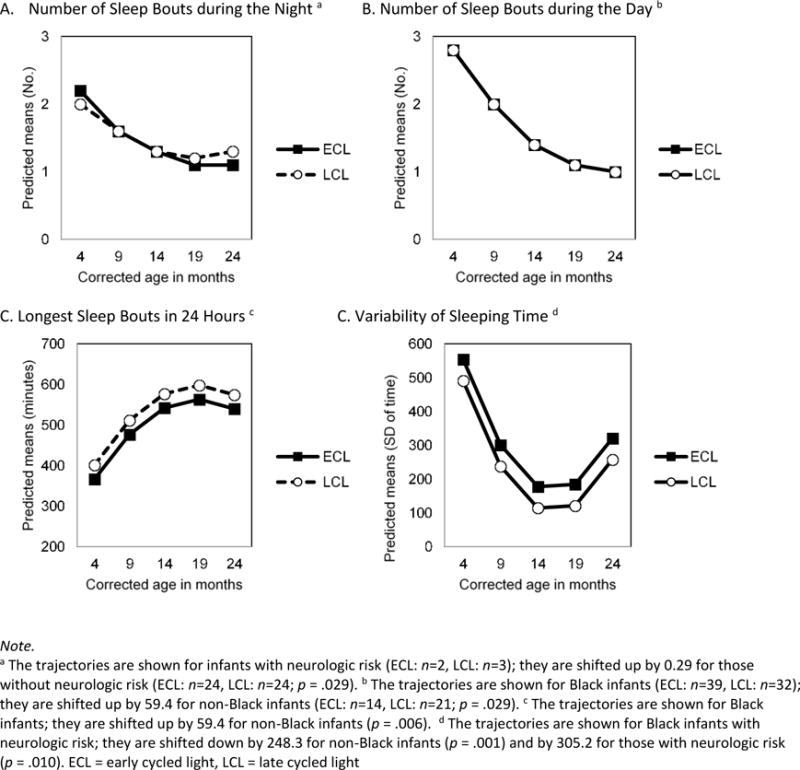
Sleep Development After Discharge up to 2 Years by the Intervention Group Note. aThe trajectories are shown for infants with neurologic risk (ECL: n-2, LCL: n=3); they are shifted up by 0.29 for those without neurologic risk (ECL: n=24, LCL: n=24; p = .029). bThe trajectories are shown for Black infants (ECL: n-39, LCL: n=32); they are shifted up by 59.4 for non-Black infants (ECL: n=14, LCL: n=21; p = .029).cThe trajectories are shown for Black infants; they are shifted up by 59.4 for non-Black infants (p = .006). dThe trajectories are shown for Black infants with neurologic risk; they are shifted down by 248.3 for non-Black infants (p = .001) and by 305.2 for those with neurologic risk (p = .010). ECL = early cycled light, LCL = late cycled light

References

    1. Arslanoglu S, Bertino E, Nicocia M, Moro GE. WAPM Working Group on Nutrition: Potential chronobiotic role of human milk in sleep regulation. Journal of Perinatal Medicine. 2012;40:1–8. doi: 10.1515/JPM.2011.134. - DOI - PubMed
    1. Bakeman R, Gottman JM. Observing interaction: An introduction to sequential analysis. Cambridge, UK: Cambridge University Press; 1997.
    1. Boo NY, Chee SC, Rohana J. Randomized controlled study of the effects of different durations of light exposure on weight gain by preterm infants in a neonatal intensive care unit. Acta Paediatrica. 2002;91:674–679. doi: 10.1111/j.1651-2227.2002.tb03301.x/. - DOI - PubMed
    1. Boyle EM, Poulsen G, Field DJ, Kurinczuk JJ, Wolke D, Alfirevic Z, Quigley MA. Effects of gestational age at birth on health outcomes at 3 and 5 years of age: Population based cohort study. BMJ. 2012;344:e896. doi: 10.1136/bmj.e896. - DOI - PMC - PubMed
    1. Brandon DH, Holditch-Davis D. Validation of an instrumented sleep-wake assessment against a biobehavioral assessment. Newborn and Infant Nursing Reviews. 2005;5(3):109–115. doi: 10.1053/j.nainr.2005.04.002. - DOI

Publication types