


Incidence of First Stroke in Pregnant and Nonpregnant Women of Childbearing Age: A Population-Based Cohort Study From England
- PMID: 28432074
- PMCID: PMC5532991
- DOI: 10.1161/JAHA.116.004601
Incidence of First Stroke in Pregnant and Nonpregnant Women of Childbearing Age: A Population-Based Cohort Study From England
Abstract
Background: Pregnant women may have an increased risk of stroke compared with nonpregnant women of similar age, but the magnitude and the timing of such risk are unclear. We examined the risk of a first stroke event in women of childbearing age and compared the risk during pregnancy and in the early postpartum period with the background risk outside these periods.
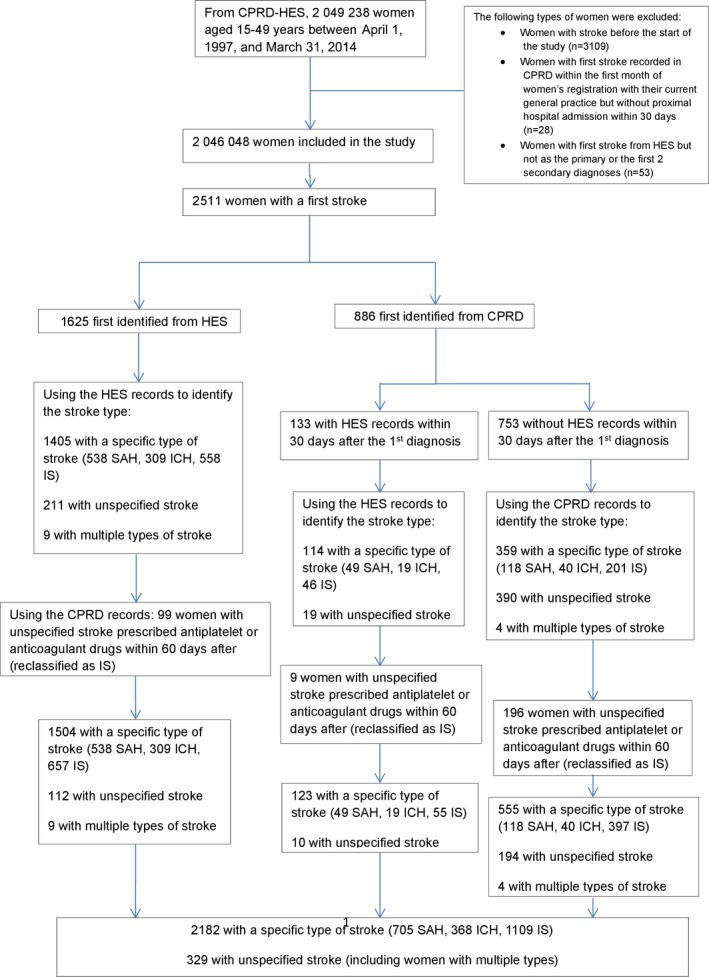
Methods and results: We conducted an open cohort study of 2 046 048 women aged 15 to 49 years between April 1, 1997, and March 31, 2014, using linked primary (Clinical Practice Research Datalink) and secondary (Hospital Episode Statistics) care records in England. Risk of first stroke was assessed by calculating the incidence rate of stroke in antepartum, peripartum (2 days before until 1 day after delivery), and early (first 6 weeks) and late (second 6 weeks) postpartum periods compared with nonpregnant time using a Poisson regression model with adjustment for maternal age, socioeconomic group, and calendar time. A total of 2511 women had a first stroke. The incidence rate of stroke was 25.0 per 100 000 person-years (95% CI 24.0-26.0) in nonpregnant time. The rate was lower antepartum (10.7 per 100 000 person-years, 95% CI 7.6-15.1) but 9-fold higher peripartum (161.1 per 100 000 person-years, 95% CI 80.6-322.1) and 3-fold higher early postpartum (47.1 per 100 000 person-years, 95% CI 31.3-70.9). Rates of ischemic and hemorrhagic stroke both increased peripartum and early postpartum.
Conclusions: Although the absolute risk of first stroke is low in women of childbearing age, healthcare professionals should be aware of a considerable increase in relative risk during the peripartum and early postpartum periods.
Keywords: epidemiology; pregnancy and postpartum; stroke; women.
© 2017 The Authors. Published on behalf of the American Heart Association, Inc., by Wiley.
Figures
References
-
- Bushnell C, McCullough LD, Awad IA, Chireau MV, Fedder WN, Furie KL, Howard VJ, Lichtman JH, Lisabeth LD, Piña IL, Reeves MJ, Rexrode KM, Saposnik G, Singh V, Towfighi A, Vaccarino V, Walters MR; American Heart Association Stroke Council; Council on Cardiovascular and Stroke Nursing; Council on Clinical Cardiology; Council on Epidemiology and Prevention; Council for High Blood Pressure Research . Guidelines for the prevention of stroke in women: a statement for healthcare professionals from the American Heart Association/American Stroke Association. Stroke. 2014;45:1545–1588. DOI: . - DOI - PMC - PubMed
-
- Scott CA, Bewley S, Rudd A, Spark P, Kurinczuk JJ, Brocklehurst P, Knight M. Incidence, risk factors, management, and outcomes of stroke in pregnancy. Obstet Gynecol. 2012;120:318–324. - PubMed
-
- Tang C‐H, Wu C‐S, Lee T‐H, Hung S‐T, Yang C‐YC, Lee C‐H, Chu P‐H. Preeclampsia‐eclampsia and the risk of stroke among peripartum in Taiwan. Stroke. 2009;40:1162–1168. - PubMed
-
- James AH, Bushnell CD, Jamison MG, Myers ER. Incidence and risk factors for stroke in pregnancy and the puerperium. Obstet Gynecol. 2005;106:509–516. - PubMed
MeSH terms
LinkOut - more resources
Full Text Sources
Other Literature Sources
Medical
Miscellaneous
