


Pulmonary rehabilitation for COPD improves exercise time rather than exercise tolerance: effects and mechanisms
- PMID: 28435239
- PMCID: PMC5388245
- DOI: 10.2147/COPD.S131061
Pulmonary rehabilitation for COPD improves exercise time rather than exercise tolerance: effects and mechanisms
Abstract
Background: COPD patients undergoing pulmonary rehabilitation (PR) show various responses. The purpose of this study was to investigate the possible mechanisms and predictors of the response to PR in COPD patients.
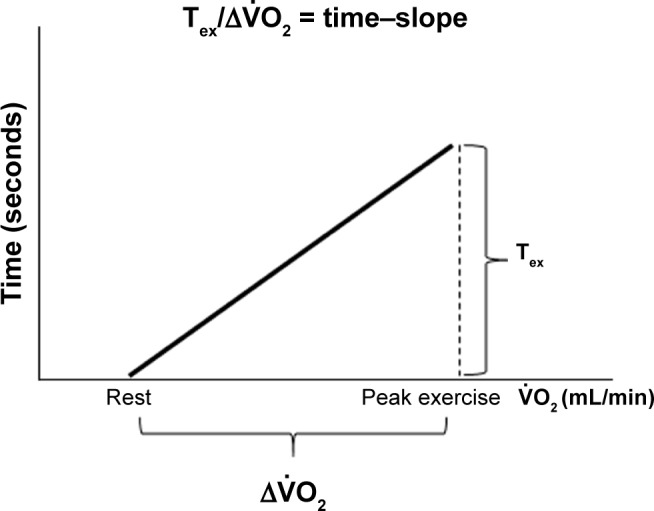
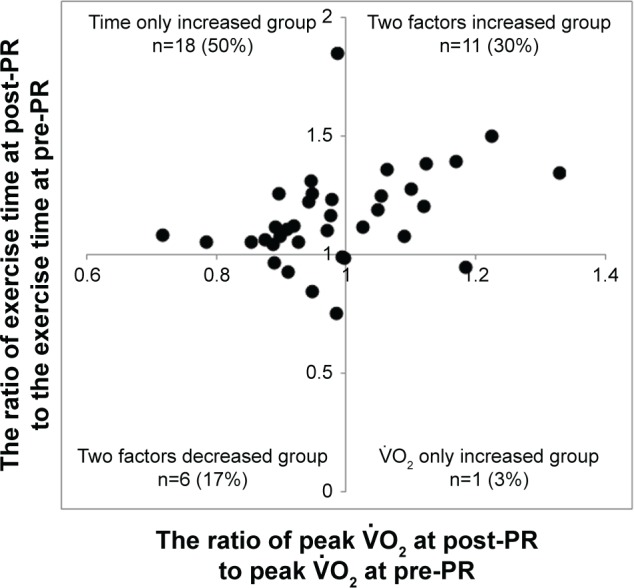
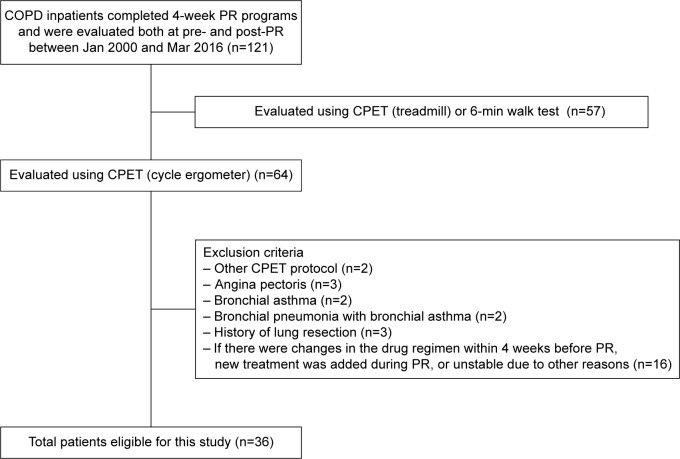
Methods: Thirty-six stable COPD patients underwent PR including a 4-week high-intensity exercise training program, and they were evaluated by cardiopulmonary exercise testing. All patients (mean age 69 years, severe and very severe COPD 94%) were classified into four groups by whether the exercise time (Tex) or the peak oxygen uptake [Formula: see text] increased after PR: two factors increased (both the Tex and the peak [Formula: see text] increased); two factors decreased; time only increased (the Tex increased, but the peak [Formula: see text] economized); and [Formula: see text] only increased (the Tex decreased, but the peak [Formula: see text] increased). Within all patients, the relationships between baseline variables and the post-to-pre-change ratio of the time-slope, Tex/(peak minus resting [Formula: see text]), were investigated.
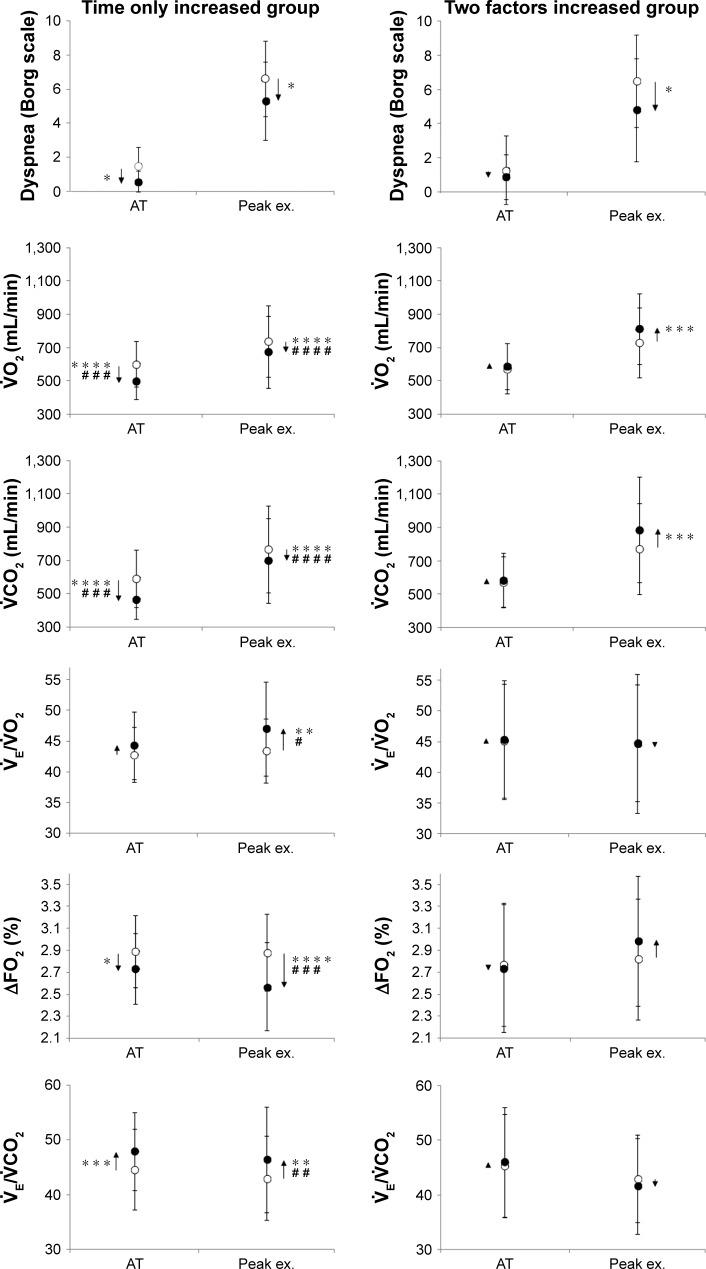
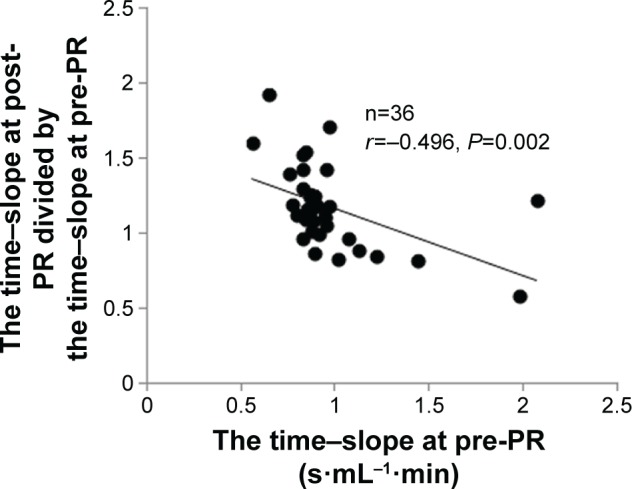
Results: Compared with the two factors increased group (n=11), in the time only increased group (n=18), the mean differences from pre-PR at peak exercise in 1) minute ventilation [Formula: see text] (P=0.004), [Formula: see text] (P<0.0001), and carbon dioxide output [Formula: see text] (P<0.0001) were lower, 2) [Formula: see text]/ [Formula: see text] (P=0.034) and [Formula: see text]/ [Formula: see text] (P=0.006) were higher, and 3) the dead space/tidal volume ratio (VD/VT) and the dyspnea level were similar. After PR, there was no significant difference in the ratio of the observed peak heart rate (HR) to the predicted peak HR (220 - age [years]) between the two groups. A significant negative correlation with the baseline time-slope (r=-0.496, P=0.002) and a positive correlation with the baseline body mass index (BMI) (r=0.496, P=0.002) were obtained.
Conclusions: PR in COPD patients improves Tex rather than exercise tolerance, economizing oxygen requirements, resulting in reduced ventilatory requirements without cardiac loads followed by reduced exertional dyspnea. In addition, the time-slope and BMI could be used to predict PR responses beforehand.
Keywords: body weight; carbon dioxide output; cardiopulmonary exercise testing; oxygen requirement; ventilatory equivalents.
Conflict of interest statement
Disclosure The authors report no conflicts of interest in this work.
Figures
References
-
- Casaburi R, Porszasz J, Burns MR, Carithers ER, Chang RS, Cooper CB. Physiologic benefits of exercise training in rehabilitation of patients with severe chronic obstructive pulmonary disease. Am J Respir Crit Care Med. 1997;155(5):1541–1551. - PubMed
-
- Celli BR, Decramer M, Wedzicha JA, et al. ATS/ERS Task Force for COPD Research An official American Thoracic Society/European Respiratory Society statement: research questions in COPD. Eur Respir J. 2015;45(4):879–905. - PubMed
-
- Laveneziana P, Palange P, ERS Research Seminar Faculty Physical activity, nutritional status and systemic inflammation in COPD. Eur Respir J. 2012;40(3):522–529. - PubMed
-
- Spruit MA, Singh SJ, Garvey C, et al. An official American Thoracic Society/European Respiratory Society statement: key concepts and advances in pulmonary rehabilitation. Am J Respir Crit Care Med. 2013;188(8):e13–e64. - PubMed
-
- Garrod R, Ford K, Daly C, Hoareau C, Howard M, Simmonds C. Pulmonary rehabilitation: analysis of a clinical service. Physiother Res Int. 2004;9(3):111–120. - PubMed
MeSH terms
LinkOut - more resources
Full Text Sources
Other Literature Sources
Medical
Research Materials
