Comparative antimicrobial efficacy of selected root canal irrigants on commonly isolated microorganisms in endodontic infection
- PMID: 28435359
- PMCID: PMC5379824
- DOI: 10.4103/ejd.ejd_141_16
Comparative antimicrobial efficacy of selected root canal irrigants on commonly isolated microorganisms in endodontic infection
Abstract
Objective: This study aims to evaluate and compare the antimicrobial efficacy of three selected root canal irrigants (BioPure MTAD, metronidazole, aztreonam) against microbes commonly isolated from polymicrobial microbiota of root canal infection.
Materials and methods: This study was designed with four experimental groups (Group I - Bacteroides fragilis, Group II - Propionibacterium acnes, Group III - Enterococcus faecalis, Group IV - Candida albicans) based on the microbes selected for the study. Group I and Group II bacteria were used to compare and evaluate antimicrobial effect of BioPure MTAD, metronidazole, aztreonam, and normal saline. Group III and Group IV bacteria were used to compare and evaluate antimicrobial efficacy of BioPure MTAD, aztreonam, and normal saline. Normal saline was used as a control irrigant in this study. Agar disc diffusion method was applied to assess and compare the antimicrobial action of selected irrigants.
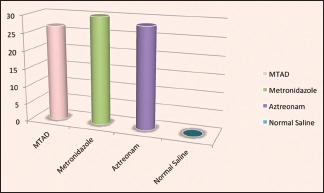
Results: Metronidazole was found to be the most effective root canal irrigant against B. fragilis and P. acnes among the tested irrigants. Mean zone of inhibition against E. faecalis has been shown to be maximum by BioPure MTAD, followed by aztreonam. Antifungal effect against C. albicans was only shown by BioPure MTAD.
Conclusions: Overall, BioPure MTAD is the most effective root canal irrigant as it has shown an antibacterial effect against all the tested microorganisms. However, metronidazole showed maximum antibacterial effect against obligate anaerobes. Aztreonam also showed an antibacterial effect in the present study, raising its possibility to be used as a root canal irrigant in the future.
Keywords: Agar disc diffusion method; BioPure MTAD; Candida albicans; Enterococcus faecalis.
Conflict of interest statement
There are no conflicts of interest.
Figures


References
-
- Kargül B, Tanboga I, Altinok B. Conventional endodontic treatment of primary molars using metronidazole as an intra-canal medicament: A pilot study. Eur Arch Paediatr Dent. 2010;11:196–200. - PubMed
-
- Antonio-Velmonte MM, Santana RT, Manalastas RM. Efficacy and safety of Aztreonam in the treatment of nosocomial gram negative bacterial infections. Phil J Microbiol Infect Dis. 1989;18:53–7.
-
- Demiryurek EO, Onuk EE, Yuksel G, Ciftci A. Evaluation of microbial contamination of resilon and gutta-percha cones and their antimicrobial activities. Afr J Microbiol Res. 2012;6:6275–80.
-
- Torabinejad M, Khademi AA, Babagoli J, Cho Y, Johnson WB, Bozhilov K. A new solution for the removal of the smear layer. J Endod. 2003;29:170–5. - PubMed
LinkOut - more resources
Full Text Sources
Other Literature Sources
Molecular Biology Databases