. 2016 Jun;3(2):11.
doi: 10.3390/vetsci3020011. Epub 2016 Jun 9.

The Comparative Diagnostic Features of Canine and Human Lymphoma

Affiliations

The Comparative Diagnostic Features of Canine and Human Lymphoma

Davis M Seelig et al. Vet Sci. 2016 Jun.

Abstract

The non-Hodgkin lymphomas (NHLs) are a heterogeneous family of lymphoid malignancies that are among the most common neoplasms of both dogs and humans. Owing to shared molecular, signaling, incidence, and pathologic features, there is a strong framework supporting the utilization of canine lymphoma as a comparative, large animal model of human NHL. In alignment with the biologic similarities, the current approach towards the diagnosis and classification of canine lymphoma is based upon the human World Health Organization guidelines. While this approach has contributed to an increasing appreciation of the potential biological scope of canine lymphoma, it has also become apparent that the most appropriate diagnostic philosophy must be multimodal, namely by requiring knowledge of microscopic, immunophenotypic, and clinical features before establishing a final disease diagnosis. This review seeks to illustrate the comparative similarities and differences in the diagnosis of canine lymphoma through the presentation of the microscopic and immunophenotypic features of its most common forms.

Keywords: canine; comparative oncology; comparative pathology; lymphoma; non-Hodgkin lymphoma.


Conflict of interest statement

The authors declare no conflict of interest.

Figures

Figure 1
Figure 1
Incidence of canine (A) and human (B) lymphoma. Canine data reflect summary data from three publications whereas human data originate from one. DLBCL; diffuse large B-cell lymphoma, PTCL, NOS; peripheral T-cell lymphoma, not otherwise specified, NMZL; nodal marginal zone lymphoma, TZL; T-zone lymphoma, T-LBL; T-cell lymphoblastic lymphoma, MCL; mantle cell lymphoma, CLL/SLL; chronic lymphocytic leukemia/small lymphocytic lymphoma, PCN; plasma cell neoplasia, FL; follicular lymphoma, HL; Hodgkin’s lymphoma, and ALC; anaplastic large cell lymphoma.
Figure 2
Figure 2
The histologic approach towards the classification of canine nodal lymphoma. Using excisional lymph node sections, lymphoma is initially divided into diffuse (effacing) or nodular (non-effacing) forms of the disease. Next, using a red blood cell or a small lymphocyte as a guideline, the neoplastic population is divided into large, small, and intermediate forms of the disease. Finally, using knowledge of additional cellular and nuclear features, including mitotic rate, and immunophenotype, a final diagnosis is established. DLBCL; diffuse large B-cell lymphoma, PTCL, NOS; peripheral T-cell lymphoma, not otherwise specified, NMZL; nodal marginal zone lymphoma, TZL; T-zone lymphoma, T-LBL; T-cell lymphoblastic lymphoma, MCL; mantle cell lymphoma, CLL/SLL; chronic lymphocytic leukemia/small lymphocytic lymphoma, PCN; plasma cell neoplasia, FL; follicular lymphoma, HL; Hodgkins lymphoma, and ALC; anaplastic large cell lymphoma.
Figure 3
Figure 3
The histologic features of human and canine precursor disease (LBL/ALL). In both species (A, B, human and C, D, canine) the architecture is diffuse (A and C). Morphologically, the neoplastic cells in both species are small-to-intermediate in size with round to convoluted nuclei containing dispersed to clumped chromatin and faint to indistinct nucleoli. A starry sky appearance (white arrow; (C) and high mitotic rate (black arrow); (D) may be seen in both.
Figure 4
Figure 4
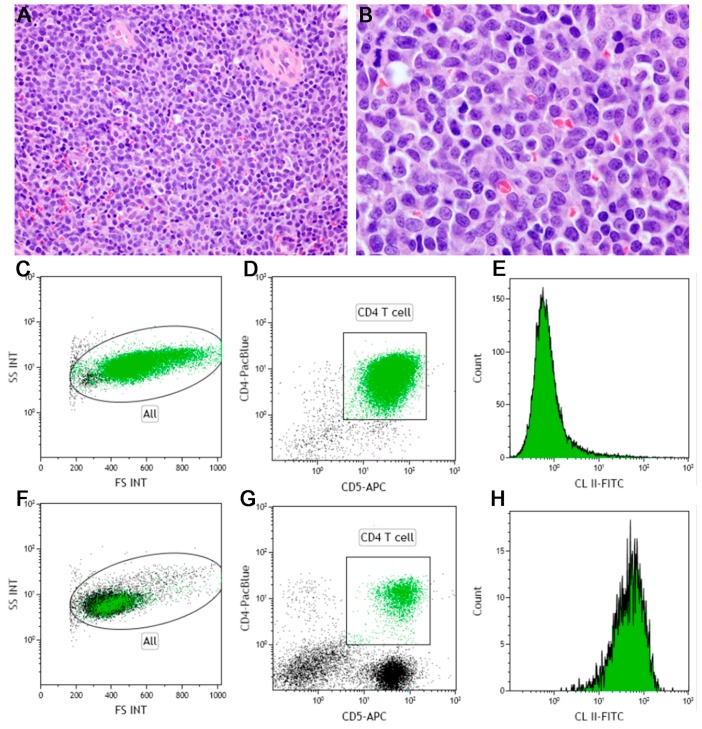
The histologic and flow cytometric features of canine peripheral T-cell lymphoma, not otherwise specified (PTCL, NOS). Architecturally, the neoplastic infiltrate is diffuse (A) and the infiltrating cells are heterogeneous, with cell size varying from small to large with pleomorphic, oval to cleaved nuclei (B). Flow cytometry of the neoplastic cells (colored green, CE) in reported cases of PTCL, NOS reveals cells that are large by light scatter (C), CD5+, CD4+ (D), and demonstrate decreased expression of MHC Class II (E). These findings contrast to the T-cells within a normal canine lymph node (green, FH), which are small by light scatter (F), CD5+, split between CD4+ and CD4 (G), and demonstrate higher levels of MHC Class II expression (H).
Figure 5
Figure 5
The histologic, immunohistochemical, and flow cytometric appearance of canine T-zone lymphoma (TZL). Affected nodal tissue is characterized by expansion and effacement of the T-cell areas of the cortex and medulla with resulting capsular displacement and compression of residual follicles (black arrows, A). The neoplastic cells are intermediately-sized and contain a moderate amount of pale blue cytoplasm and ovoid nuclei with sharp, shallow indentations, finely granular chromatin, and inapparent nucleoli (B). Anti-CD3 (red, C) and anti-Pax5 (red, D) immunohistochemistry demonstrates the T-cell phenotype of the neoplastic cells and further illustrates the compressed, B-cell rich residual follicles (white arrow, D). Flow cytometrically, in contrast to a normal canine peripheral lymph node (HJ), TZL (EG) is characterized by the presence of an intermediate-sized population of CD5+ cells (colored blue) which are phenotypically aberrant owing to their lack of CD45 expression (F vs. I) and increased CD21 expression (G vs. J).
Figure 6
Figure 6
The histologic and flow cytometric features of human and canine diffuse large B-cell lymphoma (DLBCL). In both species, DLBCL is a diffuse disease (AC, human and DF, canine) and often demonstrates a starry-sky appearance due to phagocytic histiocytes (white arrow, E). Neoplastic cells are large with varying amounts of cytoplasm and vesicular nuclei with prominent nucleoli. The mitotic rate is often high (black arrow, F). Flow cytometrically, the neoplastic cells (colored black) in hDLBCL are light chain restricted (G), large by forward light scatter, CD5− (H), CD45+, CD20+ (I), CD19+, and CD10− (J). Similarly, the neoplastic cells in cDLBCL (colored red) are large by forward scatter (K) and are CD21+ and CD22+ (L).
Figure 7
Figure 7
This histologic and flow cytometric appearance of human and canine nodal marginal zone lymphoma (AC, human and DF, canine). At low magnification both species demonstrate a nodular architectural pattern characterized by expansion of germinal centers and perifollicular areas (A, D) by a population of intermediate-sized neoplastic cells. In both, residual follicular structures are common (black arrow, A and D). At higher magnification, the neoplastic infiltrate in hMZL consists of transformed intermediate (white arrow, C) and large cells (gray arrow, C). In contrast, neoplastic cells in cMZL are predominately intermediate sized with abundant pale cytoplasm and irregular nuclei containing peripheralized chromatin and a single central nucleolus (F). Flow cytometrically, the neoplastic cells (colored blue, GJ) in hMZL are lambda light chain restricted, CD20+, CD45+, CD19+, CD5−, and CD10−.
Figure 8
Figure 8
The histologic and flow cytometric features of human and canine mantle cell lymphoma (AC, human and DF, canine). Architecturally, hMCL is a heterogeneous disease, although the nodular (mantle zone) pattern is presented (A, B). The tumor infiltrate expands the mantle cell cuff and surrounds a reactive germinal center (black arrow, A). The neoplastic cells are small to intermediately sized, contain scant cytoplasm and demonstrate indented nuclear contours with evenly dispersed chromatin (C). Architecturally, cMCL is characterized by discrete to coalescing nodules of a monotonous population of neoplastic cells (D, E). Morphologically, these cells are small to intermediate in size with round nuclei, condensed chromatin, and inapparent nucleoli (F). By flow cytometry, the cells are intermediate-sized by forward scatter (G), light chain restricted (H), CD20+, CD5+ (I), CD79b+, and CD23− (J). The neoplastic cells in cMCL (colored red) are small to intermediate in size (K) and are CD21+ and CD22+ (L).
Figure 9
Figure 9
The histologic features of human and canine follicular lymphoma (AC, human and DF, canine). Architecturally, in both species, the disease is nodular (A, C) and the neoplastic follicles lack germinal center polarization (gray arrow, B and E). Morphologically, the tumor infiltrate in both species is bimorphic, composed of predominantly smaller neoplastic centrocytes (black arrow, C and F) and rare admixed larger neoplastic centroblasts (white arrow, C and F). By flow cytometry, the neoplastic cells in human FL (colored black) are light chain restricted (G), CD10+, variably CD19+ (H), CD20+, CD45+ (I), but CD5−, and are intermediate size by forward light scatter (J).

References

    1. Howlader N., Krapcho M., Garshell J., Miller D., Altekruse S.F., Kosary C.L., Yu M., Ruhl J., Tatalovich Z., Mariotto A., et al., editors. National Cancer Institute; Bethesda, MD, USA: 2015. SEER Cancer Statistics Review, 1975–2012.
    1. Merlo D.F., Rossi L., Pellegrino C., Ceppi M., Cardellino U., Capurro C., Ratto A., Sambucco P.L., Sestito V., Tanara G., et al. Cancer incidence in pet dogs: Findings of the animal tumor registry of Genoa, Italy. J. Vet. Intern. Med. 2008;22:976–984. doi: 10.1111/j.1939-1676.2008.0133.x. - DOI - PubMed
    1. Dorn C.R., Taylor D.O., Chaulk L.E., Hibbard H.H. The prevalence of spontaneous neoplasms in a defined canine population. Am. J. Public Health Nations Health. 1966;56:254–265. doi: 10.2105/AJPH.56.2.254. - DOI - PMC - PubMed
    1. Dorn C.R., Taylor D.O., Schneider R., Hibbard H.H., Klauber M.R. Survey of animal neoplasms in Alameda and Contra Costa Counties, California. II. Cancer morbidity in dogs and cats from Alameda County. J. Natl. Cancer Inst. 1968;40:307–318. - PubMed
    1. Dorn C.R., Taylor D.O., Schneider R. The epidemiology of canine leukemia and lymphoma. Bibl. Haematol. 1970:403–415. - PubMed

LinkOut - more resources