


Comparison of neural substrates of temporal discounting between youth with autism spectrum disorder and with obsessive-compulsive disorder
- PMID: 28436342
- PMCID: PMC5964452
- DOI: 10.1017/S0033291717001088
Comparison of neural substrates of temporal discounting between youth with autism spectrum disorder and with obsessive-compulsive disorder
Abstract
Background: Autism spectrum disorder (ASD) and obsessive-compulsive disorder (OCD) share abnormalities in hot executive functions such as reward-based decision-making, as measured in the temporal discounting task (TD). No studies, however, have directly compared these disorders to investigate common/distinct neural profiles underlying such abnormalities. We wanted to test whether reward-based decision-making is a shared transdiagnostic feature of both disorders with similar neurofunctional substrates or whether it is a shared phenotype with disorder-differential neurofunctional underpinnings.
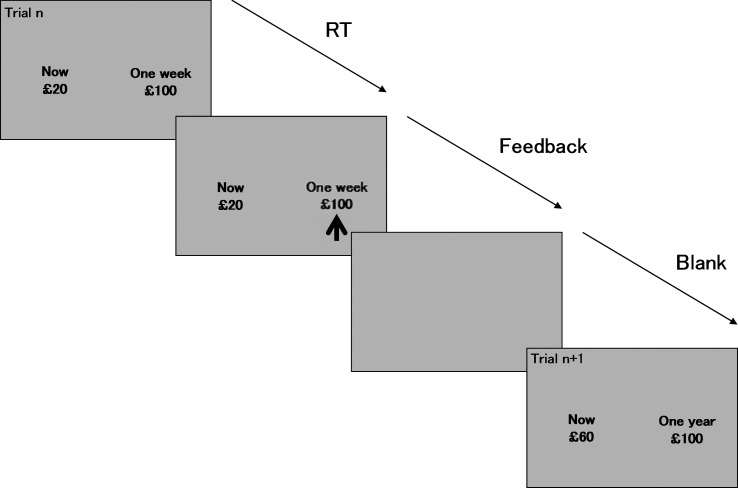
Methods: Age and IQ-matched boys with ASD (N = 20), with OCD (N = 20) and 20 healthy controls, performed an individually-adjusted functional magnetic resonance imaging (fMRI) TD task. Brain activation and performance were compared between groups.
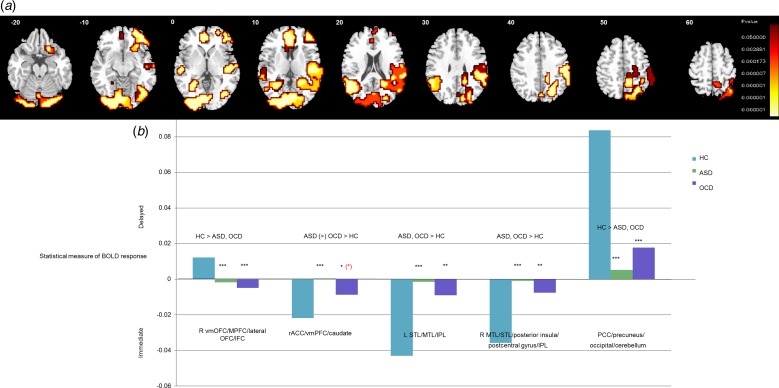
Results: Boys with ASD showed greater choice-impulsivity than OCD and control boys. Whole-brain between-group comparison revealed shared reductions in ASD and OCD relative to control boys for delayed-immediate choices in right ventromedial/lateral orbitofrontal cortex extending into medial/inferior prefrontal cortex, and in cerebellum, posterior cingulate and precuneus. For immediate-delayed choices, patients relative to controls showed reduced activation in anterior cingulate/ventromedial prefrontal cortex reaching into left caudate, which, at a trend level, was more decreased in ASD than OCD patients, and in bilateral temporal and inferior parietal regions.
Conclusions: This first fMRI comparison between youth with ASD and with OCD, using a reward-based decision-making task, shows predominantly shared neurofunctional abnormalities during TD in key ventromedial, orbital- and inferior fronto-striatal, temporo-parietal and cerebellar regions of temporal foresight and reward processing, suggesting trans-diagnostic neurofunctional deficits.
Keywords: ASD; OCD; fMRI; temporal discounting.
Figures
References
-
- Abramovitch A, Abramowitz JS, Mittelman A (2013). The neuropsychology of adult obsessive–compulsive disorder: a meta-analysis. Clinical Psychology Review 33, 1163–1171. - PubMed
-
- American Psychiatric Association (2013). Diagnostic and Statistical Manual of Mental Disorders, 5th edn American Psychiatric Publishing: Arlington, VA.
-
- Antrop I, Stock P, Verté S, Wiersema JR, Baeyens D, Roeyers H (2006). ADHD and delay aversion: the influence of non-temporal stimulation on choice for delayed rewards. Journal of Child Psychology and Psychiatry 47, 1152–1158. - PubMed
-
- Bari A, Robbins TW (2013). Inhibition and impulsivity: behavioral and neural basis of response control. Progress in Neurobiology 108, 44–79. - PubMed
Publication types
MeSH terms
Grants and funding
LinkOut - more resources
Full Text Sources
Other Literature Sources
Medical
