


Genomic analyses identify hundreds of variants associated with age at menarche and support a role for puberty timing in cancer risk
- PMID: 28436984
- PMCID: PMC5841952
- DOI: 10.1038/ng.3841
Genomic analyses identify hundreds of variants associated with age at menarche and support a role for puberty timing in cancer risk
Abstract
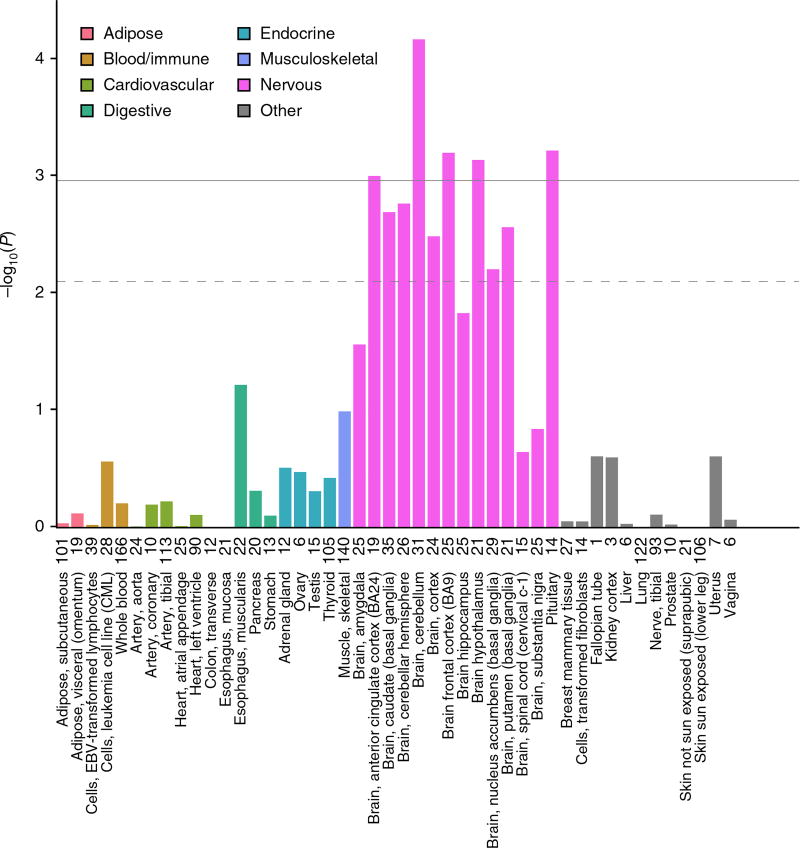
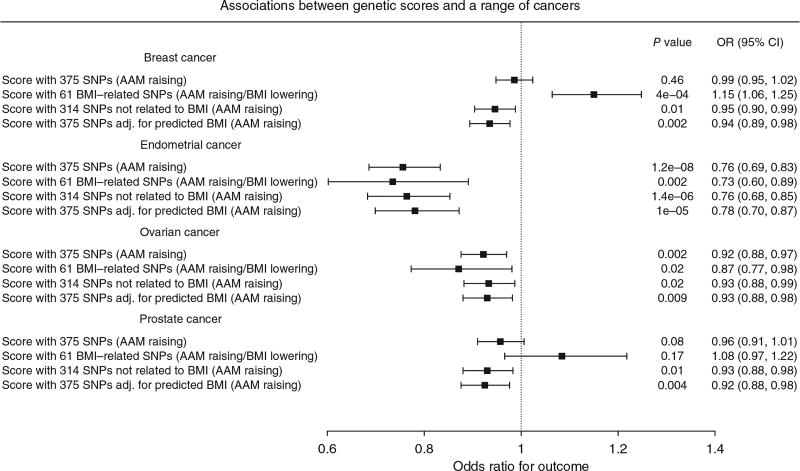
The timing of puberty is a highly polygenic childhood trait that is epidemiologically associated with various adult diseases. Using 1000 Genomes Project-imputed genotype data in up to ∼370,000 women, we identify 389 independent signals (P < 5 × 10⁻⁸) for age at menarche, a milestone in female pubertal development. In Icelandic data, these signals explain ∼7.4% of the population variance in age at menarche, corresponding to ∼25% of the estimated heritability. We implicate ∼250 genes via coding variation or associated expression, demonstrating significant enrichment in neural tissues. Rare variants near the imprinted genes MKRN3 and DLK1 were identified, exhibiting large effects when paternally inherited. Mendelian randomization analyses suggest causal inverse associations, independent of body mass index (BMI), between puberty timing and risks for breast and endometrial cancers in women and prostate cancer in men. In aggregate, our findings highlight the complexity of the genetic regulation of puberty timing and support causal links with cancer susceptibility.
Conflict of interest statement
The authors declare no competing financial interests.
Figures
Comment in
-
Reproductive endocrinology: Puberty timing and cancer risk.Nat Rev Endocrinol. 2017 Jul;13(7):377. doi: 10.1038/nrendo.2017.63. Epub 2017 May 12. Nat Rev Endocrinol. 2017. PMID: 28497815 No abstract available.
References
-
- Parent AS, et al. The timing of normal puberty and the age limits of sexual precocity: variations around the world, secular trends, and changes after migration. Endocr. Rev. 2003;24:668–693. - PubMed
MeSH terms
Substances
Grants and funding
- SP/07/008/24066/BHF_/British Heart Foundation/United Kingdom
- 16565/CRUK_/Cancer Research UK/United Kingdom
- MC_UU_12015/2/MRC_/Medical Research Council/United Kingdom
- 14136/CRUK_/Cancer Research UK/United Kingdom
- G0401527/MRC_/Medical Research Council/United Kingdom
- MC_UU_12013/1/MRC_/Medical Research Council/United Kingdom
- MC_UU_12013/5/MRC_/Medical Research Council/United Kingdom
- MR/N003284/1/MRC_/Medical Research Council/United Kingdom
- MC_UU_12013/3/MRC_/Medical Research Council/United Kingdom
- G1000143/MRC_/Medical Research Council/United Kingdom
- MR/J012165/1/MRC_/Medical Research Council/United Kingdom
- Z01 AG006000/ImNIH/Intramural NIH HHS/United States
- MC_EX_MR/L100002/1/MRC_/Medical Research Council/United Kingdom
- R56 AG029451/AG/NIA NIH HHS/United States
- G1001357/MRC_/Medical Research Council/United Kingdom
- MC_UU_12015/1/MRC_/Medical Research Council/United Kingdom
- MC_PC_U127561128/MRC_/Medical Research Council/United Kingdom
- UM1 CA182913/CA/NCI NIH HHS/United States
- P2C HD050924/HD/NICHD NIH HHS/United States
- 202802/Z/16/Z/WT_/Wellcome Trust/United Kingdom
- T32 HL007055/HL/NHLBI NIH HHS/United States
- R01 CA192393/CA/NCI NIH HHS/United States
- 16561/CRUK_/Cancer Research UK/United Kingdom
- 10124/CRUK_/Cancer Research UK/United Kingdom
LinkOut - more resources
Full Text Sources
- Archivio Istituzionale della Ricerca Unimi - Access Free Full Text
- Enlighten: Publications, University of Glasgow - Access Free Full Text
- Europe PubMed Central
- HAL archives ouvertes - Access Free Full Text
- Nature Publishing Group
- PubMed Central
- White Rose Research Online
- eScholarship, University of California - Access Free Full Text
Other Literature Sources
Medical
Molecular Biology Databases
Miscellaneous
