


Maternal blood cadmium, lead and arsenic levels, nutrient combinations, and offspring birthweight
- PMID: 28438148
- PMCID: PMC5402649
- DOI: 10.1186/s12889-017-4225-8
Maternal blood cadmium, lead and arsenic levels, nutrient combinations, and offspring birthweight
Abstract
Background: Cadmium (Cd), lead (Pb) and arsenic (As) are common environmental contaminants that have been associated with lower birthweight. Although some essential metals may mitigate exposure, data are inconsistent. This study sought to evaluate the relationship between toxic metals, nutrient combinations and birthweight among 275 mother-child pairs.
Methods: Non-essential metals, Cd, Pb, As, and essential metals, iron (Fe), zinc (Zn), selenium (Se), copper (Cu), calcium (Ca), magnesium (Mg), and manganese (Mn) were measured in maternal whole blood obtained during the first trimester using inductively coupled plasma mass spectrometry. Folate concentrations were measured by microbial assay. Birthweight was obtained from medical records. We used quantile regression to evaluate the association between toxic metals and nutrients due to their underlying wedge-shaped relationship. Ordinary linear regression was used to evaluate associations between birth weight and toxic metals.
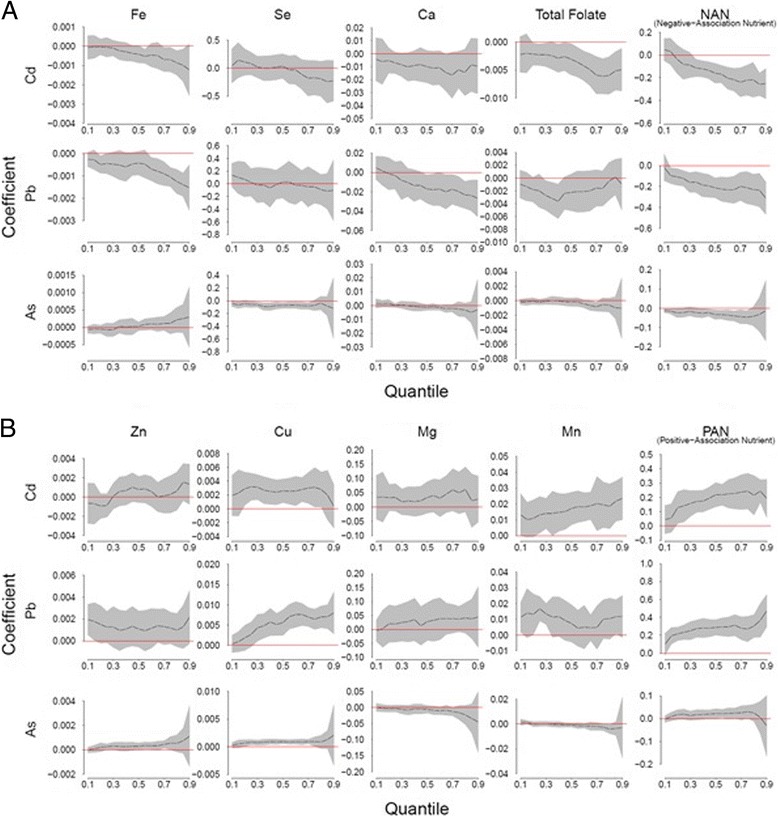
Results: After multivariate adjustment, the negative association between Pb or Cd and a combination of Fe, Se, Ca and folate was robust, persistent and dose-dependent (p < 0.05). However, a combination of Zn, Cu, Mn and Mg was positively associated with Pb and Cd levels. While prenatal blood Cd and Pb were also associated with lower birthweight. Fe, Se, Ca and folate did not modify these associations.
Conclusion: Small sample size and cross-sectional design notwithstanding, the robust and persistent negative associations between some, but not all, nutrient combinations with these ubiquitous environmental contaminants suggest that only some recommended nutrient combinations may mitigate toxic metal exposure in chronically exposed populations. Larger longitudinal studies are required to confirm these findings.
Keywords: Birthweight; Dietary nutrients; Epidemiology; Toxic metals.
Figures
Similar articles
-
A cross-sectional study of the association between blood metal mixtures exposure and hyperuricemia.Clin Rheumatol. 2024 Dec;43(12):3889-3900. doi: 10.1007/s10067-024-07156-3. Epub 2024 Oct 28. Clin Rheumatol. 2024. PMID: 39466531
-
Assessment of 12 Metals and Metalloids in Blood of General Populations Living in Wuhan of China by ICP-MS.Biol Trace Elem Res. 2019 Jun;189(2):344-353. doi: 10.1007/s12011-018-1486-8. Epub 2018 Aug 23. Biol Trace Elem Res. 2019. PMID: 30140990
-
Decreased vaccine antibody titers following exposure to multiple metals and metalloids in e-waste-exposed preschool children.Environ Pollut. 2017 Jan;220(Pt A):354-363. doi: 10.1016/j.envpol.2016.09.071. Epub 2016 Sep 29. Environ Pollut. 2017. PMID: 27692881
-
Neurotoxicity of Metal Mixtures.Adv Neurobiol. 2017;18:227-265. doi: 10.1007/978-3-319-60189-2_12. Adv Neurobiol. 2017. PMID: 28889271 Review.
-
Toxic metal (Cd, Hg, Mn, Pb) partition in the maternal/foetal unit: A systematic mini - review of recent epidemiological studies.Toxicol Lett. 2020 Oct 10;332:20-26. doi: 10.1016/j.toxlet.2020.06.007. Epub 2020 Jun 20. Toxicol Lett. 2020. PMID: 32569801
Cited by
-
Maternal Diet During Pregnancy and Blood Cadmium Concentrations in an Observational Cohort of British Women.Nutrients. 2020 Mar 26;12(4):904. doi: 10.3390/nu12040904. Nutrients. 2020. PMID: 32224907 Free PMC article.
-
Quality and risk assessment of lead and cadmium in drinking water for child development centres use in Phatthalung province, Thailand.Environ Anal Health Toxicol. 2023 Dec;38(4):e2023020-0. doi: 10.5620/eaht.2023020. Epub 2023 Oct 12. Environ Anal Health Toxicol. 2023. PMID: 38298039 Free PMC article.
-
Characterization of urinary concentrations of heavy metals among socioeconomically disadvantaged black pregnant women.Environ Monit Assess. 2020 Feb 27;192(3):200. doi: 10.1007/s10661-020-8163-z. Environ Monit Assess. 2020. PMID: 32107644 Free PMC article.
-
Adverse maternofoetal outcomes associated with ionised calcaemia, total calcaemia, albuminaemia, and calcium supplementation in pregnancy: Analysis from a resource-limited setting.PLoS One. 2022 Aug 1;17(8):e0271525. doi: 10.1371/journal.pone.0271525. eCollection 2022. PLoS One. 2022. PMID: 35913943 Free PMC article.
-
Dietary Heavy Metal Exposure among Finnish Adults in 2007 and in 2012.Int J Environ Res Public Health. 2021 Oct 9;18(20):10581. doi: 10.3390/ijerph182010581. Int J Environ Res Public Health. 2021. PMID: 34682327 Free PMC article.
References
MeSH terms
Substances
Grants and funding
LinkOut - more resources
Full Text Sources
Other Literature Sources
Medical
Research Materials
