. 2017 Aug 15:138:174-184.
doi: 10.1016/j.bcp.2017.04.020. Epub 2017 Apr 22.

A systematic evaluation of microRNAs in regulating human hepatic CYP2E1

Affiliations

A systematic evaluation of microRNAs in regulating human hepatic CYP2E1

Yong Wang et al. Biochem Pharmacol. .

Abstract

Cytochrome P450 2E1 (CYP2E1) is an important drug metabolizing enzyme for processing numerous xenobiotics in the liver, including acetaminophen and ethanol. Previous studies have shown that microRNAs (miRNAs) can suppress CYP2E1 expression by binding to the 3'-untranslated region (3'-UTR) of its transcript. However, a systematic analysis of CYP2E1 regulation by miRNAs has not been described. Here, we applied in silico, in vivo, and in vitro approaches to investigate miRNAs involved in the regulation of CYP2E1. Initially, potential miRNA binding sites in the CYP2E1 mRNA transcript were identified and screened using in silico methods. Next, inverse correlations were found in human liver samples between the expression of CYP2E1 mRNA and the levels of two miRNA species, hsa-miR-214-3p and hsa-miR-942-5p. In a HepG2-derived CYP2E1 over-expression cell model, hsa-miR-214-3p exhibited strong suppression of CYP2E1 expression by targeting the coding region of its mRNA transcript, but hsa-miR-942-5p did not inhibit CYP2E1 levels. Electrophoretic mobility shift assays confirmed that hsa-miR-214-3p recruited other cellular protein factors to form stable complexes with specific sequences present in the CYP2E1 mRNA open reading frame. Transfection of HepaRG cells with hsa-miR-214-3p mimics inhibited expression of the endogenous CYP2E1 gene. Further, hsa-miR-214-3p mimics partially blocked ethanol-dependent increases in CYP2E1 mRNA and protein levels in HepG2 cells and they reduced the release of alanine aminotransferase from CYP2E1-overexpressing HepG2 cells exposed to acetaminophen. These results substantiate the suppressing effect of hsa-miR-214-3p on CYP2E1 expression.

Keywords: CYP2E1; Drug metabolizing enzymes; Inter-individual variability; Pharmacogenomics; microRNA, hsa-miR-214-3p.


Conflict of interest statement

Conflict of interest

The authors have no conflict of interest.

Figures
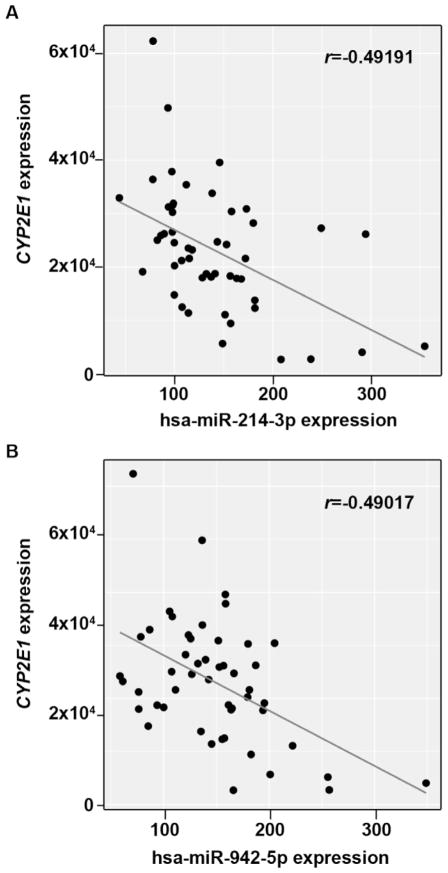
Fig. 1
Fig. 1
Correlation between the expression of hsa-miR-214-3p or hsa-miR-942-5p and CYP2E1 transcripts in human non-tumor liver tissues. The levels of (A) hsa-miR-214-3p (r = −0.49191, P = 0.000285), and (B) hsa-miR-942-5p (r = −0.49017, P = 0.000302), were negatively correlated with CYP2E1 mRNA levels (50 non-tumor liver samples) in the TGCA LIHC public dataset using Pearson’s correlation analysis.
Fig. 2
Fig. 2
Hsa-miR-214-3p inhibited exogenous CYP2E1 expression in HepG2CYP2E1-cells. The 40 nmol/L miRNA negative control, hsa-miR-214-3p mimics and hsa-miR-942-5p mimics were transiently transfected into the HepG2CYP2E1cells. (A) Increased expression of hsa-miR-214-3p and hsa-miR-942-5p after transfection. (B) CYP2E1 mRNA levels decreased when transfected with hsa-miR-214-3p mimics but not hsa-miR-942-5p mimics. (C) Western blots with antibodies specific for CYP2E1 and GAPDH and (D) quantitative densitometry show that transfection with hsa-miR-214-3p mimics contributed to the down-regulated CYP2E1 protein levels. Plotted values were first normalized by U6 RNA, GAPDH mRNA, or GAPDH protein levels (A, B, and D respectively) and in each case normalized ratios for cells transfected with miR214-3p and miR-942-5p were compared to ratios for cells transfected with miR-NC. *P < 0.05; miR-NC, miRNA negative control. Each assay was performed using at least 3 independent experiments.
Fig. 3
Fig. 3
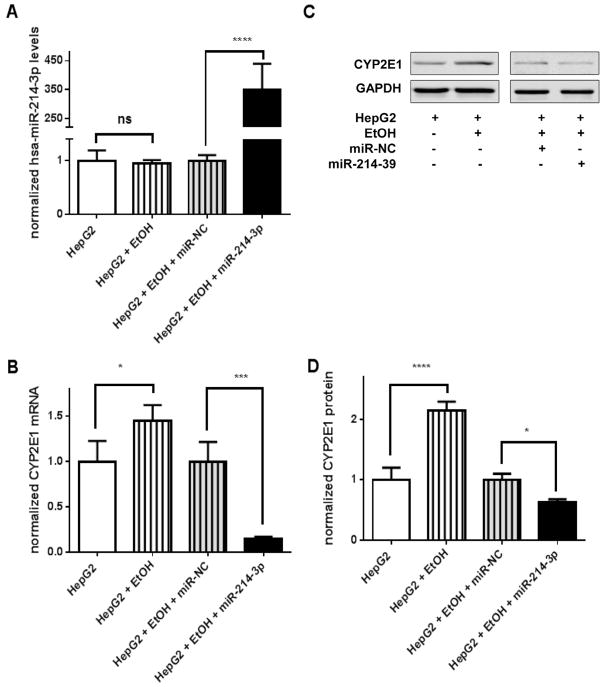
Hsa-miR-214-3p suppressed ethanol-induced CYP2E1 expression in HepG2 cells. (A) Treatment of HepG2 cells with 200 mM ethanol does not affect hsa-miR-214-3p expression. Conditions used for introducing hsa-miR-214-3p mimics into HepG2 cells increased its level by 350-fold in the presence of 200 mM ethanol for 24 h compared to HepG2 cells transfected with miRNA negative control. (B) Increased CYP2E1 mRNA levels were observed in HepG2 cells exposed to 200 mM ethanol for 24 h. Compared to HepG2 cells transfected with negative control miRNA, CYP2E1 mRNA levels were suppressed by 65% in cells transfected with hsa-miR-214-3p. (C) Western blots with antibodies specific for CYP2E1 and GAPDH show that higher levels of CYP2E1 protein are detected in HepG2 cells treated with 200 mM ethanol for 24 h. Ethanol-induced CYP2E1 protein expression is partially blocked in HepG2 cells transfected with hsa-miR-214-3p compared to HepG2 cells transfected with negative control miRNA. (D) Quantitative densitometric analysis of immunoblotting images above confirm that ethanol-induced CYP2E1 protein expression is inhibited in HepG2 cells in the presence of hsa-miR-214-3p. Plotted values were first normalized by levels of U6 RNA, GAPDH mRNA, or GAPDH protein (A, B, and D, respectively) and then compared to normalized ratios as depicted in the plots. Each assay was performed in triplicate. *P < 0.05; **P < 0.001; NC, miRNA negative control.
Fig. 4
Fig. 4
Extracellular release of ALT activity in HepG2CYP2E1 exposed to APAP. (A) After treatment with 0, 10, 20 mM APAP, the release of ALT activity increased in the medium in a dose- and time-dependent manner. (B) In the absence of APAP, no difference in ALT release was detected in HepG2CYP2E1 cells transfected with hsa-miR-214-3p mimics or miR-NC (Upper panel). ALT release stimulated by 20 mM APAP suppressed after 24 h exposure by prior transfection with hsa-miR-214-3p mimics (Lower panel). Each assay was performed in triplicate. *P < 0.05; NC, negative control; miR-NC, miRNA negative control; acetaminophen, APAP.
Fig. 5
Fig. 5
Hsa-miR-214-3p oligonucleotides interact directly with CYP2E1 mRNA oligonucleotides. RNA EMSA showed that hsa-miR-214-3p interacts with CYP2E1 mRNA oligonucleotides (three target sequences) to form stable complexes (Arrows) (lane 3 in A, B and C). The 50 × cold probe reduces the density associated with the hsa-miR-214-3p/CYP2E1 mRNA complex (lane 5 in A, B and C) but not with hsa-miR-942-5p (lane 5 in D). Hsa-miR-214-3p/CYP2E1 mRNA/protein complexes were observed by adding HepaRG protein extract in B and C (lane 6 and 7, Upper arrows in B and C), but similar complexes were not detected in A and D.
Fig. 6
Fig. 6
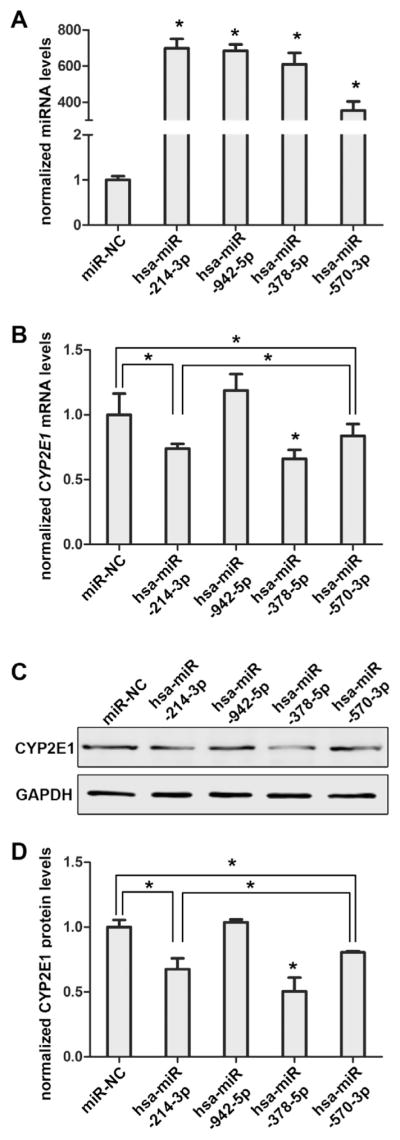
Hsa-miR-214-3p inhibited endogenous CYP2E1 expression in HepaRG cells. Differentiated HepaRG cells were transiently transfected using 40 nmol/L miRNA negative control or the mimics for hsa-miR-214-3p, hsa-miR-942-5p, hsa-miR-378-5p and hsa-miR-570-3p. Increased miRNA levels (A) and decreased CYP2E1 mRNA levels (B) were observed when transfected with hsa-miR-214-3p, hsa-miR-378-5p, hsa-miR-570-3p but not hsa-miR-942-5p in HepaRG cells. (C) Western blots with antibodies specific for CYP2E1 and GAPDH show that CYP2E1 protein levels are decreased in HepaRG cells when transfected with the hsa-miR-214-3p, hsa-miR-378-5p and hsa-miR-570-3p mimic but not hsa-miR-942-5p. (D) Quantitative densitometric analysis of immunoblotting images above. Each experiment was performed in triplicate. *P < 0.05; NC, miRNA negative control.

References

    1. Leung TM, Nieto N. CYP2E1 and oxidant stress in alcoholic and non-alcoholic fatty liver disease. J Hepatol. 2013;58:395–398. - PubMed
    1. Gonzalez FJ. The 2006 Bernard B. Brodie Award Lecture. Cyp2e1. Drug Metab Dispos. 2007;35:1–8. - PubMed
    1. Sutti S, Rigamonti C, Vidali M, Albano E. CYP2E1 autoantibodies in liver diseases. Redox Biol. 2014;3:72–78. - PMC - PubMed
    1. Miller GP. Advances in the interpretation and prediction of CYP2E1 metabolism from a biochemical perspective. Exp Opin Drug Metab Toxicol. 2008;4:1053–1064. - PubMed
    1. Trafalis DT, Panteli ES, Grivas A, Tsigris C, Karamanakos PN. CYP2E1 and risk of chemically mediated cancers. Exp Opin Drug Metab Toxicol. 2010;6:307–319. - PubMed

Publication types

MeSH terms