. 2017 Jun 27;61(7):e00076-17.
doi: 10.1128/AAC.00076-17. Print 2017 Jul.

Emergence and Evolution of Multidrug-Resistant Klebsiella pneumoniae with both blaKPC and blaCTX-M Integrated in the Chromosome

Affiliations

Emergence and Evolution of Multidrug-Resistant Klebsiella pneumoniae with both blaKPC and blaCTX-M Integrated in the Chromosome

Weihua Huang et al. Antimicrob Agents Chemother. .

Abstract

The extended-spectrum-β-lactamase (ESBL)- and Klebsiella pneumoniae carbapenemase (KPC)-producing Enterobacteriaceae represent serious and urgent threats to public health. In a retrospective study of multidrug-resistant K. pneumoniae, we identified three clinical isolates, CN1, CR14, and NY9, carrying both blaCTX-M and blaKPC genes. The complete genomes of these three K. pneumoniae isolates were de novo assembled by using both short- and long-read whole-genome sequencing. In CR14 and NY9, blaCTX-M and blaKPC were carried on two different plasmids. In contrast, CN1 had one copy of blaKPC-2 and three copies of blaCTX-M-15 integrated in the chromosome, for which the blaCTX-M-15 genes were linked to an insertion sequence, ISEcp1, whereas the blaKPC-2 gene was in the context of a Tn4401a transposition unit conjugated with a PsP3-like prophage. Intriguingly, downstream of the Tn4401a-blaKPC-2-prophage genomic island, CN1 also carried a clustered regularly interspaced short palindromic repeat (CRISPR)-cas array with four spacers targeting a variety of K. pneumoniae plasmids harboring antimicrobial resistance genes. Comparative genomic analysis revealed that there were two subtypes of type I-E CRISPR-cas in K. pneumoniae strains and suggested that the evolving CRISPR-cas, with its acquired novel spacer, induced the mobilization of antimicrobial resistance genes from plasmids into the chromosome. The integration and dissemination of multiple copies of blaCTX-M and blaKPC from plasmids to chromosome depicts the complex pandemic scenario of multidrug-resistant K. pneumoniae Additionally, the implications from this study also raise concerns for the application of a CRISPR-cas strategy against antimicrobial resistance.

Keywords: CRISPR-Cas; CTX-M; Klebsiella pneumoniae; blaKPC; carbapenem-resistance; chromosomal beta-lactamases.


Figures

FIG 1
FIG 1
Overview of whole-chromosome sequence comparisons using progressive Mauve. (A) Chromosome comparison of K. pneumoniae isolates CR14, NY9, and CN1. Indicated are locations of β-lactamase genes (blaCTX-M-15 and blaKPC-2), prophages (▼), and the CRISPR site, as well as a large inversion in the CR14 chromosome. The boxed areas and CRISPR site are shown in more detail in later figures. (B) Chromosome comparison of K. pneumoniae isolates MS6671, CN1, and KPNIH31. Indicated are multiple β-lactamase genes, blaCTX-M-15, blaKPC-2, and blaOXA-181, and a large inversion in the KPNIH31 chromosome. A homologous PsP3-like prophage (▼) and a similar CRISPR-cas array (labeled in red font) are shared by these chromosomes. For a better view of sequence alignment and chromosomal architecture in comparison, genome sequences of KPNIH31 (2013, United States) and MS6671 (2014, United Arab Emirates) are adjusted to dnaA as the first gene.
FIG 2
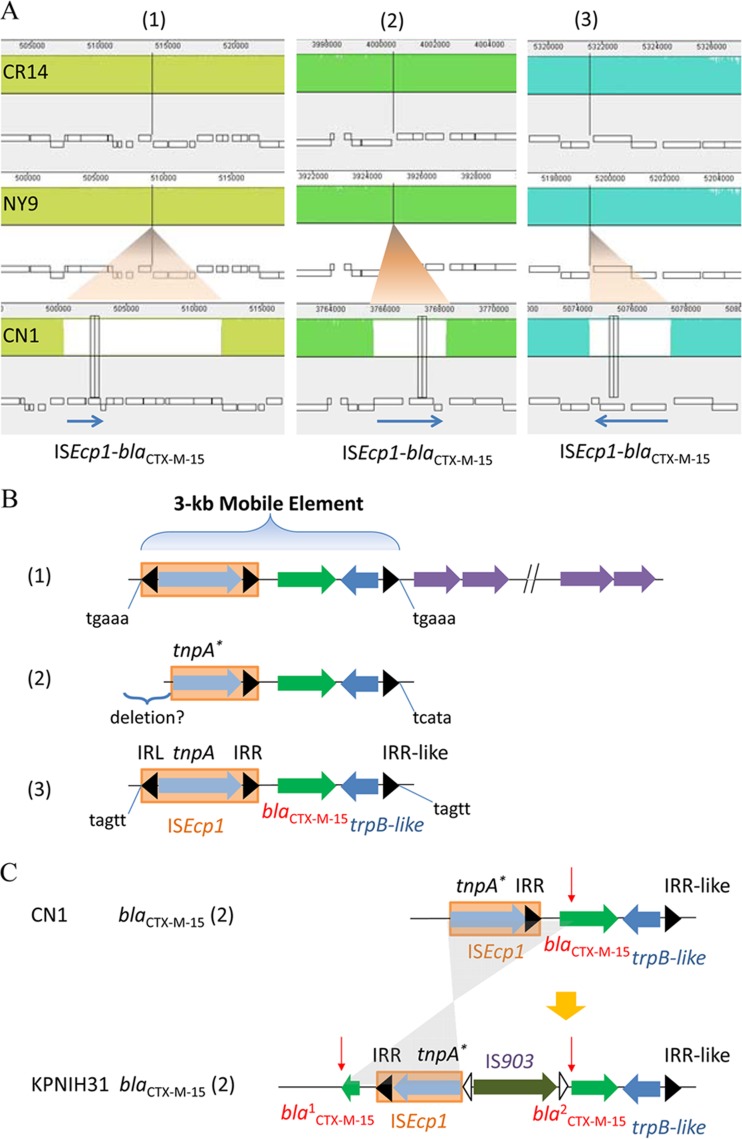
FIG 2
Integration of blaCTX-M-15 in the chromosome by mobile element ISEcp1. (A) A zoomed-in view of three blaCTX-M-15 genes inserted in the CN1 chromosome, compared with chromosomes of CR14 and NY9. The blue arrow indicates a mobile element of ISEcp1-blaCTX-M-15. (B) A schematic view of genetic elements in 3-kb mobile elements of ISEcp1-blaCTX-M-15 in the CN1 chromosome. IRL, left inverted repeat; IRR, right inverted repeat; tnpA, gene encoding transposase A type; trpB-like, gene encoding tryptophan synthase subunit beta-like protein. The target site duplication (TSD) sequences are shown at the ends. The suggested deletion was marked on the second copy of ISEcp1-blaCTX-M-15. (C) A schematic view of the second copies of ISEcp1-blaCTX-M-15 in CN1 and KPNIH31 chromosomes. The second copy of ISEcp1-blaCTX-M-15 in KPNIH31 was disrupted by IS903 insertion. Indicated with a red arrow is the interruption site. Insertion of IS903 interrupts the blaCTX-M-15 gene in the middle and further inverts a truncated part of ISEcp1 (shaded gray). IRR, right inverted repeat.
FIG 3
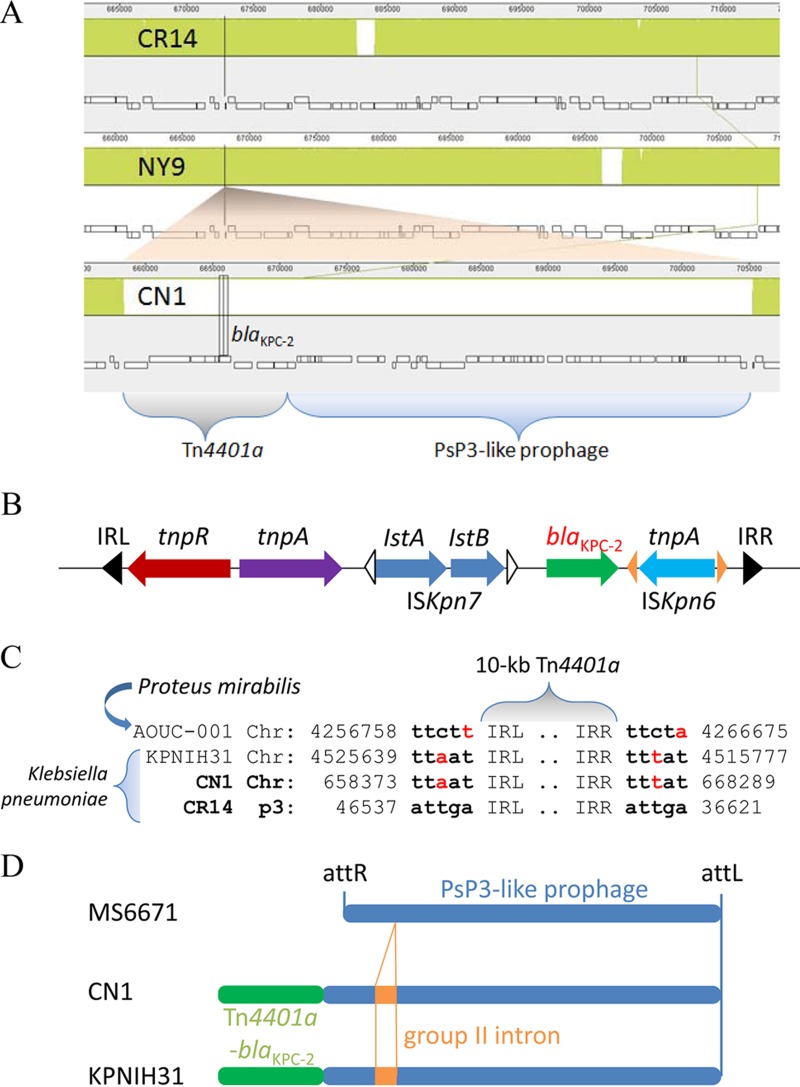
FIG 3
Integration of blaKPC-2 in the chromosome by a mobile element, Tn4401a. (A) A zoomed-in view of blaKPC-2 insertion in the CN1 chromosome by a 10-kb Tn4401a conjugated with a 43-kb PsP3-like prophage and compared with chromosomes of CR14 and NY9. (B) A schematic view of genetic elements in a 10-kb mobile element of Tn4401a-blaKPC-2, including transposase tnpA, resolvase tnpR, and insertion sequences ISKpn6 and ISKpn7. IRL, left inverted repeat; IRR, right inverted repeat. (C) Comparison of target site duplication (TSD) sequences of Tn4401a-blaKPC-2 transposon in plasmid pCR14_3 (p3) with those in chromosomes of K. pneumoniae CN1 and KPNIH31 (2013, United States) and Proteus mirabilis AOUC-001 (2013, Italy). The numbers shown indicate nucleotide positions at either chromosome or plasmid. (D) A schematic view of PsP3-like prophage region in K. pneumoniae MS6671, CN1, and KPNIH31. MS6671 contained both 32-bp phage attachment sites (attL and attR) at the ends, whereas CN1 and KPNIH31 lost attR at the site of Tn4401a-blaKPC-2 (green bar) conjugating with the PsP3-like prophage (blue bar). Additionally, CN1 and KPNIH31 had identical sequences in the region, and both contained an insertion of group II intron (orange bar) in the prophage.
FIG 4
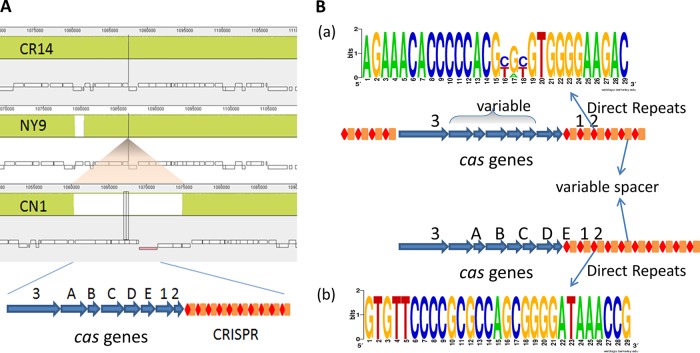
FIG 4
CRISPR-cas system in K. pneumoniae. (A) A zoomed-in view of CRISPR-cas array insertion in the CN1 chromosome, showing the cas operon of eight cas genes followed by sequence repeats with spacers. (B) A schematic view of two subtypes (a and b) of the CRISPR-cas system in K. pneumoniae. The consensus sequences were generated in WebLogo in analysis of direct repeats collected from 22 CRISPR arrays and grouped into two subtypes. Numbers and sizes of direct repeats, spacers, and cas genes are not to scale.

References

    1. CDC. 2013. Antibiotic resistance threats in the United States, 2013. Centers for Disease Control and Prevention, Atlanta, GA.
    1. Paterson DL, Bonomo RA. 2005. Extended-spectrum beta-lactamases: a clinical update. Clin Microbiol Rev 18:657–686. doi:10.1128/CMR.18.4.657-686.2005. - DOI - PMC - PubMed
    1. Zhao WH, Hu ZQ. 2013. Epidemiology and genetics of CTX-M extended-spectrum beta-lactamases in Gram-negative bacteria. Crit Rev Microbiol 39:79–101. doi:10.3109/1040841X.2012.691460. - DOI - PMC - PubMed
    1. Nordmann P, Cuzon G, Naas T. 2009. The real threat of Klebsiella pneumoniae carbapenemase-producing bacteria. Lancet Infect Dis 9:228–236. doi:10.1016/S1473-3099(09)70054-4. - DOI - PubMed
    1. Kitchel B, Rasheed JK, Patel JB, Srinivasan A, Navon-Venezia S, Carmeli Y, Brolund A, Giske CG. 2009. Molecular epidemiology of KPC-producing Klebsiella pneumoniae isolates in the United States: clonal expansion of multilocus sequence type 258. Antimicrob Agents Chemother 53:3365–3370. doi:10.1128/AAC.00126-09. - DOI - PMC - PubMed

MeSH terms

LinkOut - more resources