


Autism spectrum disorders: a meta-analysis of executive function
- PMID: 28439105
- PMCID: PMC5984099
- DOI: 10.1038/mp.2017.75
Autism spectrum disorders: a meta-analysis of executive function
Abstract
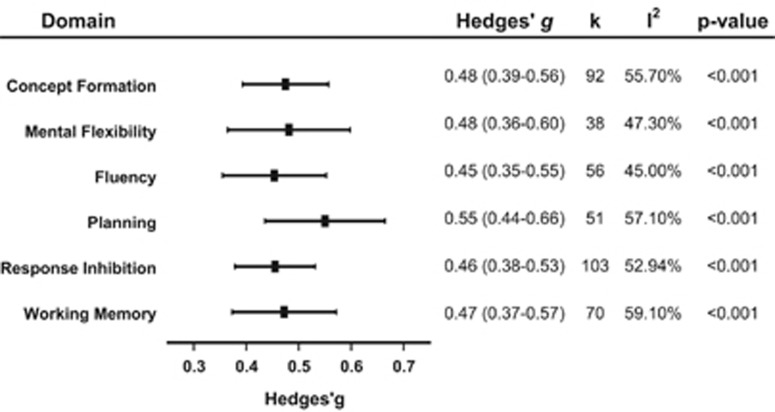
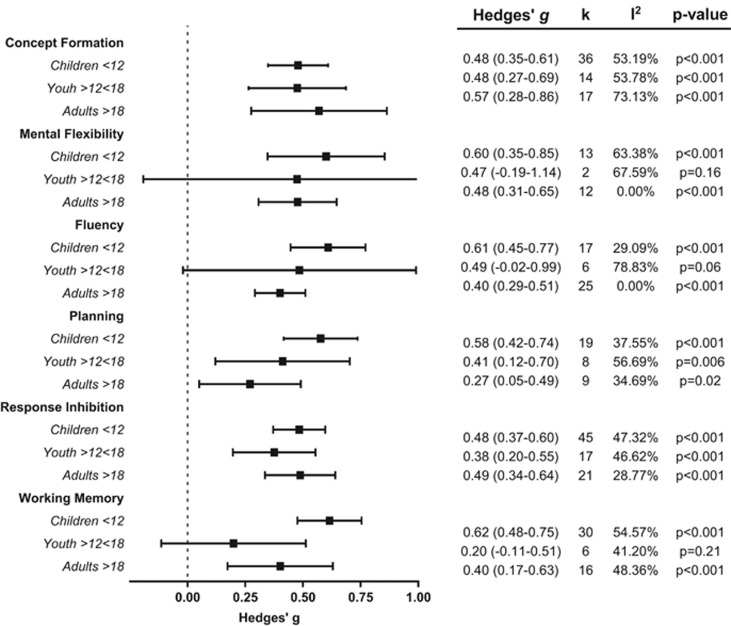
Evidence of executive dysfunction in autism spectrum disorders (ASD) across development remains mixed and establishing its role is critical for guiding diagnosis and intervention. The primary objectives of this meta-analysis is to analyse executive function (EF) performance in ASD, the fractionation across EF subdomains, the clinical utility of EF measures and the influence of multiple moderators (for example, age, gender, diagnosis, measure characteristics). The Embase, Medline and PsychINFO databases were searched to identify peer-reviewed studies published since the inclusion of Autism in DSM-III (1980) up to end of June 2016 that compared EF in ASD with neurotypical controls. A random-effects model was used and moderators were tested using subgroup analysis. The primary outcome measure was Hedges' g effect size for EF and moderator factors. Clinical sensitivity was determined by the overlap percentage statistic (OL%). Results were reported according to the PRISMA (Preferred Reporting Items for Systematic Reviews and Meta-Analyses) guidelines. A total of 235 studies comprising 14 081 participants were included (N, ASD=6816, Control=7265). A moderate overall effect size for reduced EF (Hedges' g=0.48, 95% confidence interval (CI) 0.43-0.53) was found with similar effect sizes across each domain. The majority of moderator comparisons were not significant although the overall effect of executive dysfunction has gradually reduced since the introduction of ASD. Only a small number of EF measures achieved clinical sensitivity. This study confirms a broad executive dysfunction in ASD that is relatively stable across development. The fractionation of executive dysfunction into individual subdomains was not supported, nor was diagnostic sensitivity. Development of feasible EF measures focussing on clinical sensitivity for diagnosis and treatment studies should be a priority.
Conflict of interest statement
IH is a Commissioner in Australia’s new National Mental Health Commission from 2012. He was a director of headspace: the national youth mental health foundation until January 2012. He was previously the chief executive officer (till 2003) and clinical adviser (till 2006) of beyondblue, an Australian National Depression Initiative. He is the Co-Director, Health and Policy at the Brain and Mind Centre that operates two early-intervention youth services under contract to headspace. He has led a range of community-based and pharmaceutical industry-supported depression awareness and education and training programs. He has led projects for health professionals and the community supported by governmental, community agency and pharmaceutical industry partners (Wyeth, Eli Lily, Servier, Pfizer, AstraZeneca) for the identification and management of depression and anxiety. He has received honoraria for presentations of his own work at educational seminars supported by a number of non-government organisations and the pharmaceutical industry (including Servier, Pfizer, AstraZeneca and Eli Lilly). He is a member of the Medical Advisory Panel for Medibank Private and also a Board Member of Psychosis Australia Trust. He leads an investigator-initiated study of the effects of agomelatine on circadian parameters (supported in part by Servier) and has participated in a multicentre clinical trial of the effects of agomelatine on sleep architecture in depression and a Servier-supported study of major depression and sleep disturbance in primary care settings. The other authors declare no conflict of interest.
Figures
References
-
- American Psychiatric AssociationDiagnostic and Statistical Manual of Mental Disorders, 5th edn. Washington DC, 2013.
-
- Pellicano E. Links between theory of mind and executive function in young children with autism: clues to developmental primacy. Dev Psychol 2007; 43: 974–990. - PubMed
-
- Leung RC, Vogan VM, Powell TL, Anagnostou E, Taylor MJ. The role of executive functions in social impairment in autism spectrum disorder. Child Neuropsychol 2016; 22: 336–344. - PubMed
Publication types
MeSH terms
LinkOut - more resources
Full Text Sources
Other Literature Sources
Medical
