


Ability to adjust nocturnal fat oxidation in response to overfeeding predicts 5-year weight gain in adults
- PMID: 28440048
- PMCID: PMC5407418
- DOI: 10.1002/oby.21807
Ability to adjust nocturnal fat oxidation in response to overfeeding predicts 5-year weight gain in adults
Abstract
Objective: To determine whether metabolic responses to short-term overfeeding predict longitudinal changes in body weight.
Methods: Twenty-four-hour energy expenditure (EE) and substrate utilization were measured at baseline in a room calorimeter following 3 days of eucaloric and hypercaloric feeding (40% excess) in a sample of lean adults (n: 34; age: 28 ± 2 y; BMI: 22 ± 3 kg/m2 ). Body mass and fat mass (dual-energy x-ray absorptiometry) were measured annually for 5 years. Regression analyses examined whether changes in EE and fuel use with overfeeding predicted body weight and composition changes over 5 years.
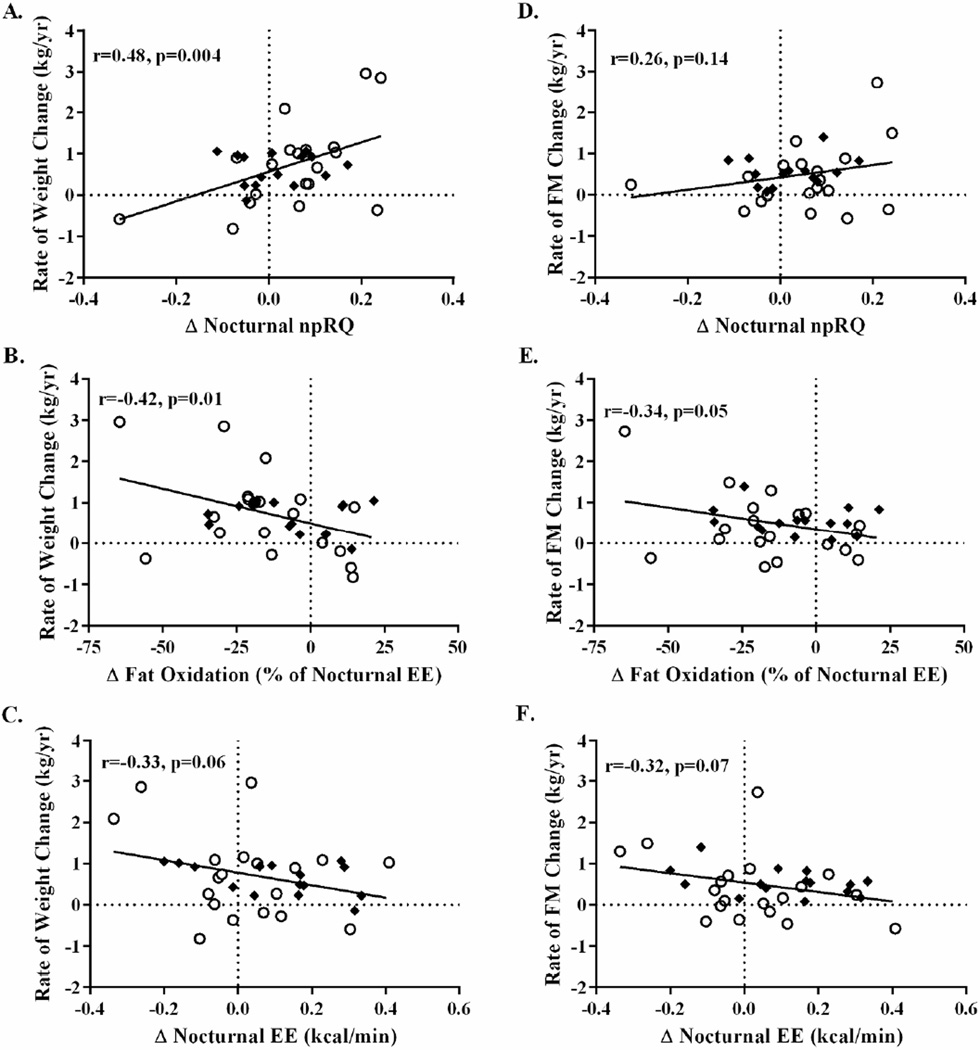
Results: Overfeeding increased EE and reduced fat oxidation when examined over the 24-hour, waking, and nocturnal periods. Absolute change in body mass over 5 years was 3.0 ± 0.6 kg (average rate of change = 0.7 ± 0.1 kg/y, P < 0.001). Lower nocturnal (but not 24-hour or waking) fat oxidation (r = -0.42, P = 0.01) and EE (r = -0.33, P = 0.05) with overfeeding were the strongest predictors of 5-year weight gain. When adjusted for covariates, changes in nocturnal fat oxidation and EE with overfeeding predicted 41% of the variance in weight change (P = 0.02).
Conclusions: Failure to maintain fat oxidation at night following a period of overfeeding appears to be associated with a metabolic phenotype favoring weight gain.
© 2017 The Obesity Society.
Conflict of interest statement
Figures

References
-
- Jensen MD, Ryan DH, Apovian CM, Ard JD, Comuzzie AG, Donato KA, et al. 2013 AHA/ACC/TOS guideline for the management of overweight and obesity in adults: a report of the American College of Cardiology/American Heart Association Task Force on Practice Guidelines and The Obesity Society. J Am Coll Cardiol. 2014;63(25 Pt B):2985–3023. - PubMed
-
- Ravussin E. Metabolic differences and the development of obesity. Metabolism. 1995;44(9 Suppl 3):12–14. - PubMed
MeSH terms
Grants and funding
LinkOut - more resources
Full Text Sources
Other Literature Sources
Medical
