


Major Limb Outcomes Following Lower Extremity Endovascular Revascularization in Patients With and Without Diabetes Mellitus
- PMID: 28440113
- PMCID: PMC5624231
- DOI: 10.1177/1526602817705135
Major Limb Outcomes Following Lower Extremity Endovascular Revascularization in Patients With and Without Diabetes Mellitus
Abstract
Purpose: To determine whether diabetes mellitus has an independent impact on major limb outcomes at 1 year after endovascular treatment of lower extremity peripheral artery disease (PAD).
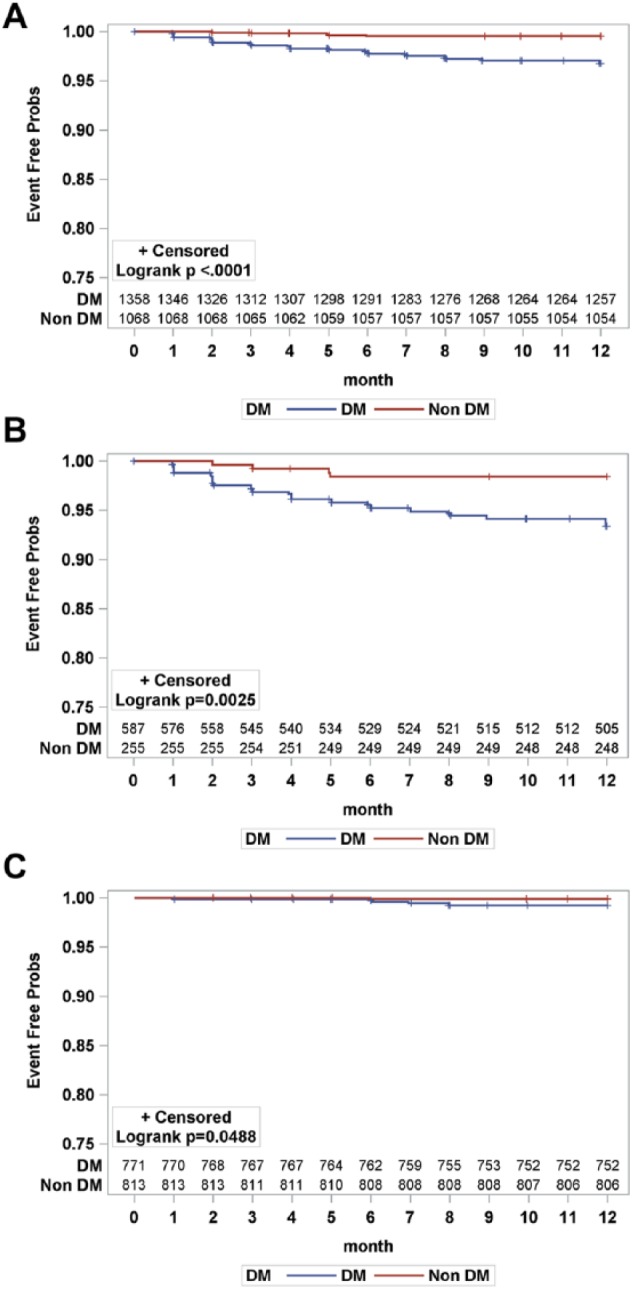
Methods: The study involved 1906 consecutive patients (mean age 66 years; 1469 men) enrolled in the observational Excellence in Peripheral Artery Disease (XLPAD) registry ( ClinicalTrials.gov identifier NCT01904851) between January 2005 and October 2015 after undergoing index endovascular procedures in 2426 limbs for arterial occlusive disease. Patient outcomes included 12-month target limb amputation (above ankle) and target limb revascularization as well as all-cause death. Kaplan-Meier analysis and adjusted Cox proportional hazard models were used for time-to-event analysis of outcomes for the entire study sample as well as for the critical limb ischemia (CLI) and claudication subgroups. Results of the Cox regression models are reported as the hazard ratio (HR) and 95% confidence interval (CI).
Results: Diabetics undergoing endovascular procedures had higher rates of comorbid conditions (p<0.001), CLI (p<0.001), heavily calcified lesions (p=0.002), multivessel disease (p=0.030), and fewer infrapopliteal runoff vessels (p<0.001). Regression analysis after adjusting for confounders revealed significantly higher target limb major amputation in diabetics compared with nondiabetics (HR 5.02, 95% CI 1.44 to 17.56, p=0.011). However, repeat revascularization rates were similar. When considering CLI and claudication subgroups, diabetes was associated with a nonsignificant increased risk of 12-month major amputation only for patients presenting with CLI (HR 3.48, 95% CI 0.97 to 12.51, p=0.056). Diabetes was also associated with an increased risk of 12-month all-cause mortality in the overall study sample (HR 4.64, 95% CI 2.01 to 10.70, p<0.001) and in the CLI subgroup (HR 14.15, 95% CI 3.16 to 63.32, p<0.001) but not in the claudication subgroup (HR 1.42, 95% CI 0.45 to 4.54, p=0.552).
Conclusion: Diabetes increases the risk of major amputation and all-cause death at 12 months following endovascular revascularization in patients with symptomatic PAD. These risks are especially heightened in patients presenting with CLI.
Keywords: amputation; balloon angioplasty; diabetes mellitus; mortality; peripheral artery disease; reintervention, stenosis; stent; target lesion revascularization.
Conflict of interest statement
Figures


References
-
- Chen L, Magliano DJ, Zimmet PZ. The worldwide epidemiology of type 2 diabetes mellitus—present and future perspectives. Nat Rev Endocrinol. 2012;8:228–236. - PubMed
-
- Menke A, Casagrande S, Geiss L, et al. Prevalence of and trends in diabetes among adults in the United States, 1988–2012. JAMA. 2015;314:1021–1029. - PubMed
-
- Marso SP, Hiatt WR. Peripheral arterial disease in patients with diabetes. J Am Coll Cardiol. 2006;47:921–929. - PubMed
-
- Lüscher TF, Creager MA, Beckman JA, et al. Diabetes and vascular disease: pathophysiology, clinical consequences, and medical therapy: part II. Circulation. 2003;108:1655–1661. - PubMed
Publication types
MeSH terms
Associated data
Grants and funding
LinkOut - more resources
Full Text Sources
Other Literature Sources
Medical
Research Materials
Miscellaneous
