Review
. 2017 Sep;24(9):562-571.
doi: 10.1038/gt.2017.29. Epub 2017 Jul 27.

The importance of international collaboration for rare diseases research: a European perspective

Affiliations
Review

The importance of international collaboration for rare diseases research: a European perspective

D Julkowska et al. Gene Ther. 2017 Sep.

Abstract

Over the last two decades, important contributions were made at national, European and international levels to foster collaboration into rare diseases research. The European Union (EU) has put much effort into funding rare diseases research, encouraging national funding organizations to collaborate together in the E-Rare program, setting up European Reference Networks for rare diseases and complex conditions, and initiating the International Rare Diseases Research Consortium (IRDiRC) together with the National Institutes of Health in the USA. Co-ordination of the activities of funding agencies, academic researchers, companies, regulatory bodies, and patient advocacy organizations and partnerships with, for example, the European Research Infrastructures maximizes the collective impact of global investments in rare diseases research. This contributes to accelerating progress, for example, in faster diagnosis through enhanced discovery of causative genes, better understanding of natural history of rare diseases through creation of common registries and databases and boosting of innovative therapeutic approaches. Several examples of funded pre-clinical and clinical gene therapy projects show that integration of multinational and multidisciplinary expertize generates new knowledge and can result in multicentre gene therapy trials. International collaboration in rare diseases research is key to improve the life of people living with a rare disease.


Conflict of interest statement

The authors declare no conflict of interest.

Figures
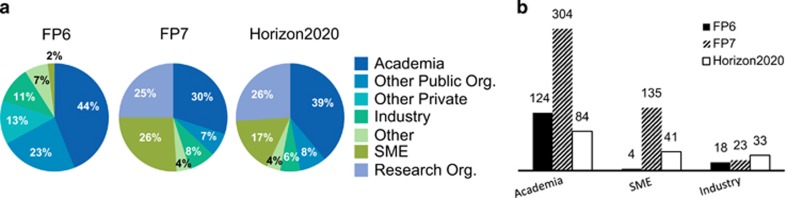
Figure 1
Figure 1
(a) Comparative analysis of the type of organizations supported by the EU throughout the framework programmes*. Industry: any commercial private entity larger than SME; other private: other private non-commercial organizations; other public: other public non-commercial organizations; SME: small and medium-size enterprises. (b) Overview of the EU support throughout the framework programmes* presented per three main organization types. The numbers shown refer to millions of euros. Legend: as the definition of organizations’ types has significantly evolved throughout the FPs, a straightforward comparison of participation between FPs is somewhat difficult. However, results for Academia, SME and Industry could be analyzed as the proportion of the financial support to these three particular types comes to 63% throughout FP6, 74% throughout FP7 and 70% throughout Horizon 2020. *Of note, analysis of FP7 projects was performed on 118 projects.
Figure 2
Figure 2
(a) Exchange of researchers in E-Rare funded projects. Analysis of 37 projects financed in 2007, 2009 and 2011. Visit refers to max 2 weeks; Short stay refers to 1–12 months; Long stay refers to more than 1-year stay. (b) Establishment of new collaboration during the lifetime of the research project. 37 projects were analyzed of which 28 developed new collaborations. Half of these new partnerships involves 1 or 2 new partners. The other 14 consortia developed collaborations with more than 3 new partners during the lifetime of the project.
Figure 3
Figure 3
Research pipeline of projects financed by E-Rare. Analysis of all projects funded between 2007 and 2016. The projects funded by E-Rare are covering the whole research pipeline from molecular and pathophysiological studies to clinical trials. All research projects have been analyzed to classify their work in 5 categories (non-exclusive): molecular and pathophysiological studies; diagnostic studies; new therapeutic approaches; pre-clinical and validation studies; clinical trials. However, many of them include studies that could be assigned to more than one category. The numbers represent therefore projects reflecting one or combination of categories. As example: 28 projects focus on molecular and pathophysiological mechanisms of RD (only), whereas 8 projects include studies from molecular and pathophysiological mechanism to the set-up of new therapeutic approaches and diagnostics.
Figure 4
Figure 4
Schematic presentation of involvement of Patients’ Organizations in E-Rare funding activities. The process is divided into following phases: 1, expression of interest; 2, preparation of call documents; 3, call launch and advertisement; 4, 1st scientific evaluation; 5, PO’s choice of projects of interest; 6, 2nd scientific evaluation; 7, common funding decision.
Figure 5
Figure 5
Coordinators and partners in E-Rare gene therapy research projects by country (International Organization for Standardization abbreviation is used).
Figure 6
Figure 6
IRDiRC governance structure.

References

    1. Regulation (EC) No. 141/2000 of the European Parliament and of the Council of 16 December 1999 on orphan medicinal products. Available at: http://eur-lex.europa.eu/legal-content/EN/TXT/?uri=OJ:L:2000:018:TOC (accessed on 15 February 2017).
    1. Rare Disease Act 2002. Available at: https://www.gpo.gov/fdsys/pkg/PLAW-107publ280/html/PLAW-107publ280.htm (accessed on 15 February 2017).
    1. Japan Intractable Disease Information Center. Available at: http://www.nanbyou.or.jp (accessed on 15 February 2017).
    1. Communication from the European Commission on Rare Diseases: Europe’s challenges. Available at: http://eur-lex.europa.eu/legal-content/EN/TXT/PDF/?uri=CELEX:52008DC0679... (accessed on 15 February 2017).
    1. The European Union Horizon 2020 Health Work Programme. Available at: https://ec.europa.eu/research/participants/portal/desktop/en/opportuniti... (accessed on 15 February 2017).

Publication types

MeSH terms
