


Familial longevity is characterized by high circadian rhythmicity of serum cholesterol in healthy elderly individuals
- PMID: 28440906
- PMCID: PMC5334529
- DOI: 10.1111/acel.12547
Familial longevity is characterized by high circadian rhythmicity of serum cholesterol in healthy elderly individuals
Abstract
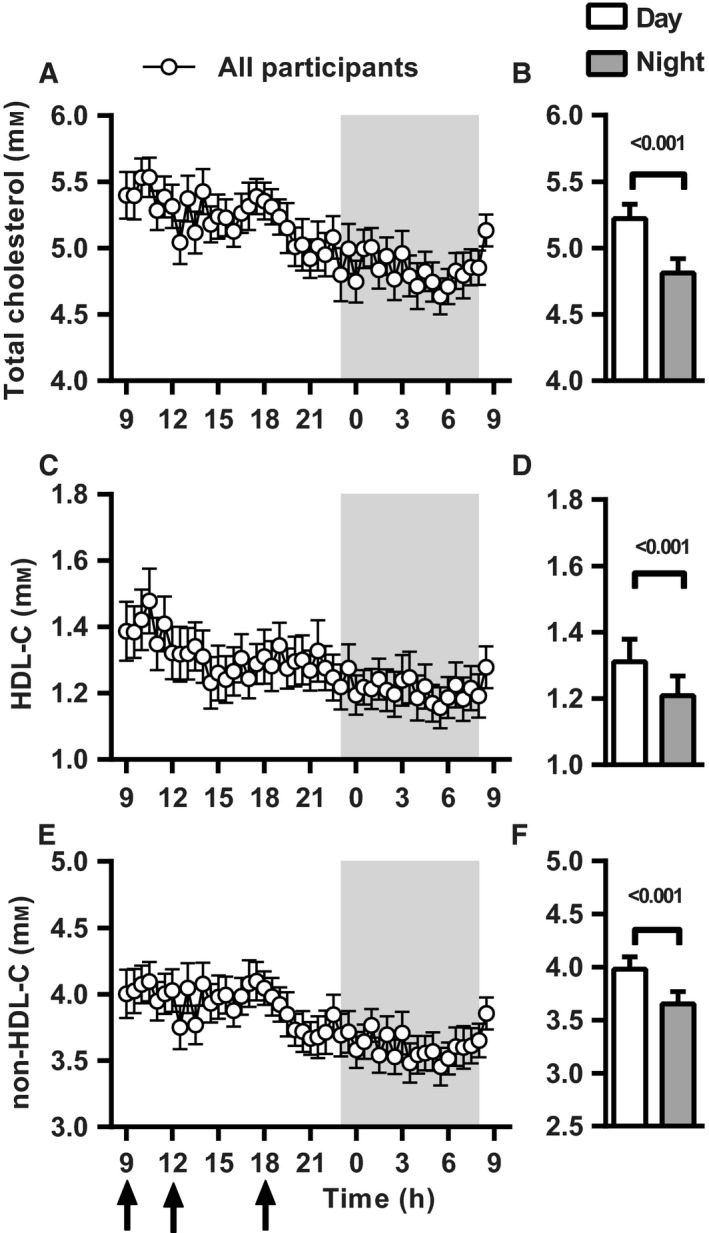
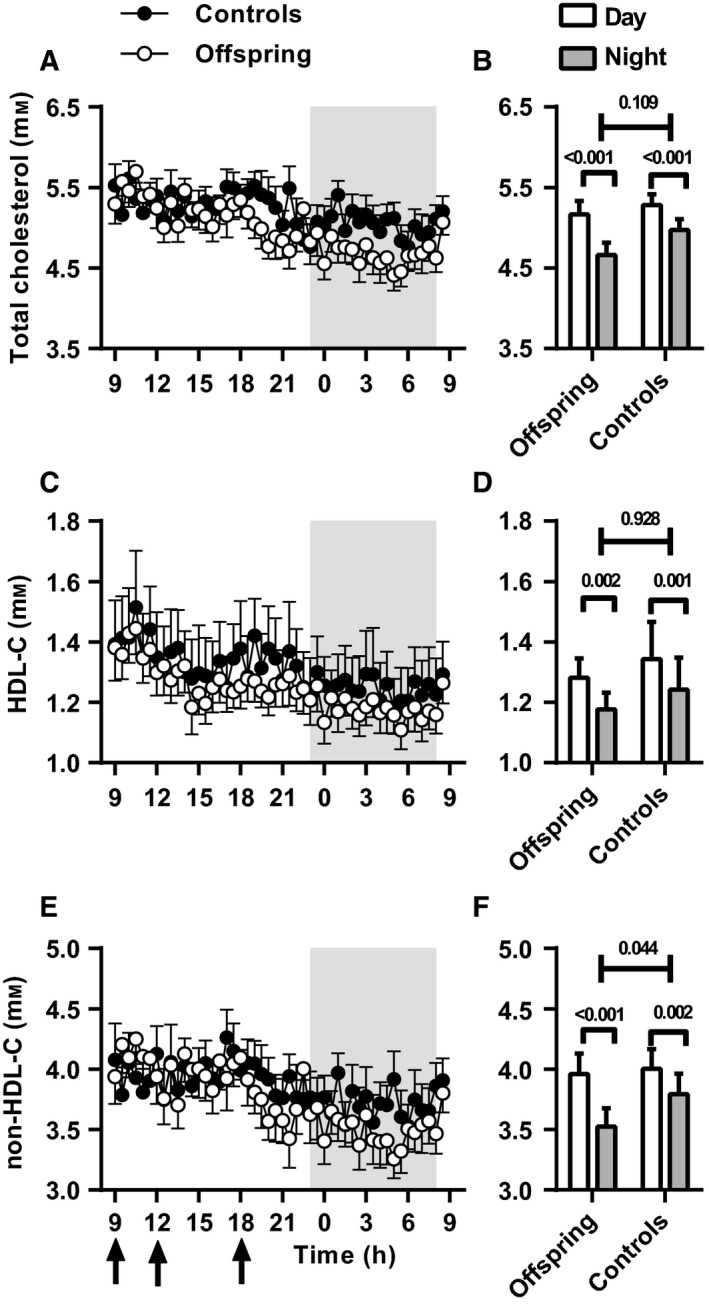
The biological clock, whose function deteriorates with increasing age, determines bodily circadian (i.e. 24h) rhythms, including that of cholesterol metabolism. Dampening of circadian rhythms has been associated with aging and disease. Therefore, we hypothesized that individuals with a familial predisposition for longevity have a higher amplitude circadian serum cholesterol concentration rhythm. The aim of this study was to investigate circadian rhythmicity of serum cholesterol concentrations in offspring of nonagenarian siblings and their partners. Offspring from nonagenarian siblings (n = 19), and their partners as controls (n = 18), were recruited from the Leiden Longevity Study. Participants (mean age 65 years) were studied in a controlled in-hospital setting over a 24-h period, receiving three isocaloric meals at 9:00 h, 12:00 h and 18:00 h. Lights were off between 23:00 h and 8:00 h. Serum total cholesterol (TC), HDL cholesterol (HDL-C), non-HDL-C and triglycerides (TG) were determined every 30 min over a 24-h period. Serum TC concentrations were higher during day than during night in offspring (5.2 vs. 4.7 mm, P < 0.001) and in controls (5.3 vs. 5.0 mm, P < 0.001). The difference in TC concentrations between day and night tended to be greater in offspring than in controls (0.5 vs. 0.3 mm, P = 0.109), reaching statistical significance in females (P = 0.045). Notably, the day-night serum differences in non-HDL-C were twofold greater in offspring than in controls (0.43 vs. 0.21 mm, P = 0.044) and most explicit in females (0.53 vs. 0.22, P = 0.078). We conclude that familial longevity is characterized by a high circadian rhythmicity of non-HDL-C in healthy elderly offspring from nonagenarian siblings.
Keywords: aging; biological clock; cholesterol; circadian rhythm; longevity.
© 2016 The Authors. Aging Cell published by the Anatomical Society and John Wiley & Sons Ltd.
Figures
References
-
- Barzilai N, Gabriely I, Gabriely M, Iankowitz N, Sorkin JD (2001) Offspring of centenarians have a favorable lipid profile. J. Am. Geriatr. Soc. 49, 76–79. - PubMed
-
- Barzilai N, Atzmon G, Schechter C, Schaefer EJ, Cupples AL, Lipton R, Cheng S, Shuldiner AR (2003) Unique lipoprotein phenotype and genotype associated with exceptional longevity. JAMA 290, 2030–2040. - PubMed
-
- Buysse DJ, Reynolds CF III, Monk TH, Berman SR, Kupfer DJ (1989) The Pittsburgh Sleep Quality Index: a new instrument for psychiatric practice and research. Psychiatry Res. 28, 193–213. - PubMed
Publication types
MeSH terms
Substances
LinkOut - more resources
Full Text Sources
Other Literature Sources
Miscellaneous
