


Synaptic Homeostasis and Its Immunological Disturbance in Neuromuscular Junction Disorders
- PMID: 28441759
- PMCID: PMC5412475
- DOI: 10.3390/ijms18040896
Synaptic Homeostasis and Its Immunological Disturbance in Neuromuscular Junction Disorders
Abstract
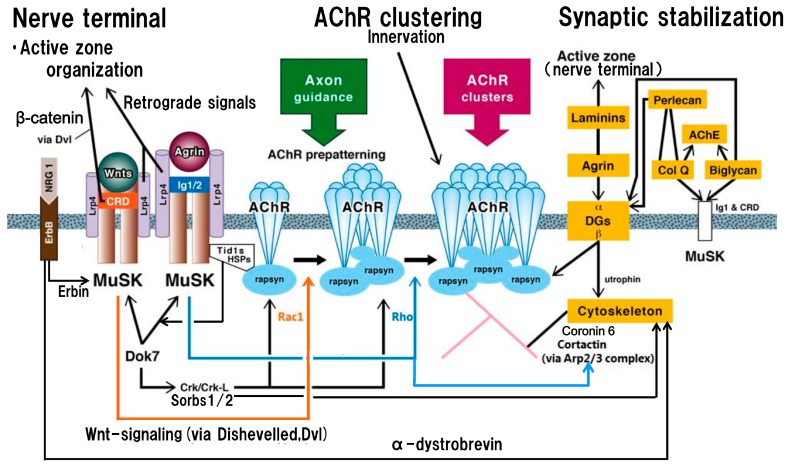
In the neuromuscular junction, postsynaptic nicotinic acetylcholine receptor (nAChR) clustering, trans-synaptic communication and synaptic stabilization are modulated by the molecular mechanisms underlying synaptic plasticity. The synaptic functions are based presynaptically on the active zone architecture, synaptic vesicle proteins, Ca2+ channels and synaptic vesicle recycling. Postsynaptically, they are based on rapsyn-anchored nAChR clusters, localized sensitivity to ACh, and synaptic stabilization via linkage to the extracellular matrix so as to be precisely opposed to the nerve terminal. Focusing on neural agrin, Wnts, muscle-specific tyrosine kinase (a mediator of agrin and Wnts signalings and regulator of trans-synaptic communication), low-density lipoprotein receptor-related protein 4 (the receptor of agrin and Wnts and participant in retrograde signaling), laminin-network (including muscle-derived agrin), extracellular matrix proteins (participating in the synaptic stabilization) and presynaptic receptors (including muscarinic and adenosine receptors), we review the functional structures of the synapse by making reference to immunological pathogenecities in postsynaptic disease, myasthenia gravis. The synapse-related proteins including cortactin, coronin-6, caveolin-3, doublecortin, R-spondin 2, amyloid precursor family proteins, glia cell-derived neurotrophic factor and neurexins are also discussed in terms of their possible contribution to efficient synaptic transmission at the neuromuscular junction.
Keywords: Wnts; adenosine receptor; agrin; laminins; low-density lipoprotein receptor-related protein 4; muscarinic acetylcholine receptor; muscle-specific tyrosine kinase; myasthenia gravis; neuromuscular junction; nicotinic acetylcholine receptor.
Conflict of interest statement
The author declares no conflicts of interest.
Figures
References
-
- Klooster R., Plomp J.J., Huijbers M.G., Niks E.H., Straasheijm K.R., Detmers F.J., Hermans P.W., Sleijpens A., Verrips A., Losen M., et al. Muscle-specific kinase myasthenia gravis IgG4 autoantibodies cause severe neuromuscular junction dysfunction in mice. Brain. 2012;135(Pt 4):1081–1101. doi: 10.1093/brain/aws025. - DOI - PubMed
-
- Viegas S., Jacobson L., Waters P., Cossins J., Jacob S., Leite M.I., Webster R., Vincent A. Passive and active immunization models of MuSK-ab positive myasthenia: Electrophysiological evidence for pre and postsynaptic defects. Exp. Neurol. 2012;234:506–512. doi: 10.1016/j.expneurol.2012.01.025. - DOI - PubMed
Publication types
MeSH terms
Substances
LinkOut - more resources
Full Text Sources
Other Literature Sources
Miscellaneous
