Review
. 2017 Apr 24;7(4):92.
doi: 10.3390/nano7040092.

Gold Nanoparticles for Modulating Neuronal Behavior

Affiliations
Review

Gold Nanoparticles for Modulating Neuronal Behavior

Chiara Paviolo et al. Nanomaterials (Basel). .

Abstract

Understanding the detailed functioning and pathophysiology of the brain and the nervous system continues to challenge the scientific community, particularly in terms of scaling up techniques for monitoring and interfacing with complex 3D networks. Nanotechnology has the potential to support this scaling up, where the eventual goal would be to address individual nerve cells within functional units of both the central and peripheral nervous system. Gold nanoparticles provide a variety of physical and chemical properties that have attracted attention as a light-activated nanoscale neuronal interface. This review provides a critical overview of the photothermal and photomechanical properties of chemically functionalized gold nanoparticles that have been exploited to trigger a range of biological responses in neuronal tissues, including modulation of electrical activity and nerve regeneration. The prospects and challenges for further development are also discussed.

Keywords: gold nanoparticles; neuronal cell behavior; photothermal effects; plasmonics.


Conflict of interest statement

The authors declare no conflict of interest.

Figures
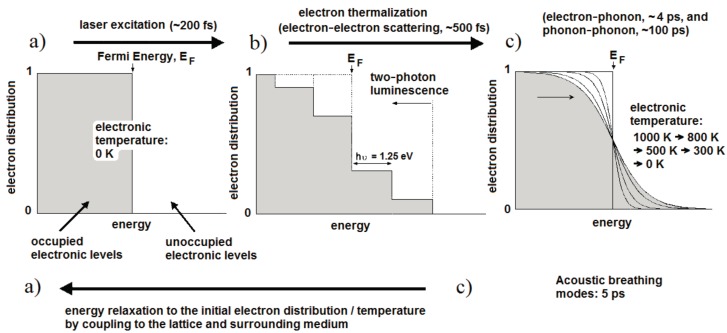
Figure 1
Figure 1
Electron distributions and corresponding timescales of the fundamental processes in laser heating of Au NPs: the initial distribution (a) is excited to a non-thermal state (b); before relaxing to the Fermi-Dirac distribution (c) and finally returning to the initial state once energy has been transferred to the surrounding medium (after Link and El-Sayed [33]).
Figure 2
Figure 2
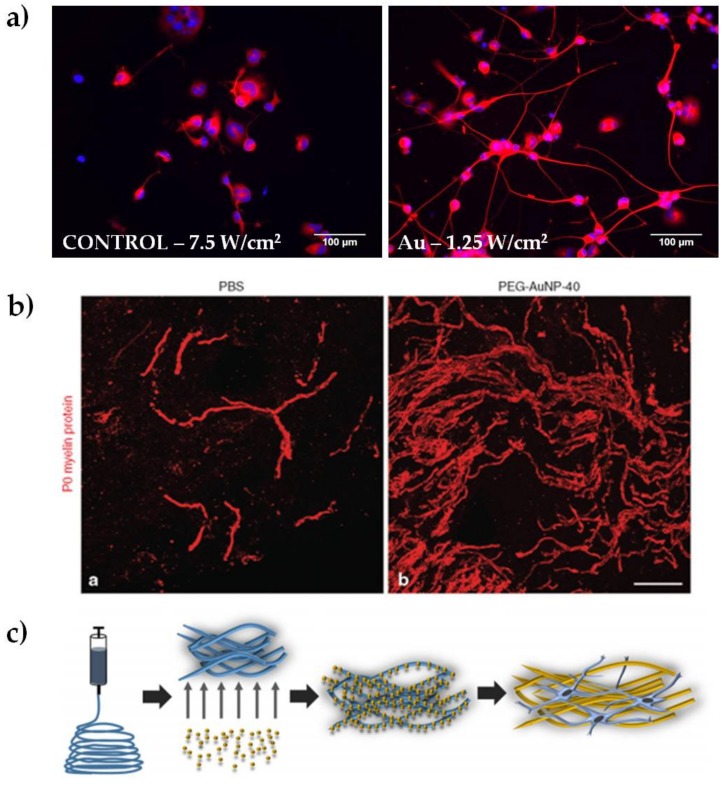
Representative results of Au NPs for peripheral nerve regeneration. (a) Examples of epifluorescence images of NG108-15 neuronal cells cultured alone or with Au NRs and exposed to different laser irradiances, as indicated in each panel. Cells were marked for β-III tubulin (in red) and DAPI (in blue, reproduced with permission from [49]); (b) Spontaneous remyelination by Schwann cells (myelin marker P0, in red) was enhanced in mice treated with polyethylene glycol-coated Au NPs (reproduced with permission from [7]); (c) schematic representation of electrospun nanofibers doped with 10 nm Au NPs (reproduced with permission from [27]).
Figure 3
Figure 3
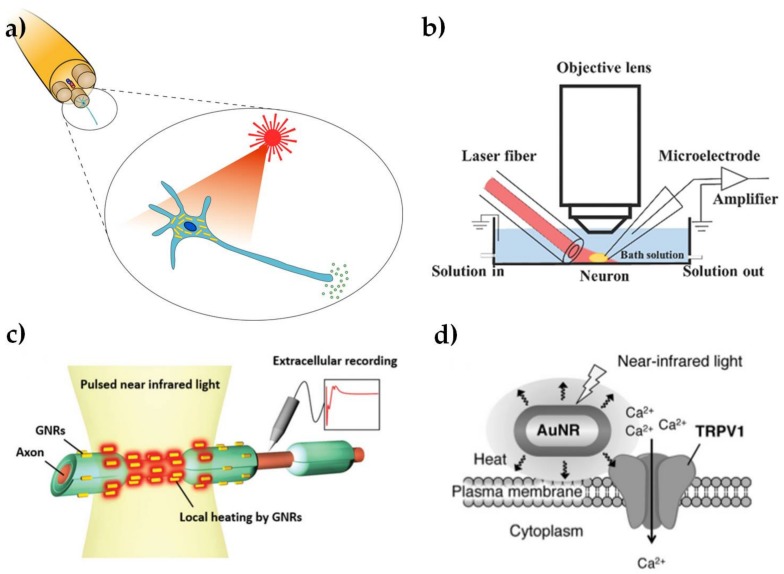
Summary illustration of Au NPs for modulation of nerve electrical activity. (a) Schematic representation of laser-induced activation of cells incubated with Au NPs (reproduced with permission from [73]); (b) Schematic representation of a whole-cell patch clamp recording for optically-stimulated neurons (reproduced with permission from [10]); (c) Schematic representation of optically-stimulated rat sciatic nerves injected with Au NRs (reproduced with permission from [11]); (d) Schematic representation of localized heating of TRPV1 channels with NIR excitation of Au NRs (reproduced with permission from [9]).

References

    1. Mclaughlin S., Podrebarac J., Ruel M., Suuronen E.J., McNeill B., Alarcon E.I. Nano-engineered biomaterials for tissue regeneration: What has been achieved so far? Front. Mater. 2016;3:1–28. doi: 10.3389/fmats.2016.00027. - DOI
    1. Hodgkin A.L., Huxley A.F. Resting and action potentials in single nerve fibres. J. Physiol. Lond. 1945;104:176–195. doi: 10.1113/jphysiol.1945.sp004114. - DOI - PMC - PubMed
    1. Bell J.H.A., Haycock J.W. Next generation nerve guides: Materials, fabrication, growth factors, and cell delivery. Tissue Eng. B. 2012;18:116–128. doi: 10.1089/ten.teb.2011.0498. - DOI - PubMed
    1. Shilo M., Motiei M., Hana P., Popovtzer R. Transport of nanoparticles through the blood-brain barrier for imaging and therapeutic applications. Nanoscale. 2014;6:2146–2152. doi: 10.1039/C3NR04878K. - DOI - PubMed
    1. Wang Y., Guo L. Nanomaterial-enabled neural stimulation. Front. Neurosci. 2016;10:1–7. doi: 10.3389/fnins.2016.00069. - DOI - PMC - PubMed