Long-Term Outcomes of In Situ Fusion for Treating Dysplastic Spondylolisthesis
- PMID: 28443165
- PMCID: PMC5401835
- DOI: 10.4184/asj.2017.11.2.213
Long-Term Outcomes of In Situ Fusion for Treating Dysplastic Spondylolisthesis
Abstract
Study design: Retrospective, observational, single-center study.
Purpose: To investigate the long-term outcomes of in situ fusion procedures for treating dysplastic spondylolisthesis.
Overview of literature: In situ fusion performed in patients with dysplastic spondylolisthesis avoids the development of nerve complications.
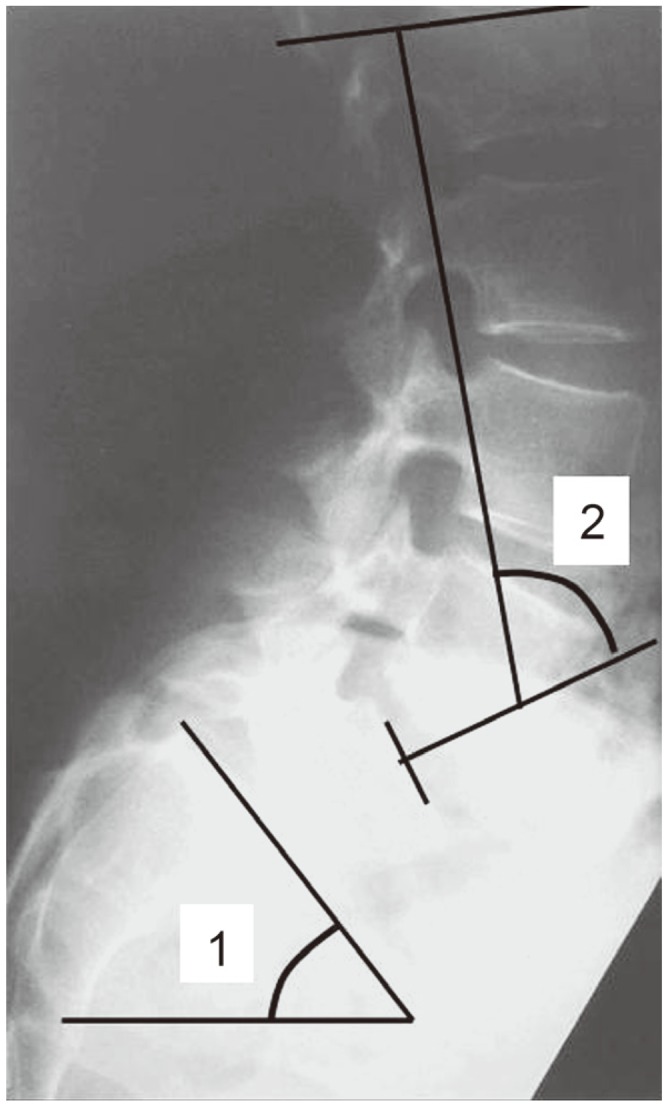
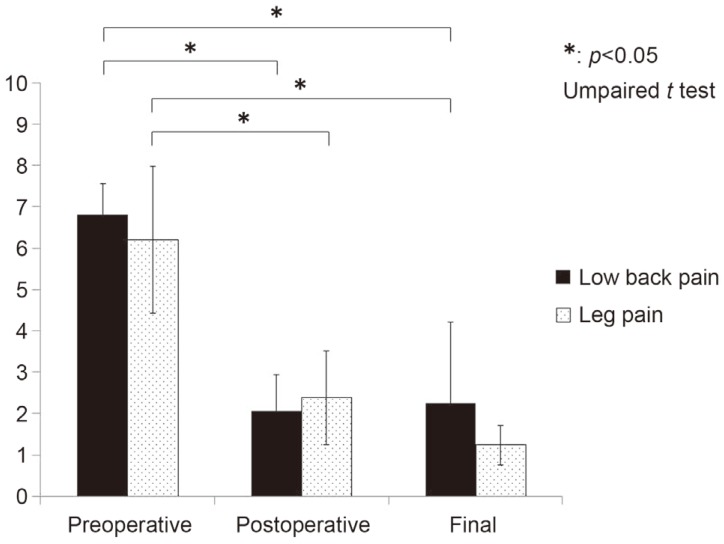
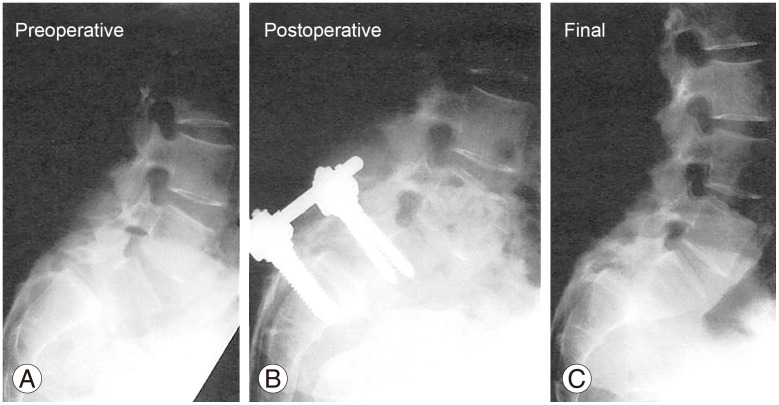
Methods: In total, 12 of 28 patients who underwent in situ fusion for treating dysplastic spondylolisthesis at Chiba University Hospital from 1974 to 2004 were followed up in August 2013. Surgical complications were evaluated. Low back pain and leg pain were assessed using a visual analog scale (VAS). Vertebral alignment, including the lumbosacral angle and lumbar lordosis angle measurement on radiographic images (profile view in the neutral standing position), was evaluated during preoperative, postoperative, and final examinations.
Results: The mean follow-up duration, patient age at the final examination, and patient age at operation were 20.0±7.2, 42.3±13.3, and 22.3±11.4 years, respectively. No complications were reported. Mean VAS scores for low back pain and leg pain were significantly lower at the final examination than at the preoperative examination (p<0.05). At the preoperative, postoperative, and final examinations, the mean lumbosacral angle was 32.3°±14.2°, 33.7°±11.8°, and 36.5°±16.4°, while the mean lumbar lordosis angle was 51.0°±14.8°, 48.6°±18.8°, and 49.6°±15.5°, respectively. No significant differences were noted among these values across the different time periods (p<0.05).
Conclusions: In situ fusion performed in patients with dysplastic spondylolisthesis avoids the development of nerve complications such as nerve paralysis that may occur after repositioning operation and maintains appropriate long-term sagittal alignment, even 20 years after operation.
Keywords: Alignment; Dysplastic; In situ; Spondylolisthesis; Visual analog scale.
Conflict of interest statement
Conflict of Interest: No potential conflict of interest relevant to this article was reported.
Figures
Comment in
-
Letter to the Editor: Long-term Outcomes of In Situ Fusion for Treating Dysplastic Spondylolisthesis.Asian Spine J. 2017 Oct;11(5):843-844. doi: 10.4184/asj.2017.11.5.843. Epub 2017 Oct 11. Asian Spine J. 2017. PMID: 29093795 Free PMC article. No abstract available.
References
-
- Moke L, Debeer P, Moens P. Spondylolisthesis in twins: multifactorial etiology: a case report and review of the literature. Spine (Phila Pa 1976) 2011;36:E741–E746. - PubMed
-
- Cavalier R, Herman MJ, Cheung EV, Pizzutillo PD. Spondylolysis and spondylolisthesis in children and adolescents: I. Diagnosis, natural history, and nonsurgical management. J Am Acad Orthop Surg. 2006;14:417–424. - PubMed
-
- Demchenko OV, Kolesnichenko VA. Mechanisms of incidence and specifics of spondylolysis and spondylolisthesis course in vertebral osteochondropathy. Klin Khir. 2000;(3):35–37. - PubMed
-
- Al-Khawashki H, Wasef Al-Sebai M. Combined dysplastic and isthmic spondylolisthesis: possible etiology. Spine (Phila Pa 1976) 2001;26:E542–E546. - PubMed
-
- Moshirfar A, Khanna AJ, Kebaish KM. Treatment of symptomatic spondyloptosis in an adult previously treated with in situ fusion and instrumentation by L5 vertebrectomy and L4-S1 instrumented reduction. Spine J. 2007;7:100–105. - PubMed
LinkOut - more resources
Full Text Sources
Other Literature Sources
Research Materials