


Atypical Chemokine Receptor 1 Polymorphism can not Affect Susceptibility to Hepatitis C Virus
- PMID: 28443566
- PMCID: PMC5615962
- DOI: 10.4274/balkanmedj.2016.0766
Atypical Chemokine Receptor 1 Polymorphism can not Affect Susceptibility to Hepatitis C Virus
Abstract
Background: Hepatitis C virus has infected 130 to 150 million individuals globally. Atypical chemokine receptor 1 has become a focus of research because of its diverse roles in different diseases. However, little is known regarding the association of atypical chemokine receptor 1 polymorphism with susceptibility to hepatitis C virus.
Aims: To determine the association of an atypical chemokine receptor 1 polymorphism (rs12075) with hepatitis C virus susceptibility.
Study design: Case-control study.
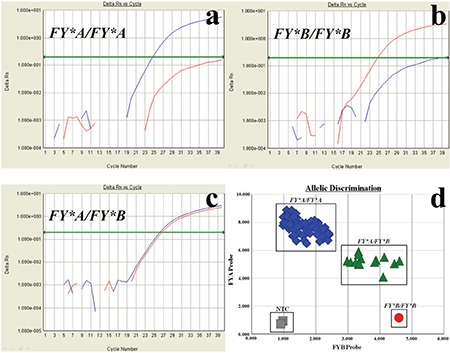
Methods: We collected blood samples from 231 patients infected with hepatitis C virus and 239 blood donors as control subjects. Genotyping of atypical chemokine receptor 1 was performed using a 5'-nuclease assay with TaqMan-minor groove binding probes. Comparisons between hepatitis C virus-infected patients and control subjects were assessed using Fisher's exact test.
Results: The genotype frequencies of FY*A/FY*A, FY*A/FY*B and FY*B/FY*B were 86.1%, 13.9% and 0% in the patient group, and 86.2%, 13.4% and 0.4% in the control group, respectively. The difference in atypical chemokine receptor 1 genotype frequencies between hepatitis C virus-infected patients and control group was not significant (p=1.00, OR=1.004, 95% CI=0.594-1.695). FY*A and FY*B allele frequencies were 93.1% and 6.9% in the patient group, and 92.9% and 7.1% in the control group, respectively. The difference in atypical chemokine receptor 1 allele frequencies between hepatitis C virus-infected patients and the control group was not significant (p=1.00, OR=0.972, 95% CI=0.589-1.603).
Conclusion: Our result indicates that atypical chemokine receptor 1 polymorphism (rs12075) does not affect susceptibility to hepatitis C virus.
Keywords: Atypical chemokine receptor 1; hepatitis C virus susceptibility.; polymorphism.
Conflict of interest statement
Figures
References
-
- Williams R. Global challenges in liver disease. Hepatology. 2006;44:521–6. - PubMed
-
- Shepard CW, Finelli L, Alter MJ. Global epidemiology of hepatitis C virus infection. Lancet Infect Dis. 2005;5:558–67. - PubMed
-
- Bowen DG, Walker CM. Adaptive immune responses in acute and chronic hepatitis C virus infection. Nature. 2005;436:946–52. - PubMed
-
- Mohd Hanafiah K, Groeger J, Flaxman AD, Wiersma ST. Global epidemiology of hepatitis C virus infection: new estimates of age-specific antibody to HCV seroprevalence. Hepatology. 2013;57:1333–42. - PubMed
-
- Chen YS, Li L, Cui FQ, Xing WG, Wang L, Jia ZY, et al. A sero-epidemiological study on hepatitis C in China. Zhonghua Liu Xing Bing Xue Za Zhi. 2011;32:888–91. - PubMed
MeSH terms
Substances
LinkOut - more resources
Full Text Sources
Other Literature Sources
