


Prognostic Factors in Severe Chagasic Heart Failure
- PMID: 28443956
- PMCID: PMC5389874
- DOI: 10.5935/abc.20170027
Prognostic Factors in Severe Chagasic Heart Failure
Abstract
Background: Prognostic factors are extensively studied in heart failure; however, their role in severe Chagasic heart failure have not been established.
Objectives: To identify the association of clinical and laboratory factors with the prognosis of severe Chagasic heart failure, as well as the association of these factors with mortality and survival in a 7.5-year follow-up.
Methods: 60 patients with severe Chagasic heart failure were evaluated regarding the following variables: age, blood pressure, ejection fraction, serum sodium, creatinine, 6-minute walk test, non-sustained ventricular tachycardia, QRS width, indexed left atrial volume, and functional class.
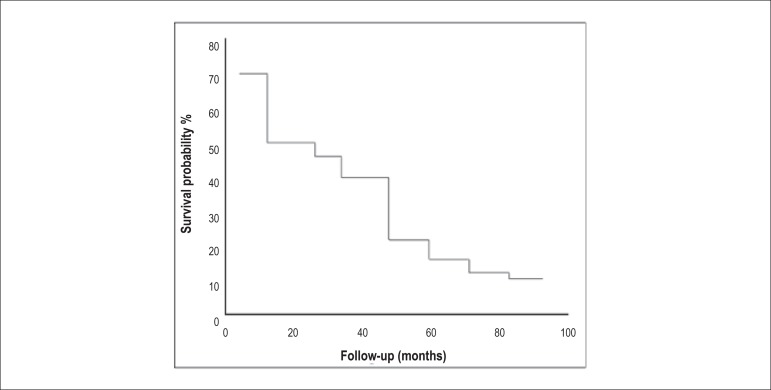
Results: 53 (88.3%) patients died during follow-up, and 7 (11.7%) remained alive. Cumulative overall survival probability was approximately 11%. Non-sustained ventricular tachycardia (HR = 2.11; 95% CI: 1.04 - 4.31; p<0.05) and indexed left atrial volume ≥ 72 mL/m2 (HR = 3.51; 95% CI: 1.63 - 7.52; p<0.05) were the only variables that remained as independent predictors of mortality.
Conclusions: The presence of non-sustained ventricular tachycardia on Holter and indexed left atrial volume > 72 mL/m2 are independent predictors of mortality in severe Chagasic heart failure, with cumulative survival probability of only 11% in 7.5 years.
Conflict of interest statement
No potential conflict of interest relevant to this article was reported.
References
-
- Bocchi EA, Marcondes-Braga FG, Ayub-Ferreira SM, Rohde LE, Oliveira WA, Almeida DR, et al. Sociedade Brasileira de Cardiologia III Brazilian guidelines on chronic heart failure. Arq Bras Cardiol. 2009;93(1) Suppl. 1:3–70. - PubMed
-
- Albuquerque DC, Souza JD, Neto, Bacal F, Rohde LE, Bernardez-Pereira S, Berwanger O, et al. Investigadores Estudo BREATHE I Brazilian Registry of Heart Failure - Clinical Aspects, Care Quality and Hospitalization Outcomes. Arq Bras Cardiol. 2015;104(6):433–442. Erratum in: Arq Bras Cardiol. 2015;105(2):208. - PMC - PubMed
-
- Nogueira PR, Rassi S, Correa K de S. Epidemiological, clinical and therapeutic profile of heart failure in a tertiary hospital. Arq Bras Cardiol. 2010;95(3):392–398. - PubMed
-
- Bocchi EA, Marcondes-Braga FG, Bacal F, Ferraz AS, Albuquerque D, Rodrigues D de A, et al. Updating of the Brazilian guideline for chronic heart failure - 2012. Arq Bras Cardiol. 2012;98(1) Suppl 1:1–33. - PubMed
-
- Areosa CM, Almeida DR, Carvalho AC, De-Paola AA. Evaluation of heart failure prognostic factors in patients referred for heart transplantation. Arq Bras Cardiol. 2007;88(6):667–673. - PubMed
MeSH terms
Substances
LinkOut - more resources
Full Text Sources
Other Literature Sources
Medical
