Comparative Study
. 2017 Nov 1;38(41):3094-3104.
doi: 10.1093/eurheartj/ehx177.

Predictive value of telomere length on outcome following acute myocardial infarction: evidence for contrasting effects of vascular vs. blood oxidative stress

Affiliations
Comparative Study

Predictive value of telomere length on outcome following acute myocardial infarction: evidence for contrasting effects of vascular vs. blood oxidative stress

Marios Margaritis et al. Eur Heart J. .

Abstract

Aims: Experimental evidence suggests that telomere length (TL) is shortened by oxidative DNA damage, reflecting biological aging. We explore the value of blood (BTL) and vascular TL (VTL) as biomarkers of systemic/vascular oxidative stress in humans and test the clinical predictive value of BTL in acute myocardial infarction (AMI).

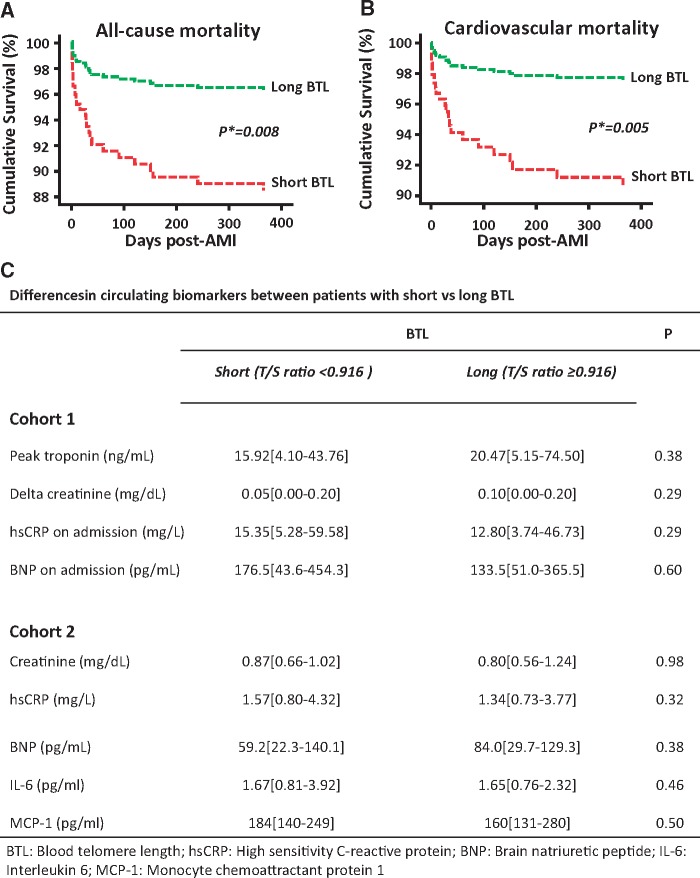
Methods and results: In a prospective cohort of 290 patients surviving recent AMI, BTL measured on admission was a strong predictor of all-cause [hazard ratio (HR) [95% confidence interval (CI)]: 3.21 [1.46-7.06], P = 0.004] and cardiovascular mortality (HR [95% CI]: 3.96 [1.65-9.53], P = 0.002) 1 year after AMI (for comparisons of short vs. long BTL, as defined by a T/S ratio cut-off of 0.916, calculated using receiver operating characteristic analysis; P adjusted for age and other predictors). To explore the biological meaning of these findings, BTL was quantified in 727 consecutive patients undergoing coronary artery bypass grafting (CABG), and superoxide (O2.-) was measured in peripheral blood mononuclear cells (PBMNC). VTL/vascular O2.- were quantified in saphenous vein (SV) and mammary artery (IMA) segments. Patients were genotyped for functional genetic polymorphisms in P22ph°x (activating NADPH-oxidases) and vascular smooth muscle cells (VSMC) selected by genotype were cultured from vascular tissue. Short BTL was associated with high O2.- in PBMNC (P = 0.04) but not in vessels, whereas VTL was related to O2.- in IMA (ρ = -0.49, P = 0.004) and SV (ρ = -0.52, P = 0.01). Angiotensin II (AngII) incubation of VSMC (30 days), as a means of stimulating NADPH-oxidases, increased O2.- and reduced TL in carriers of the high-responsiveness P22ph°x alleles (P = 0.007).

Conclusion: BTL predicts cardiovascular outcomes post-AMI, independently of age, whereas VTL is a tissue-specific (rather than a global) biomarker of vascular oxidative stress. The lack of a strong association between BTL and VTL reveals the importance of systemic vs. vascular factors in determining clinical outcomes after AMI.

Keywords: NADPH-oxidases; Post-procedural outcome; Superoxide; Telomere length.


Figures

Figure 1
Figure 1
In Cohort 1, short blood telomere length (BTL, T/S ratio < 0.916) was predictive of all-cause (A) and cardiovascular mortality (B) during the first year after acute myocardial infarction (AMI). BTL in Cohort 1 was not associated with known predictors of outcome following AMI, and these analyses were replicated in Cohort 2 to account for potential differences between stable and unstable coronary artery disease (CAD), as described in Panel C (data presented as median [25th–75th percentile]). Delta-creatinine: change in creatinine from admission to the peak value during hospital stay; hsCRP, high sensitivity C-reactive protein; BNP, brain natriuretic peptide; IL-6, interleukin 6; MCP-1, monocyte chemoattractant protein 1; *P-values in Kaplan–Meier curves shown in Panels A and B derived from Breslow test; P-values in Panel C derived from Mann–Whitney U tests.
Figure 2
Figure 2
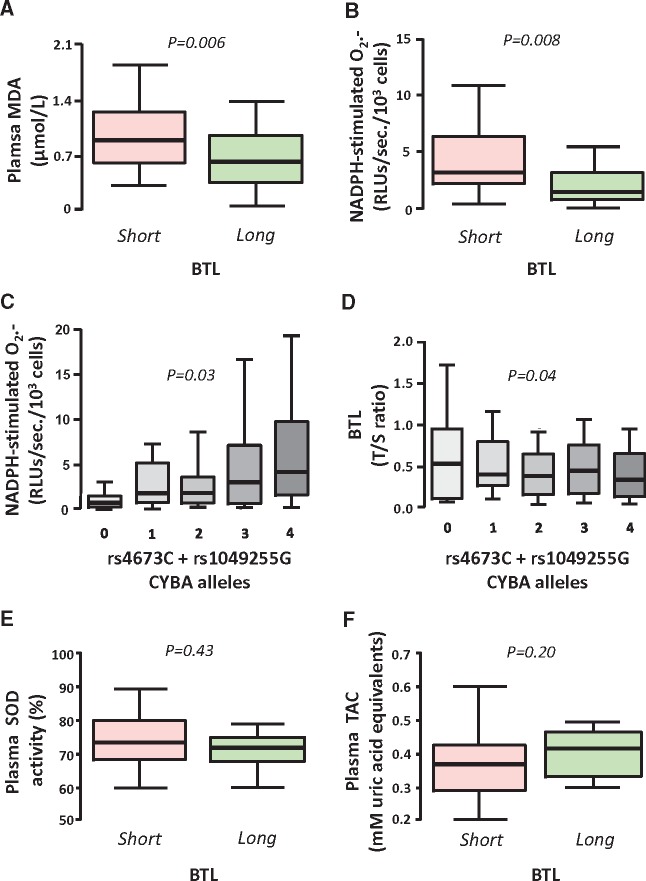
In Cohort 2, short blood telomere length (BTL < 0.916) was associated with elevated plasma malondialdehyde (MDA, A) and increased NADPH-stimulated superoxide (O2.-) production by peripheral blood mononuclear cells (PBMNC, B) in patients undergoing coronary artery bypass grafting surgery. The combined effect of two functional single nucleotide polymorphisms of the CYBA gene encoding the p22ph°x subunit of NADPH-oxidases (rs4673 and rs1049255) affected O2.- production in PBMNC, in a way that the number of rs4673C and rs1049255G alleles would be positively related with NADPH-stimulated O2.- in these cells (C). Mendelian randomization approach revealed that this additive genetic effect resulted in reduced BTL (D). BTL was not associated with either plasma superoxide dismutase (SOD) activity (E) or plasma total antioxidant capacity (TAC, F). Values are presented as median [25th–75th percentile]; P-values are calculated using Mann–Whitney U tests for Panels A, B, and EF or Kruskal–Wallis tests for Panels C and D.
Figure 3
Figure 3
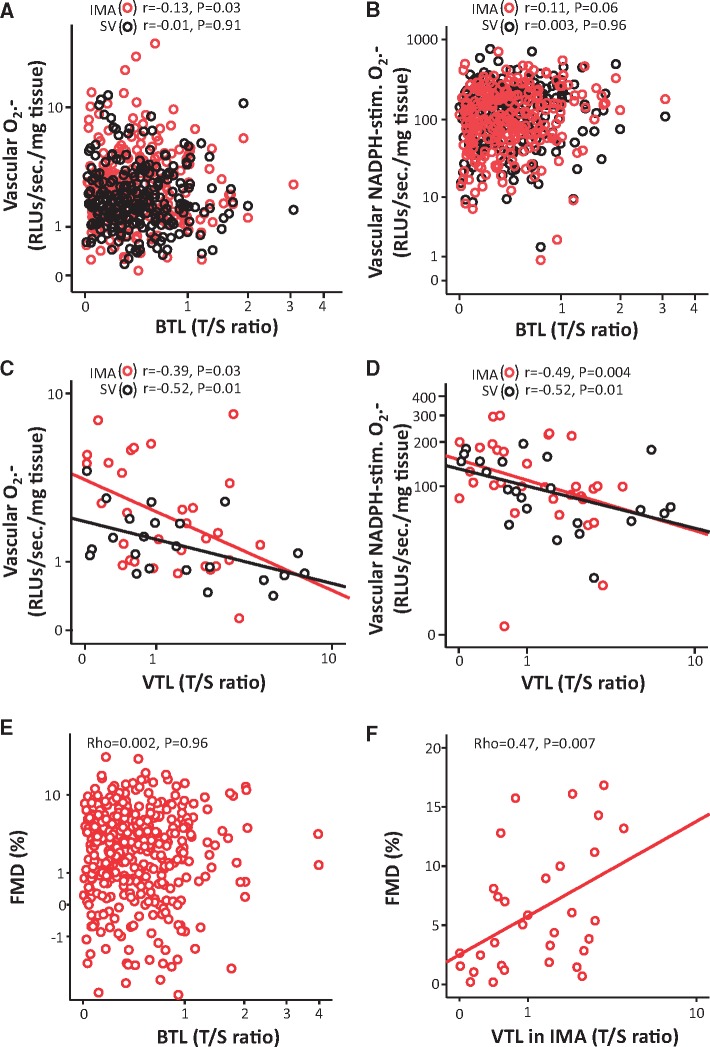
In the ex vivo arm of Cohort 2, blood telomere length (BTL) was not associated with basal or NADPH-stimulated superoxide (O2.-) in saphenous vein (SV) or internal mammary artery (IMA) segments (A and B). On the contrary, there was an inverse association between vascular telomere length (VTL) and both basal (C) and NADPH-stimulated O2.- (D) in the respective vascular tissue, in a subgroup of 32 IMA & 24 SV. Shortened VTL in IMA was associated with impaired flow mediated dilatation (FMD) of the brachial artery in vivo (F), in contrast with BTL (E).
Figure 4
Figure 4
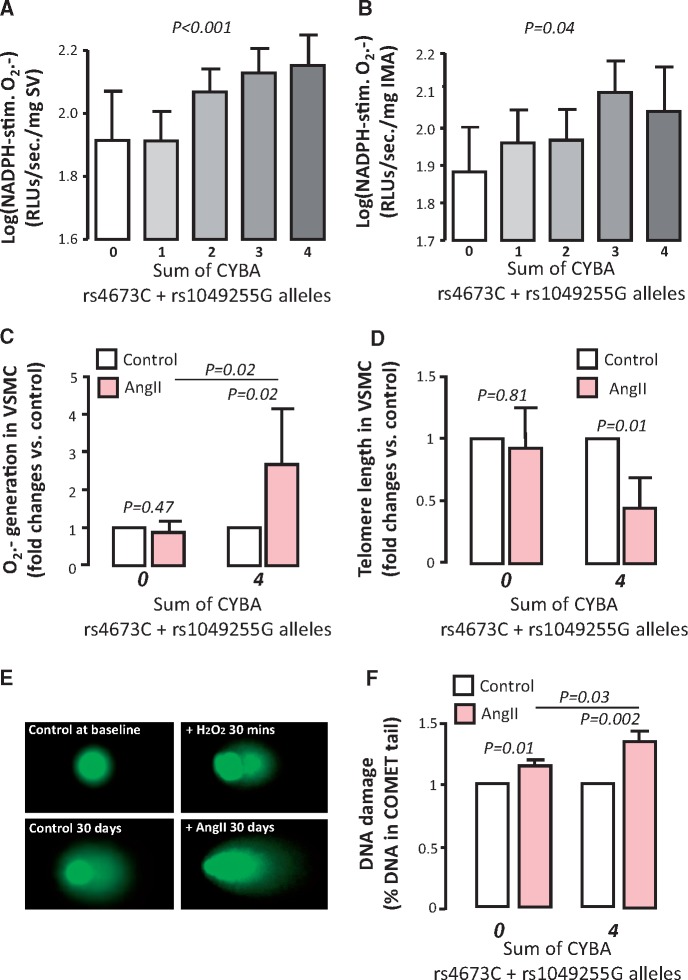
The combined effect of the two functional single nucleotide polymorphisms located in the CYBA gene encoding the p22ph°x subunit of NADPH oxidase (rs4673 and rs1049255) affected superoxide (O2.-) production in both saphenous veins (SV, A) and internal mammary arteries (IMA, B) in Cohort 2, in a way that the number of rs4673C and rs1049255G alleles were positively related with NADPH-stimulated O2.- in these vessels. Following a Mendelian randomization approach using these two SNPs, vascular smooth muscle cells (VSMC) isolated from homozygote patients for rs4673T and rs1049255A (low vascular NADPH-oxidases activity, 0 risk alleles) vs. VSMC from homozygote patients for rs4673C and rs1049255G (high vascular NADPH-oxidases activity, 4 risk alleles) were retrieved. Following 24 h stimulation of primary VSMC from the two extreme CYBA genotypes with Angiotensin II (AngII) 100 nM, only cells with the 4 risk alleles increased their O2.- generation compared to non-stimulated controls, while those with 0 risk alleles were not influenced by AngII stimulation (C, n = 8 pairs for each genotype). Accordingly, telomere length (TL) was significantly shortened following chronic (30 days on a 24 h on/off cycle) AngII 100 nM stimulation only in VSMC with 4 risk alleles (D, n = 8 pairs for each genotype). Using the Comet assay, we observed that AngII incubation significantly increased DNA damage in VSMC, an effect that was significantly greater in cells with 4 CYBA risk alleles (rs4673C and rs1049255G) vs. those with 0 CYBA alleles (E and F, n = 10 pairs per genotype). As positive control, we used VSMC exposed to H2O2 100 μM for 30 min, and examples of images are presented in Panel E. P-values in Panels A and B are calculated using Kruskal–Wallis test, and presented as logarithmic values. P-values in Panels C, D and F are calculated using Wilcoxon signed rank test and presented as fold changes versus control or risk alleles post treatment. Values presented as mean (95% confidence interval).
Figure 5
Figure 5
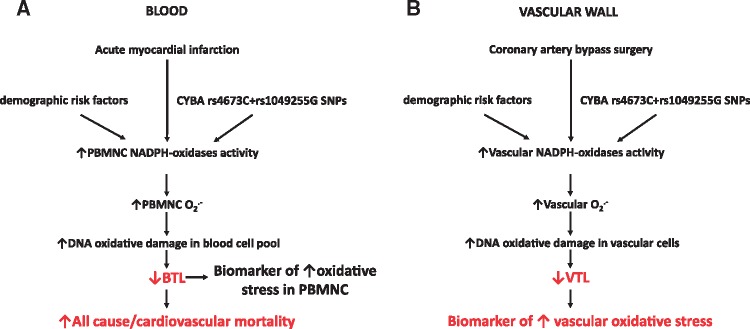
Summary of the proposed mechanism. Blood telomere length (BTL) is a biomarker of superoxide (O2.-) production by peripheral blood mononuclear cells (PBMNC). In these cells, production of O2.- is determined by NADPH-oxidases activity, which is, in turn, influenced by demographic and genetic parameters such as the CYBA single nucleotide polymorphisms (SNPs) rs4673 and rs1049255 encoding for the p22ph°x subunit of NADPH-oxidases. Importantly, acute myocardial infarction may stimulate oxidative activation of PBMNC; this is accompanied by shortening of BTL, which serves as a predictor of all-cause and cardiovascular mortality following myocardial infarction (A). Accordingly, demographic and genetic factors co-influence NADPH-oxidases activity in the vascular wall of humans undergoing coronary artery bypass surgery, which then inflicts DNA oxidative damage resulting in shortening of vascular telomere length (VTL). Therefore, VTL comprises a biomarker of increased vascular oxidative stress, in a tissue-specific manner (B).

Comment in

References

    1. Kostis WJ, Deng Y, Pantazopoulos JS, Moreyra AE, Kostis JB; Myocardial Infarction Data Acquisition System Study Group. Trends in mortality of acute myocardial infarction after discharge from the hospital. Circ Cardiovasc Qual Outcomes 2010;3:581–589. - PubMed
    1. Fox KA, Dabbous OH, Goldberg RJ, Pieper KS, Eagle KA, Van de Werf F, Avezum A, Goodman SG, Flather MD, Anderson FA Jr, Granger CB.. Prediction of risk of death and myocardial infarction in the six months after presentation with acute coronary syndrome: prospective multinational observational study (GRACE). BMJ 2006;333:1091.. - PMC - PubMed
    1. Kastelein JJ, Nissen SE, Rader DJ, Hovingh GK, Wang MD, Shen T, Krueger KA.. Safety and efficacy of LY3015014, a monoclonal antibody to proprotein convertase subtilisin/kexin type 9 (PCSK9): a randomized, placebo-controlled Phase 2 study. Eur Heart J 2016;37:1360–1369. - PMC - PubMed
    1. Nahrendorf M, Swirski FK, Aikawa E, Stangenberg L, Wurdinger T, Figueiredo JL, Libby P, Weissleder R, Pittet MJ.. The healing myocardium sequentially mobilizes two monocyte subsets with divergent and complementary functions. J Exp Med 2007;204:3037–3047. - PMC - PubMed
    1. Ghaffari S, Nadiri M, Pourafkari L, Sepehrvand N, Movasagpoor A, Rahmatvand N, Rezazadeh Saatloo M, Ahmadi M, Nader ND.. The predictive value of total neutrophil count and neutrophil/lymphocyte ratio in predicting in-hospital mortality and complications after STEMI. J Cardiovasc Thorac Res 2014;6:35–41. - PMC - PubMed

Publication types

MeSH terms