Review
. 2017 Apr;19(4):36.
doi: 10.1007/s11906-017-0734-1.

The Gut, Its Microbiome, and Hypertension

Affiliations
Review

The Gut, Its Microbiome, and Hypertension

Elaine M Richards et al. Curr Hypertens Rep. 2017 Apr.

Abstract

Purpose of the review: Evidence is rapidly accumulating implicating gut dysbiosis in hypertension (HTN). However, we are far from understanding whether this is a cause or consequence of HTN, and how to best translate this fundamental knowledge to advance the management of HTN. This review aims to summarize recent advances in the field, illustrate the connections between the gut and hypertension, and establish that the gut microbiota (GM)-gut interaction is centrally positioned for consideration as an innovative approach for HTN therapeutics.

Recent findings: Animal models of HTN have shown that gut pathology occurs in HTN, and provides some clues to mechanisms linking the dysbiosis, gut pathology, and HTN. Circumstantial evidence links gut dysbiosis and HTN. Gut pathology, apparent in animal HTN models, has not been fully investigated in hypertensive patients. Objective evidence and an understanding of mechanisms could have a major impact for new antihypertensive therapies and/or improved applications of current ones.

Keywords: Brain-gut-immune axis; Gut microbiota; Gut pathology; Hypertension; Renin angiotensin aldosterone system.


Conflict of interest statement

Drs. Richards, Pepine, Raizada, and Kim declare no conflicts of interest relevant to this manuscript.

Figures
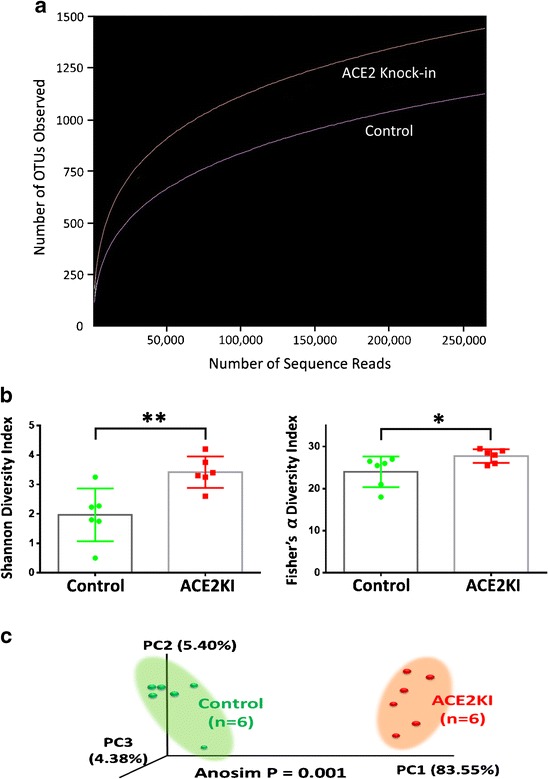
Fig. 1
Fig. 1
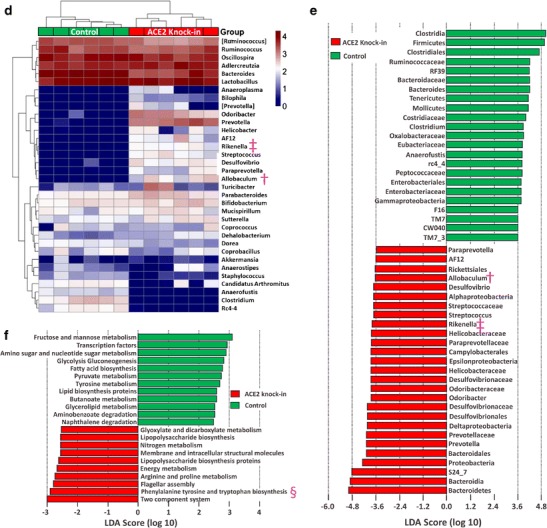
ACE2 knock-in mice have altered gut microbiota compared to littermate controls. 16S rRNA gene sequence-based identification of bacteria in ACE2 knock-in mice. a Number of OTUs (or species) found at multiple rarefaction depths; ACE2 knock-in red, littermate controls purple. b The richness (# of OTUs) and evenness (distribution across OTUs) between ACE2 knock-ins and their littermate controls were significantly different using two tests of alpha diversity, Shannon index (left) and Fisher’s alpha test (right), * = p ≤ 0.05, ** = p ≤ 0.001. c Principal coordinate analysis (PCoA) plot showing the separation between the bacterial communities found in the feces of ACE2 knock-in and their littermate control mice. The variance explained by each of the first three axes is shown in parentheses (83.55, 4.38, and 5.40%, respectively). d Heatmap illustrating the genus-level changes in bacterial abundance in the littermate controls and ACE2 knock-in mice. The relative abundance of a bacterial genus (row) in individual animals (column) is indicated by the color of the cell (blue, low abundance; red, high abundance). Bacterial genera altered in expression in both ACE2 knock-out [55] and ACE2 knock-in mice are illustrated by † (Allobaculum) and ‡ (Rikenella). e Bacterial taxa with significantly different abundances between littermate controls and ACE2 knock-in mice identified by linear discriminant analysis coupled with effect size (LEfSe). Bacterial taxa enriched in the ACE2 knock-in mice are shown in red, in littermate controls in green. Bacterial taxa altered in expression in both ACE2 knock-out [55] and ACE2 knock-in mice are illustrated by † (Allobaculum) and ‡ (Rikenella). f Phylogenetic investigation of communities by reconstruction of unobserved states (PICRUSt) analysis showing the significantly different functional capabilities predicted for the bacterial communites in ACE2 knock-in and littermate control mice. The phenylalanine, tyrosine, and tryptophan biosynthetic pathway expected to be altered in the knock-in mice is indicated by §
Fig. 1
Fig. 1
ACE2 knock-in mice have altered gut microbiota compared to littermate controls. 16S rRNA gene sequence-based identification of bacteria in ACE2 knock-in mice. a Number of OTUs (or species) found at multiple rarefaction depths; ACE2 knock-in red, littermate controls purple. b The richness (# of OTUs) and evenness (distribution across OTUs) between ACE2 knock-ins and their littermate controls were significantly different using two tests of alpha diversity, Shannon index (left) and Fisher’s alpha test (right), * = p ≤ 0.05, ** = p ≤ 0.001. c Principal coordinate analysis (PCoA) plot showing the separation between the bacterial communities found in the feces of ACE2 knock-in and their littermate control mice. The variance explained by each of the first three axes is shown in parentheses (83.55, 4.38, and 5.40%, respectively). d Heatmap illustrating the genus-level changes in bacterial abundance in the littermate controls and ACE2 knock-in mice. The relative abundance of a bacterial genus (row) in individual animals (column) is indicated by the color of the cell (blue, low abundance; red, high abundance). Bacterial genera altered in expression in both ACE2 knock-out [55] and ACE2 knock-in mice are illustrated by † (Allobaculum) and ‡ (Rikenella). e Bacterial taxa with significantly different abundances between littermate controls and ACE2 knock-in mice identified by linear discriminant analysis coupled with effect size (LEfSe). Bacterial taxa enriched in the ACE2 knock-in mice are shown in red, in littermate controls in green. Bacterial taxa altered in expression in both ACE2 knock-out [55] and ACE2 knock-in mice are illustrated by † (Allobaculum) and ‡ (Rikenella). f Phylogenetic investigation of communities by reconstruction of unobserved states (PICRUSt) analysis showing the significantly different functional capabilities predicted for the bacterial communites in ACE2 knock-in and littermate control mice. The phenylalanine, tyrosine, and tryptophan biosynthetic pathway expected to be altered in the knock-in mice is indicated by §

References

    1. Writing Group Members. Mozaffarian D, Benjamin EJ, Go AS, Arnett DK, Blaha MJ, Cushman M, Das SR, de Ferranti S, Després JP, Fullerton HJ, Howard VJ, Huffman MD, Isasi CR, Jiménez MC, Judd SE, Kissela BM, Lichtman JH, Lisabeth LD, Liu S, Mackey RH, Magid DJ, DK MG, Mohler ER, Moy CS, Muntner P, Mussolino ME, Nasir K, Neumar RW, Nichol G, Palaniappan L, Pandey DK, Reeves MJ, Rodriguez CJ, Rosamond W, Sortie PD, Stein J, Towfighi A, Turan TN, Virani SS, Woo D, Yeh RW, Turner MB, American Heart Association Statistics Committee. Stroke Statistics Subcommittee Executive summary: heart disease and stroke statistics-2016 update: a report from the American Heart Association. Circulation. 2016;133:447–454. doi: 10.1161/CIR.0000000000000366. - DOI - PubMed
    1. Vighi G, Marcucci F, Sensi L, Di Cara G, Frati F. Allergy and the gastrointestinal system. Clin Exp Immunol. 2008;153(Suppl 1):3–6. doi: 10.1111/j.1365-2249.2008.03713.x. - DOI - PMC - PubMed
    1. Erny D, Hrabě de Angelis AL, Jaitin D, Peter Wieghofer P, Staszewski O, David E, Keren-Shaul H, Mahlakoiv T, Jakobshagen K, Buch T, Schwierzeck V, Utermöhlen O, Chun E, Garrett WS, McCoy KD, Diefenbach A, Staeheli P, Stecher B, Amit I, Prinz M. Host microbiota constantly control maturation and function of microglia in the CNS. Nature Neurosci. 2015;18:965–977. doi: 10.1038/nn.4030. - DOI - PMC - PubMed
    1. Yatsunenko T, Rey FE, Manary MJ, Trehan I, Dominguez-Bello MG, Contreras M, Magris M, Hidalgo G, Baldassano RN, Anokhin AP, Heath AC, Warner B, Reeder J, Kuczynski J, Caporaso JG, Lozupone CA, Lauber C, Clemente JC, Knights D, Knight R, Gordon JI. Human gut microbiome viewed across age and geography. Nature. 2012;486:222–227. - PMC - PubMed
    1. Meneely GR, Dahl LK. Electrolytes in hypertension: the effects of sodium chloride: the evidence from animal and human studies. Med Clin North Am. 1961;45:271–283. doi: 10.1016/S0025-7125(16)33891-3. - DOI - PubMed

MeSH terms